Note
Kaar Engineering's nine-tube receiver covered 500 kHz–42 MHz in four bands. It is a high-quality, utilitarian, general-coverage communications receiver built during World War II.
The difference between the standard KE23A and the KE23AT is that the AT version includes a universal power transformer (that allowed operation from line voltages of 110, 120, 150, 210, and 230 VAC at 40-60 Hz), and a mechanical bandspread. The KE-23A is a scaled down version. See attached AWA article.
Rated at 1–5 microvolts up to 16 MHz, and 3–15 microvolts on the highest band.
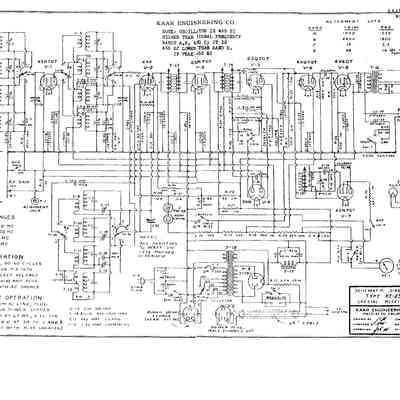
IF: Peak IF is 455 KC. The oscillator operates 455 kHz higher than the signal frequency on Bands A, B, and C, and 455 kHz lower on Band D.
Tube Lineup
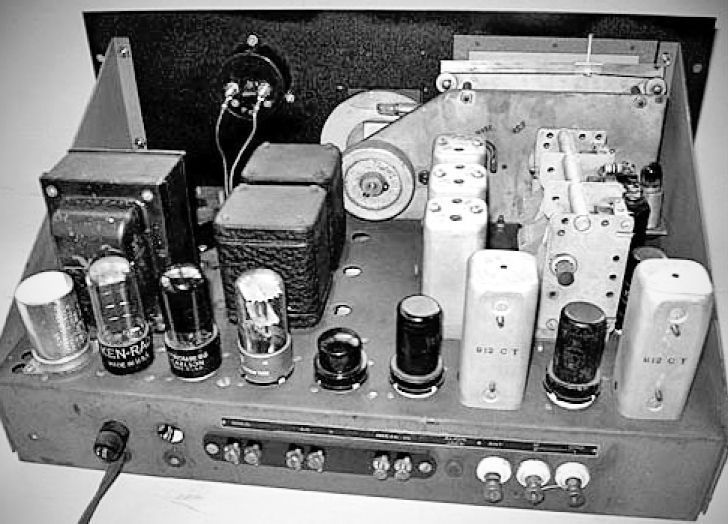
The KE23AT is built around nine octal tubes and two neon lamps. Notably, the design does not include a crystal filter.
– V-1 (6SK7GT): RF Amplifier
– V-2 (6K8): Mixer / Oscillator
– V-3 (6SK7GT): 1st IF Amplifier
– V-4 (6H6): Automatic Noise Limiter (ANL) / Squelch
– V-5 (6SQ7GT): 2nd IF Amplifier / Detector / AVC
– V-6 (6SQ7GT): Audio Phase Inverter / Audio Amplifier
– V-7 (6SK7GT): Beat Frequency Oscillator (BFO)
– V-8 (6V6GT): Audio Power Output
– V-9 (5Y3GT): Rectifier
– Neon Lamps: Two NE-48 lamps are utilized within the oscillator circuit.
Reflecting wartime military requirements of 1944, the receiver features highly versatile power options:
1. AC Operation: Accommodates multi-voltage AC input ranging from 100V to 230V ($40\text{–}60\text{ cycles}$) in five selectable steps via an internal voltage selector switch (`SW-10`).
2. DC Emergency Operation: Can run off a 6-volt car battery paired with an external vibrator pack.
Switching between AC and DC was achieved simply by unplugging an internally connected 24-inch power cable from the rear apron and plugging it into the emergency power source.
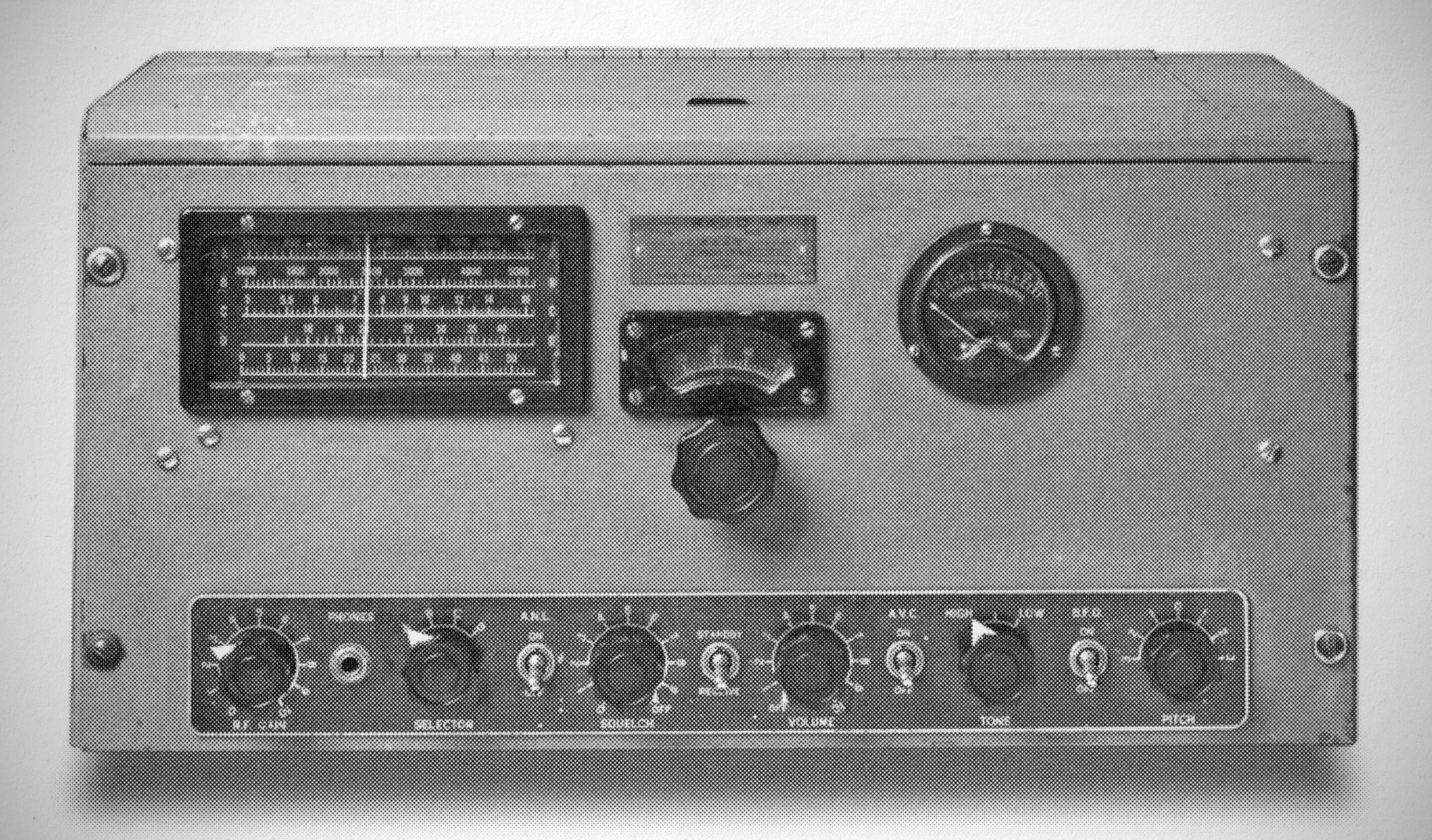
Features a completely gear-driven, weighted single-knob tuning mechanism with a high 1:100 tuning ratio. Dial cord string is only used to drive the vertical pointer on the 4 1/4 slide-rule dial scale. Includes a 0–100 logging scale on the round center dial and a factory-branded GE signal strength meter on the front panel.
Outfitted with an RF Gain control, Volume control, BFO Pitch control, a three-position Tone Control, an Automatic Noise Limiter (ANL) switch, and a squelch circuit (a rare feature for a communications receiver of this vintage).
The rear apron provides three ceramic antenna terminals, a dedicated alignment jack hooked directly into the AVC line, receiver muting provisions for transmitter break-in use, and audio outputs designed for both 4-ohm and 500-ohm lines. It originally shipped with a matching 8-inch, 4-ohm speaker (Model PK-23ST).