Note
QST, Aug 1958, p. 129.
QST, Apr 1964, p. 139.
Eico short form catalog 1965, p. 42.
Kit or wired.
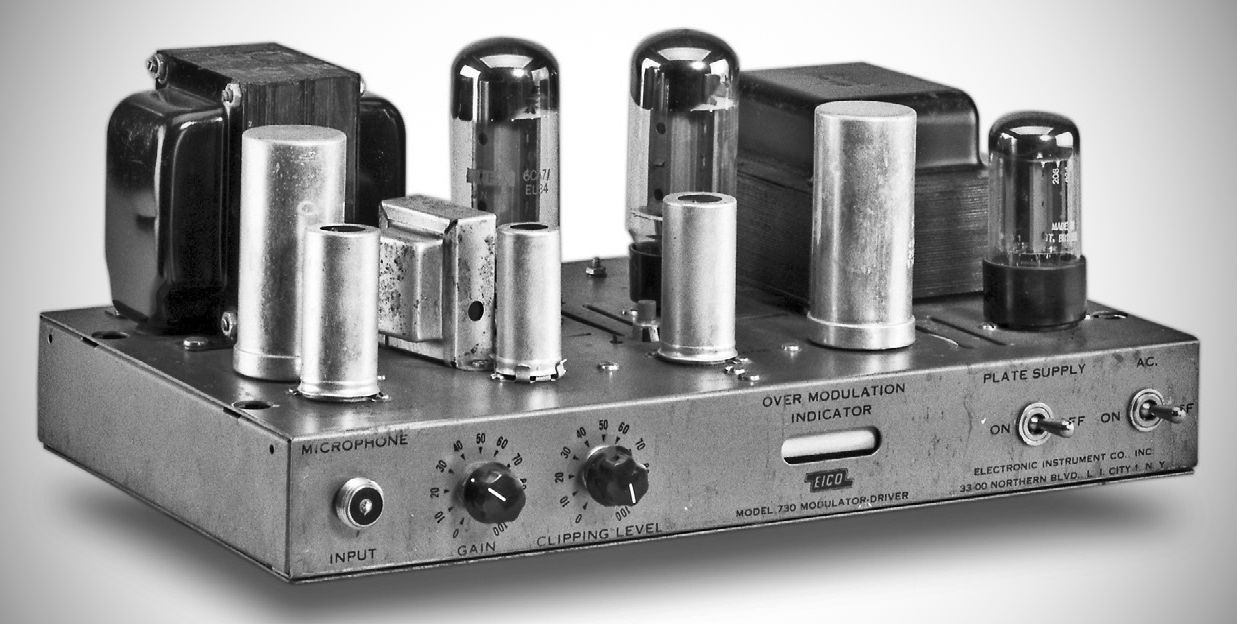
The EICO Model 730 is a high‑level universal modulator/driver designed in the late 1950s and marketed by EICO for amateur radio “phone” (voice) operation. It is rated to deliver approximately 50 watts of undistorted audio, sufficient to modulate 100 % (full modulation) a transmitter whose final RF plate input reaches up to about 100 watts.
One of its key design features is the multi‑match output transformer which offers taps to match loads from about 500 to 10,000Ω, enabling broad compatibility with various transmitter plate amplifier impedances.
It also incorporates an over‑modulation indicator (a “magic eye” tube) so that the operator can visually monitor when audio peaks are exceeding proper limits and avoid splatter or distortion.
The 730 uses a 12AX7 (ECC83) speech amplifier stage, a 6AL5 clipper for controlling speech peaks, a 6AN8 interstage buffer/phase inverter, and a pair of EL34 (6CA7) tubes as the push–pull output modulators.
The rectifier is the GZ34 slow warm‑up type, permitting lower inrush and improved tubular and electrolytic life.
Adjustments for bias and balance allow fine tuning, and the circuit uses negative feedback around the modulation transformer to reduce distortion.
Plug and play with the Eico 720 or 723.
Power output: 50 watts
Inputs: low level, high impedance crystal or dynamic mics; or high level,
low impedance phone patch, for example.
Tubes: (1) 12AX7/ECC83, (1) 6AL5, (1) 6AN8, (2) 6CA7/EL34
References
EICO catalog, copyright 1958
Review. Popular Electronics, Sep 1959, p. 81.
Review. CQ, Apr 1962, p. 46.