Note
Abstract: The Echophone Saga
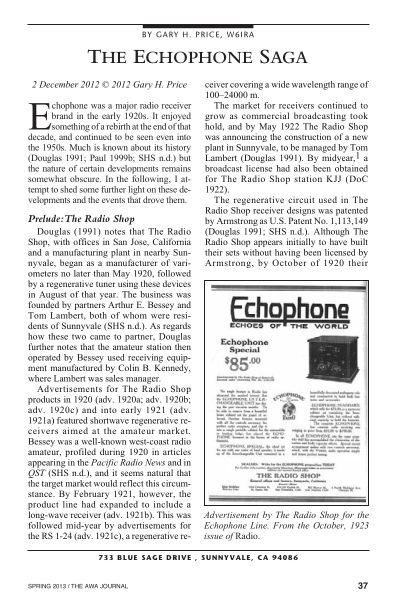
This paper traces the historical evolution and corporate transitions of Echophone, a prominent radio receiver brand from the early 1920s through the 1950s. Originally emerging as a broadcast-listener extension of The Radio Shop in Sunnyvale, California—founded by Arthur E. Bessey and Tom Lambert—the brand initially built its success on Armstrong’s non-transferable regenerative circuit design. As the radio market rapidly modernized, Echophone faced numerous corporate reorganizations, geographic relocations (spanning St. Louis, Long Beach, Hollywood, and Waukegan), and shifting manufacturing alliances.
The narrative details how market pressures and strict patent licensing dynamics, particularly from RCA, forced the brand to transition from regenerative circuits to tuned radio-frequency (TRF) and superheterodyne designs. In the 1930s, Echophone pivoted into early television receiver production under Western Television before its ultimate acquisition by Bill Halligan and Ray Durst. Absorbed into the Hallicrafters Corporation in 1936, the Echophone name returned to its amateur radio roots and persisted into the 1950s. Ultimately, this case study illustrates how the trajectory of early wireless manufacturing was profoundly shaped by investor availability, shifting consumer markets, and legal patent challenges.