AWA Old Timer’s Bulletin, Vol 39, No 2 1998. Courtesy Antique Wireless Association
Name/Title
A Brief History of the Transistor
Scope and Content
A Brief History of the Transistor
Category
Other
General Notes
Note
Abstract
Title: The Birth of the Transistor
Author: Steven J. Babbert, W6THU
Publication: The Old Timer's Bulletin (May 1998)
This historical overview chronicles the scientific evolution that culminated in the invention of the transistor at Bell Telephone Laboratories in December 1947. While the solid-state revolution is commonly associated with the mid-20th century, the foundational principles of semiconductor physics—including negative temperature coefficients, photoconductivity, and rectification—were observed by 19th-century pioneers such as Michael Faraday and Karl F. Braun.
The article traces how the maturation of early wireless technology and "cat's whisker" crystal detectors temporarily gave way to vacuum tube dominance following Lee DeForest's triode and Edwin Armstrong's regeneration circuit. However, by the 1930s, breakthroughs in quantum mechanics and band theory provided the necessary theoretical framework to understand semiconductor behaviors, paving the way for highly organized, wartime radar research that perfected silicon and germanium purification.
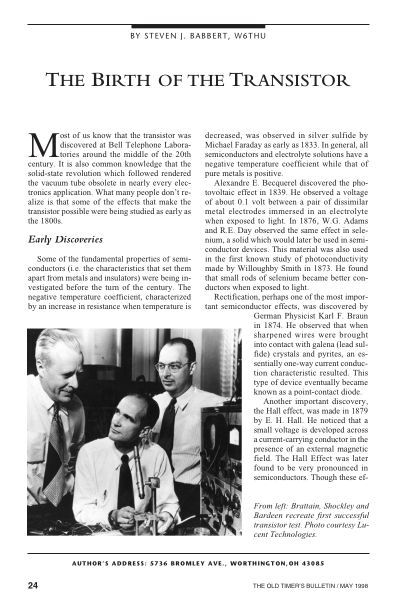
Ultimately, the limitations of vacuum tubes and mechanical switches in telephone exchanges spurred Bell Labs to establish its interdisciplinary Semiconductor Group. Led by the theoretical and experimental insights of John Bardeen, Walter H. Brattain, and William Shockley, the team overcame surface-state barriers to achieve the first successful point-contact transistor amplification on December 23, 1947. The paper concludes by noting the rapid transition from the predictable yet fragile point-contact design to the robust junction transistor, a lineage that earned the trio the 1956 Nobel Prize in Physics and laid the groundwork for modern microelectronics.