Note
Abstract
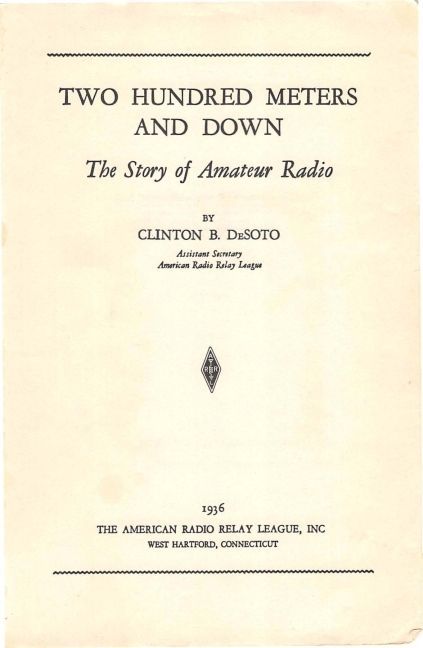
Two Hundred Meters and Down: The Story of Amateur Radio (1936) by Clinton B. DeSoto
This paper provides a comprehensive historical account of the origin, legislative battles, and organizational growth of amateur radio in the United States. The text chronicles the evolution of wireless communication from late 19th-century scientific discoveries to its establishment as a structured hobby by 1936.
Key themes include:
The Transition from Experimentation to Communication: The shift of early 20th-century electrical hobbyists into a dedicated class of radio amateurs focused on personal communication and public service.
Legislative and Regulatory Challenges: The impact of the Radio Act of 1912, which restricted amateurs to the supposedly useless wavelengths below 200-meters (frequencies higher than 1500 kHz) in an attempt to mitigate interference with commercial and naval stations.
Technical Progress: The role of amateur innovation—most notably Edwin H. Armstrong’s development of the regenerative circuit—and the widespread adoption of technologies like crystal detectors and vacuum tubes.
Organizational Expansion: The founding of the American Radio Relay League (ARRL) in 1914 by Hiram Percy Maxim and Clarence D. Tuska, which established national message-relaying networks and a unified front for amateur rights.
Ultimately, the work highlights the altruistic spirit, technical contributions, and enduring resilience of the amateur radio community.
--------------------------------
Abstract
"The First Century: Wireless and Amateur Radio History" by Michael W. Marinaro (WN1M)
This series of articles provides a comprehensive historical chronicle of the evolution of wireless communication and the rise of the amateur radio community from the early 20th century through the interwar era. Published across multiple installments in The AWA Journal, the compilation traces key technological paradigms, organizational milestones, and heroic human endeavors that transformed radio from a localized laboratory novelty into a vital global utility.
Key thematic areas covered in the series include:
The Foundation of the Amateur Radio Fraternity: The early days of spark gap transmitters and the pivotal roles played by visionaries Hiram Percy Maxim and Clarence D. Tuska in transforming the Radio Club of Hartford into the American Radio Relay League (ARRL) in 1914. It outlines the league's initial structure, its subsequent separation from the local club, and its financial resilience.
WWI and Post-War Reorganization: The dramatic impact of World War I, which legally silenced amateur airwaves, followed by the successful post-war battle against Navy control to reclaim amateur operating privileges. This era catalyzed rapid structural changes, including the leadership of Kenneth B. Warner and the establishment of QST magazine.
Operating Milestones and the Demise of Spark: The operational triumphs of the early 1920s, including the historic 1921 National Convention in Chicago, fast-paced Transcontinental Relay Tests, and the definitive shift from "King Spark" to Continuous Wave (CW) vacuum tube technology.
The Transatlantic Tests (1921–1923): A detailed exploration of the international trials to bridge the Atlantic Ocean. The articles highlight Paul F. Godley's iconic 1921 listening expedition to Ardrossan, Scotland, culminating in the first historic two-way transatlantic contact between French amateur Leon Deloy (8AB) and American operators in late 1923.
Polar Expeditions and Spatial Exploration: Documentation of how shortwave amateur radio became a critical logistical lifeline for exploratory feats in the 1920s and 1930s. Key highlights include Donald B. MacMillan’s Arctic expeditions aboard the Bowdoin and the survival saga of Giuseppe Biagi following the tragic 1928 Arctic crash of the airship Italia. This exploration boom directly fostered the genesis of the DX Century Club (DXCC) and the modern "DXpedition."
Corporate Titans and Early Media: The broader commercial history of wireless, mapping Guglielmo Marconi's early dynamic presence in America, the geopolitical post-WWI emergence of the Radio Corporation of America (RCA), and the rise and fall of the massive Long Island "Radio Central" VLF station. Concurrently, it examines the foundational print media and early clubs (e.g., Wireless World, The Electrical Experimenter, and the Radio Club of America) that fostered technical education and solidarity.
Ultimately, Marinaro’s work frames the first century of wireless history as a triumph of collaborative experimentation, proving how amateur operators repeatedly redefined the laws of radio propagation and laid the groundwork for modern telecommunications.
-------------------------
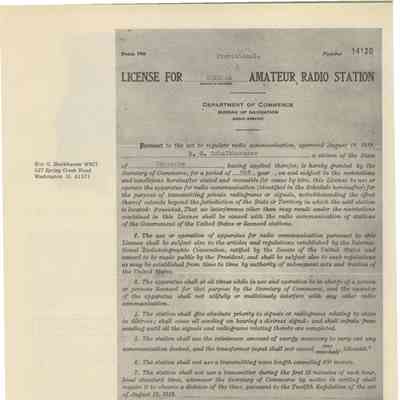
Abstract: 83 Years of U.S. Amateur Licensing, by Neil D. Friedman, N3DF
This paper provides a historical overview of the development and evolution of United States amateur radio operator licensing from its roots in the early 20th century through 1994.
Driven by advancements in radio technology, shifting regulatory philosophies, and broader cultural changes, the federal structural framework has evolved continuously.
The review details early mandates under the Department of Commerce and Labor, the transition of regulatory power to the Federal Radio Commission (FRC) and subsequently the Federal Communications Commission (FCC), and the long-standing "A-B-C" era of licensing.
Key structural modifications are analyzed, including the implementation and debates surrounding "incentive licensing" in the 1960s, the eventual elimination of the Morse code sending test, the shifting role of volunteer amateur examiners, and the controversial introduction of a code-free Technician license class in 1991.
Ultimately, this historical trajectory demonstrates that amateur radio licensing requirements are never static, but instead constantly adapt to balance operator proficiency with the growth of the amateur radio community.