Note
Company Origins and Early Growth
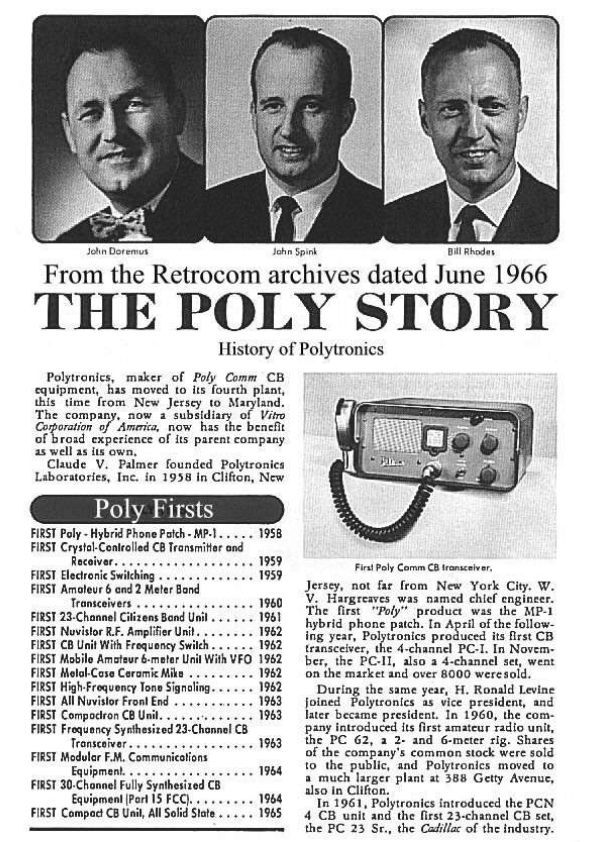
Founding: Polytronics Laboratories, Inc. was founded in 1958 by Claude V. Palmer in Clifton, New Jersey, with W. V. Hargreaves serving as chief engineer.
Early Success: The company's first product was the MP-1 hybrid phone patch. In 1959, they expanded into Citizens Band (CB) transceivers with the PC-I and PC-II models, selling over 8,000 units of the latter.
Expansion: As leadership shifted and H. Ronald Levine became president, the company went public and moved to a larger plant in Clifton in 1960. By 1963, under new president John A. Doremus, employment grew to 115 workers, prompting a move to West Caldwell, New Jersey.
Product Innovation and Market Rank
Industry Milestones: Polytronics is noted for several industry "firsts," including the first 23-channel CB unit (the "PC 23 Sr.") in 1961, the first compact all-transistor CB unit (the "Poly Compact") in 1965, and early entry into FM commercial mobile radios.
Acquisition & Scaling: In 1964, Polytronics acquired the assets of Osborne Electronics Corporation, adding solid-state transceivers and walkie-talkies to its lineup. By this time, it had become the third-largest manufacturer of CB equipment.
Vitro Acquisition and Relocation
Corporate Restructuring: Following a Chapter XI Plan of Reorganization in November 1965, Polytronics became a subsidiary of the Vitro Corporation of America.
New Leadership: Under Vitro, John Spink was named general manager, John Doremus transitioned to director of engineering, and W. F. "Bill" Rhodes became director of marketing.
Following the acquisition, Vitro moved Polytronics from its New Jersey roots to a facility in Silver Spring, Maryland, hoping to revitalize the brand by pairing it alongside its long-standing Nems-Clarke electronics division. Despite the technical synergy and initial product rollouts like the "Poly Pup" transceiver in 1966, the integration did not save the brand in the long run. Historical corporate tax and legal records reveal that Vitro ultimately sustained substantial losses on both its initial stock investment and its uncollectible receivables from Polytronics Laboratories.
As the competitive landscape of the consumer CB and amateur radio markets shifted dramatically through the late 1960s and 1970s—marked by a massive influx of solid-state imports and changes in FCC regulations—the Polytronics brand was phased out entirely. Today, vintage Poly Comm transceivers are remembered strictly as highly sought-after collector's items from the golden age of tube-era and early solid-state radio design.