Note
By Chuck Penson, WA7ZZE
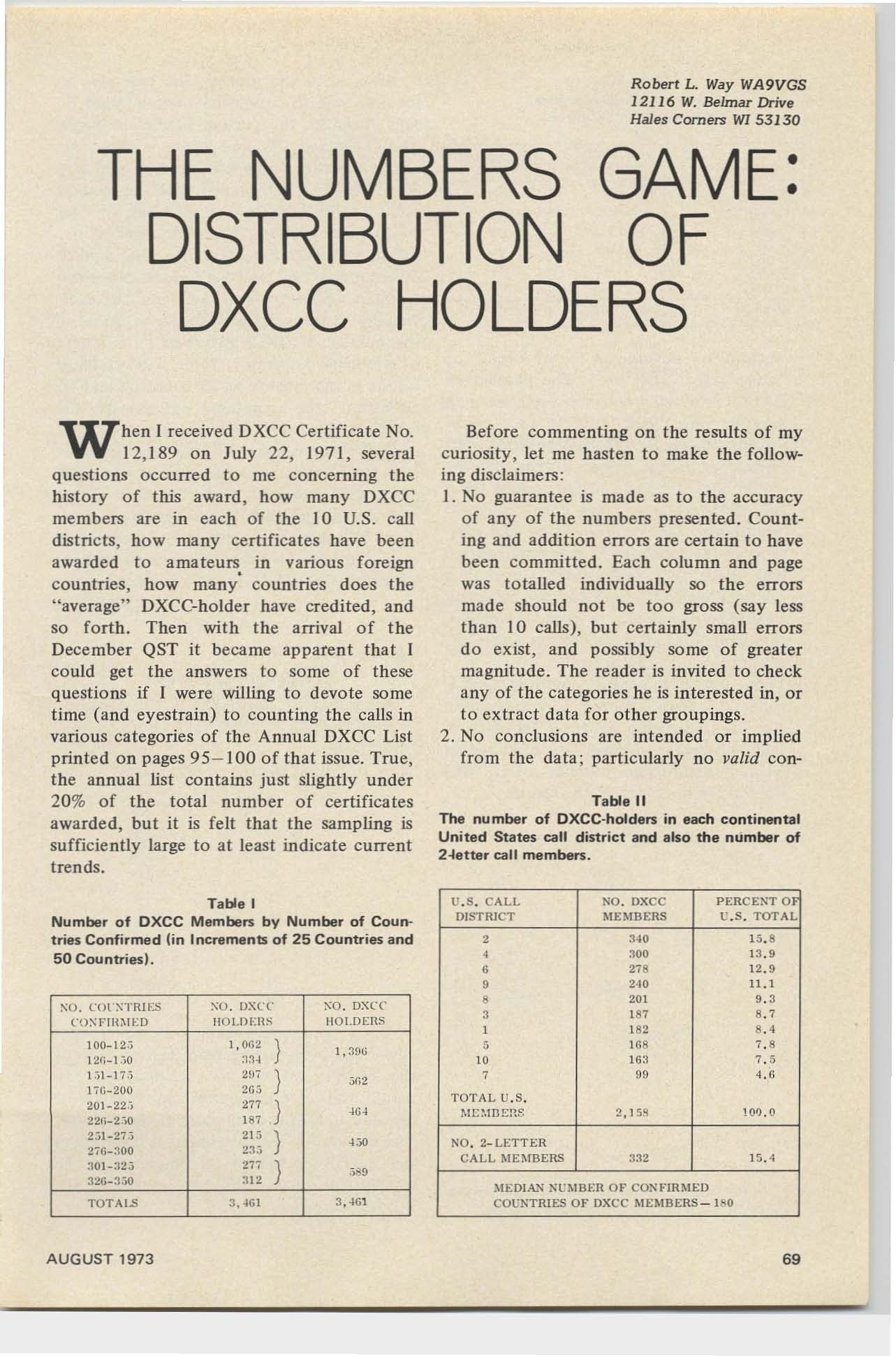
The history of the ARRL DX Century Club (DXCC) is a reflection of geopolitical history, technological progress, and the evolving spirit of global amateur radio communication. For nine decades, DXCC has stood as the premier operating achievement in amateur radio, challenging operators to make confirmed contacts with 100 or more distinct geographical or political entities across the globe.
The Pre-DXCC Era and the "DeSoto Rule" (1935)
In the early days of shortwave, from 1920s and early 1930s, the ability to communicate over long distances was rapidly advancing, but tracking achievements was chaotic. Operators claimed to have worked a certain number of "countries," but there was no standard definition of what a country actually was. Did Alaska or Hawaii count as separate from the United States? Did colonies count as independent entities?
The blueprint for modern DXing arrived in the October 1935 issue of QST magazine. Clinton B. DeSoto, W1CBD, an ARRL staff member and assistant editor, published a landmark article titled "How to Count Countries Worked."
DeSoto introduced a revolutionary concept that became known as the DeSoto Rule: "Each discrete geographical or political entity is considered to be a country." He went on to add, "It is obviously incorrect to accept either geographical or political divisions alone, as immediately the most glaring inconsistencies appear. The only general solution that comes anywhere near to solving the problem seems to be to reduce the definition of ‘country’ to the smallest common denominator - a single unit in the world's geographical and political proportions."
DeSoto argued, for example, that for a radio operator, a remote colony, an island chain, or a geographically isolated territory presented the same physical propagation and operating challenges as an independent sovereign nation. Therefore, they should count as separate entities. As always, the devil was in the details, but his basic premise was persuasive.
Well before DeSoto published his 1935 missive, it was very clear that keeping a list of countries you had worked was a *big deal,* and that a lot of people had very strong opinions on how it ought to be done. Radio was in some respects, much like bird watching, in that it is all about the numbers. His article provided a glimpse into the future, and into what the DXCC would ultimately become.
The Birth of the DXCC (1937)
After publishing its official list of DXCC entities (QST, Jan 1937, pp. 52–53), and building on the popularity of DeSoto's article, the ARRL officially announced the creation of the DX Century Club in the September 1937 issue of QST--with little fanfare, and unaware of the beast they were unleashing (QST, Sep 1937, pp. 59–60).
The rules were elegant but demanding: an amateur had to submit physical paper QSL cards confirming two-way communication with at least 100 countries on the official ARRL list. The very first ARRL DX Century Club (DXCC) award was issued to legendary DXer Frank Lucas, W8CRA (later W3CRA), of Canonsburg, Pennsylvania. He was awarded DXCC Certificate No. 1 in 1937 (QST, Nov 1937, p. 51), shortly after the official launch of the program. Early QST issues regularly published the standings of the world's top DXers.
World War II and the Post-War Reset (1947)
The momentum of the young DXCC program was abruptly halted by World War II. Following the attack on Pearl Harbor, amateur radio operations in the United States were suspended, and radio frequencies were repurposed for the military.
When the war ended and amateurs returned to the airwaves in 1945 and 1946, the global map looked entirely different. Empires were dissolving, borders were being redrawn, and new nations were emerging. The ARRL recognized that continuing the pre-war list was untenable.
In 1947, the ARRL completely restructured the program, launching what became known as the Post-War DXCC (QST, Mar 1947, p. 69). All pre-war contact totals were frozen, and everyone started back at zero. A new, rigorously defined ARRL Countries List was published (QST, February 1947, pp. 49–50), adapting DeSoto’s original criteria to the new post-war geopolitical landscape. The first post-war DXCC certificate was claimed just a few months later by renowned DXer Charles Mellen, W1FH, of West Roxbury, Massachusetts (QST, July 1947, p. 64).
Expansion, Endorsements, and the Honor Roll (1960s–1990s)
As equipment transitioned from home-brewed rigs to commercial single-sideband transceivers, global operating efficiency soared. To maintain the prestige of the award, the ARRL introduced various milestones and special tiers:
– Mode Endorsements: Separate tracking for Phone, CW, and eventually RTTY/Digital modes.
– 5-Band DXCC (5BDXCC): Announced in October 1968 (QST, Oct 1968, p. 108) to start in January 1969, this elite tier required working 100 countries on each of the five primary HF bands (80, 40, 20, 15, and 10 meters).
– The Honor Roll: Created to recognize operators who have worked almost every active entity on the list (QST, Nov 1947 p. 79). To qualify for the DXCC Honor Roll, an operator must be within 9 entities of the total number of active entities on the current list. "Top of the Honor Roll" signifies having confirmed every single active entity on Earth.
The Don Miller Affair
During the mid-1960s, Dr. Don Miller, W9WNV, was the undisputed superstar of the DX world. He was an incredibly talented operator with legendary pileup-handling skills, and he traveled to some of the most remote, uninhabited corners of the planet to activate rare or entirely new DXCC entities. To thousands of amateurs, he was a hero who handed them hard-to-get contacts.
Over time, however, rumors and suspicions began to mount. There were growing suspicions that some of Miller's DXpeditions were not all they seemed–that he wasn't where he claimed to be.
The controversy boiled over in 1967 when several veteran DXers and the ARRL Awards Committee began rigorously auditing Miller's operations. The committee uncovered evidence suggesting that Miller wasn't actually operating from the remote locations he claimed. Instead, it was alleged that he was sitting safely on a boat out at sea, or on a completely different island nearby, while using rare callsigns to generate gigantic pileups.
The specific locations that drew intense scrutiny included, among others:
– 1966, Navassa Island (K1IMP/KC4): A tiny, uninhabited Caribbean territory claimed by both the United States and Haiti, and which requires Coast Guard authorization to visit–authorization Miller did not have.
– 1966, Saint Peter and Paul Rocks (PY0XA): It was alleged that the photos Miller submitted as "proof" of his landing were actually pictures of entirely different islands in the Caribbean, and that his ship never actually reached the treacherous rocks.
– 1967, Heard Island (VK2ADY/0), It was alleged that Miller's request to visit the island had been denied.
The ARRL Awards Committee subsequently disallowed several of Miller's operations for DXCC credit (QST, Sep 1967, pp. 92-93), declaring that the contacts had not been made from the claimed locations.
Furious that his reputation was being besmirched and his operations stripped of credit, Don Miller did something unprecedented in the world of amateur radio: he sued the ARRL, its officers, and members of the Awards Committee for libel and slander (QST, May 1968, p. 81).
The lawsuit dragged on into 1968, threatening to cost the League huge amounts of money in legal fees. But during the deposition process, the legal tide turned heavily against Miller. Under oath, when confronted with maritime logs, navigation records, and conflicting photographic evidence, Miller struggled to provide specific details of his alleged trips (QST, Aug 1968, p. 10), and finally admitted that he had not, in fact been at Saint Peter and Paul Rocks at all.
The October 1968 issue of QST carried the official announcement that the lawsuit had been settled out of court—entirely on the ARRL's terms.
The key takeaways published from the legal resolution were:
1. No Money Paid: The ARRL steadfastly refused to pay Miller a single dime to drop the suit.
2. Lawsuit Withdrawn: Miller unconditionally withdrew his legal action against the League.
3. Strict Accreditation Legacy: The ARRL agreed to credit a few of Miller's 1968 operations that had been independently and meticulously documented, but the previously disqualified "faked" operations remained banned.
The Don Miller saga fundamentally altered the DXCC program. Before Miller, the DXCC desk operated on an honor system, primarily verifying that paper QSL cards looked authentic, and trusting that DXpeditions were where they said they were.
After the lawsuit, the ARRL established strict DXCC Accreditation Criteria. To this day, if a DXpedition goes to a rare or disputed location, the operators must provide ironclad "proof of presence"—including GPS tracks, landing permits, passport stamps, satellite photographs, and boat charter receipts. The modern transparency required of global DXpeditions is a direct result of the safeguards the ARRL put in place to ensure a "Don Miller scenario" could never happen again.
The Industrialization of the DXCC
The October 1968 editorial captured a profound, bittersweet moment in amateur radio history. In addressing the Don Miller crisis, the ARRL wasn’t just resolving a legal dispute; they were diagnosing a cultural shift in the hobby. The editorial essentially warned that DXing had evolved from a romantic, serendipitous pursuit into a hyper-competitive, industrialized sport.
The transition of the DXCC from a "fun game" into a high-stakes arena where "big business" and obsessiveness took over can be traced through several factors.
The Death of the "Underdog" DXer
In the 1930s through the early 1950s, DXing was largely an equalizer. Most gear was home-brewed. Achieving DXCC meant staying up until dawn, meticulously tweaking a hand-wound coil, and listening intently for a faint, drifting Morse code signal through a wall of atmospheric static. It required profound patience and a deep understanding of ionospheric propagation.
By the early 1960s, the commercial landscape had exploded. Companies like Collins, Drake, Swan, and Hallicrafters were producing high-power single sideband transceivers and linear amplifiers. If an operator had the financial means, they could purchase an off-the-shelf kilowatt station, erect a 100-foot commercial tower, top it with a huge commercial antenna, and simply blast their way through pileups.
The editorial exposed the friction this caused. The DXCC standings had become a playground where those with the deepest pockets could buy a competitive edge, turning what used to be an exercise in operating skill into an arms race of engineering and capital.
The Psychology of the Honor Roll or "The Needed One"
The fundamental nature of the DXCC list created a unique psychological trap for a specific subset of operators. When an operator reaches 300+ entities verified, the hobby changes. You are no longer casually tuning the bands to see who’s out there. Instead, you are waiting—sometimes for years—for a single, specific, uninhabited rock in the middle of the ocean to be activated.
This created an environment of intense desperation. When a rare entity *did* go on the air, the pileups were vicious. Operators would intentionally transmit over one another, ignore the DX station's instructions, and run illegal power just to get that "one needed card."
The ARRL realized that the sheer prestige of the DXCC certificate had inadvertently incentivized bad behavior. It was no longer about the joy of international goodwill or the technical triumph of radio; it was about the number on a tally sheet.
The Industrialization of DXpeditions
Because the demand for rare countries was so high, providing those contacts became a capital intensive financial operation. This is where the "big business" aspect truly manifested.
A serious DXpedition to a place like Bouvet Island, Clipperton, or some remote reef required chartering ocean-going vessels, purchasing thousands of dollars in fuel, bringing generators, tents, and medical supplies, and taking weeks off from work. To fund these operations, DXpeditions began relying heavily on corporate sponsorships from radio manufacturers, and large donations from elite DX clubs to help defray the costs.
Don Miller excelled at this business model. He understood that he was providing a highly sought-after commodity to a market of desperate buyers. The editorial was a sobering reminder of what happens when the lines between a hobby and a commercialized venture blur.
The ultimate irony of that October 1968 issue is that right alongside the warning about the DXCC taking on a toxic life of its own, the ARRL announced the Five-Band DXCC (5BDXCC).
While the editorial warned that the chase was becoming too intense and expensive, the new 5BDXCC award practically guaranteed that the arms race would intensify. To win it, an operator could no longer rely on a single great antenna for 20 meters. They now had to invest in large low-frequency antennas for 80 and 40 meters, and big arrays for 15 and 10.
The League was trying to strike a difficult balance: they wanted to channel that intense competitive energy away from single, rare, disputed islands (like Miller's) and redirect it toward a pure technical challenge spread across the entire HF spectrum. It was an admission that competitive DXing wasn't going away—so the rules of the game had to be re-engineered to keep it honest.
From "Countries" to "Entities" (1998)
For decades, the use of the word "country" caused endless confusion among amateurs. To solve this, the ARRL Board of Directors officially overhauled the DXCC rules in 1998, changing the terminology from "countries" to "entities." The criteria were codified into distinct categories based on political sovereignty, geographic separation, and association with a parent nation (e.g., distinguishing a mainland from an offshore island group).
The Digital Revolution: Logbook of the World (2003–Present)
For the first 65 years of the program, verifying contacts required sending rare, irreplaceable paper QSL cards through the mail or carrying them to approved "card checkers" at hamfests. This process was expensive, slow, and risked the loss of historic cards.
In 2003, the ARRL introduced Logbook of the World (LotW). This secure, electronic database allows operators to upload their digital logs. When two logs match (verifying the call signs, date, time, band, and mode), a DXCC credit is automatically generated via digital signature verification.
While paper QSL cards are still accepted and cherished, LotW revolutionized DXCC, making it accessible to a new generation of operators and drastically speeding up the verification process.
And to some extent, technology has leveled the playing field. The explosion of high-efficiency digital modes like FT8 in the 2010s further transformed the program, allowing weak-signal operators to achieve DXCC milestones using modest stations and wire antennas.
The DXCC Legacy
Today, the DXCC list hovers around 340 active entities, and is tweaked on a regular basis. It continues to capture the imagination of radio amateurs worldwide. Whether it's chasing a rare DXpedition to an uninhabited rock in the South Pacific or listening through the static for a new prefix on 80 meters at 3:00 AM, the DXCC program remains the ultimate operating achievement—a direct legacy of Clinton B. DeSoto’s 1935 vision to map the world through the lens of radio propagation.
Chase on.