Note
Abstract
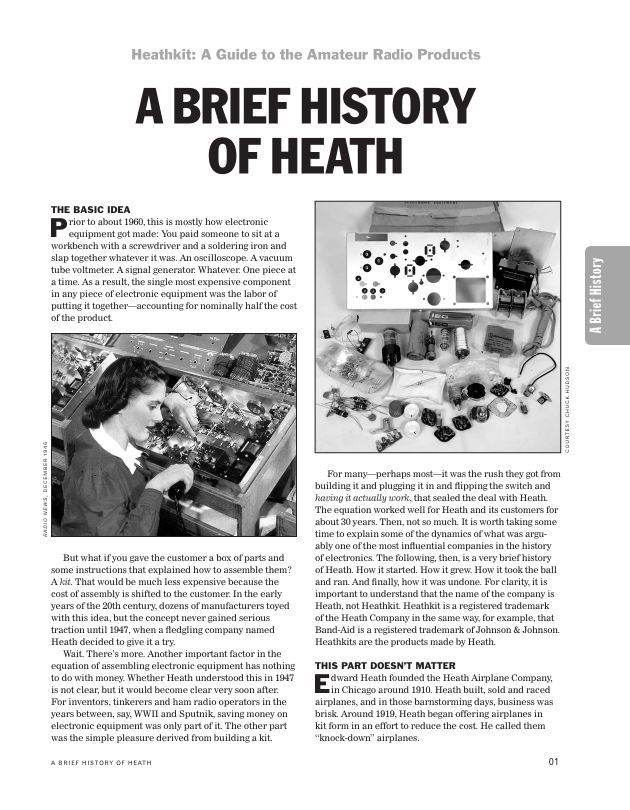
A Brief History of Heath, by Chuck Penson, WA7ZZE
This text chronicles the history, rapid rise, and eventual technological challenges of the Heath Company, famous for its "Heathkit" line of electronic products.
The Core Concept and Early History
The Kit Model: Prior to 1960 or so, electronic equipment assembly labor accounted for roughly half of a product's cost. Heath revolutionized the industry by shifting this assembly labor to the customer, providing a box of parts and detailed instructions. This halved retail prices and tapped into the builder's pride of construction.
Aviation Origins: Founded around 1910 by Edward Heath as an airplane company, the business originally sold "knock-down" kit airplanes before going bankrupt in 1934 following Ed Heath's death.
The Howard Anthony Era
Rebirth: In 1935, Howard Anthony purchased the remnants of the company for $300, keeping the Heath name. Anthony, a savvy entrepreneur who became wealthy through astute oil investments, successfully pivoted the business during World War II toward manufacturing a variety of airplane parts for the government.
The Electronics Pivot: When post-war government contracts vanished in 1945, Anthony began purchasing vast quantities of war-surplus electronic components. Inspired by a 1946 Radio News article, Heath launched its first electronic kit—a $39.50 oscilloscope—in 1947, triggering a revolution in affordable test equipment.
Expansion and Ham Radio Domination
Post-War Boom: Driven by the G.I. Bill, thousands of veterans trained in electronics required affordable instruments to start businesses, creating a highly loyal customer base.
The "Green Machines": Under the subsequent ownership of Daystrom (acquired in 1954 following Anthony's tragic death in a plane crash) and later Schlumberger, Heath expanded into amateur radio. Notable successes included the legendary DX-100 transmitter, the ubiquitous "Cantenna" dummy load, and the highly popular "Hot Water" HW-100/101 transceivers.
The SB Series: Inspired by the premium Collins S/Line, Heath developed the single-sideband (SSB) "SB" series, offering near-premium performance at a fraction of the cost, which became the high-water mark for the company.
Solid-State Challenges
The Digital Transition: The advent of solid-state electronics and integrated circuits presented unprecedented hurdles. Unlike traditional vacuum-tube kits, dense solid-state designs like the fully solid state SB-104 transceiver caused design headaches and a steep probability of user assembly errors.
The Decline: Combined with rising employee turnover and internal corporate friction by the early 1970s, the strict engineering constraint that any kit must be easily built and aligned using basic tools began to collide with the complex realities of modern digital electronics. This, combined with off-shore competition and a take-over by Zenith, spelled the end for Heath.
-------------------
Also attached:
The Earliest Heathkits and a Database for 1947 - 1956, by Erich E. Brueschke