Note
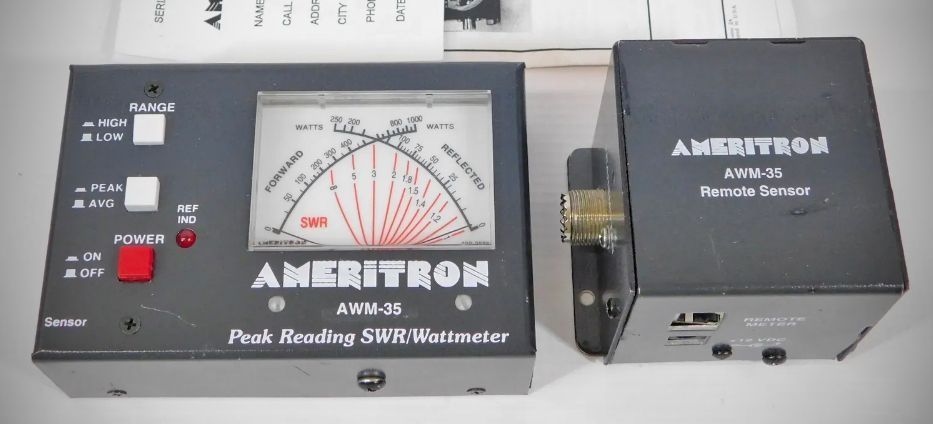
The AWM-35 SWR/Wattmeter’s unique two-unit design, with a control unit and a remote sensor, permits convenient “remote” placement of the sensor in both mobile and home stations.
The AWM-35’s cross needle meter displays peak or average FORWARD power, peak or average REFLECTED power, and SWR, all simultaneously. The control unit’s REF IND (Reflected Indicator) is a warning lamp for low and high-power operation; the lamp illuminates when a factory setting of 2:1 VSWR is reached. This level can be changed by the user.
A 12 volt DC power source is required for the meter to function. An external 12 VDC source can be provided via a jack on the sensor unit, or a 9 VDC battery can be installed inside the control unit. When an external power source is used the unit is enabled at all times and comes on when RF is sensed. When battery power is used, the battery is connected by the PWR ON/OFF pushbutton. Under battery power, the meter lamp and REF IND indicator lamp do not function, to conserve battery life.
Full scale forward and reflected power range is selected by the RANGE
HIGH/LOW pushbutton. If your transmitter runs more than 300 watts of peak output power, set this switch to the 3000 watt, HI position (in). If your transmitter runs less than 300 watts peak output power, set the pushbutton to the 300 watt, LOW position (out). Peak envelope power (PEP) is measured by placing the PEAK/AVG switch in the “in” position.
Peak and average power values are equal with steady unmodulated carriers such as closed-key CW, RTTY, FSK, or FM. The meter reading on these modes will be the same in either peak or average modes. On SSB, the ratio of PEP to average power varies with different voice and modulation characteristics. With most voices the PEP reading is three to five times higher than the average voice power reading.
The left hand FORWARD meter scale displays forward power in a scale from 0 to 300 watts. In the LO power position the reading is made directly; Each picket (scale mark) represents 5 watts below 10 watts, 10 watts between 10 and 100 watts, and 25 watts between 100 and 300 watts. In the HIGH power position, multiply the meter reading by ten.
Power readings are most accurate over the upper half of the meter scales. When measuring power with less than a perfect match, subtract reflected power from forward power to measure the true power.