Note
QST, Feb 1977, p. 164.
QST, Nov 1977, p. 171.
QST, Jan 1980 p. 113.
QST, Apr 1981, p. 204.
QST, Feb 1982, p. 192.
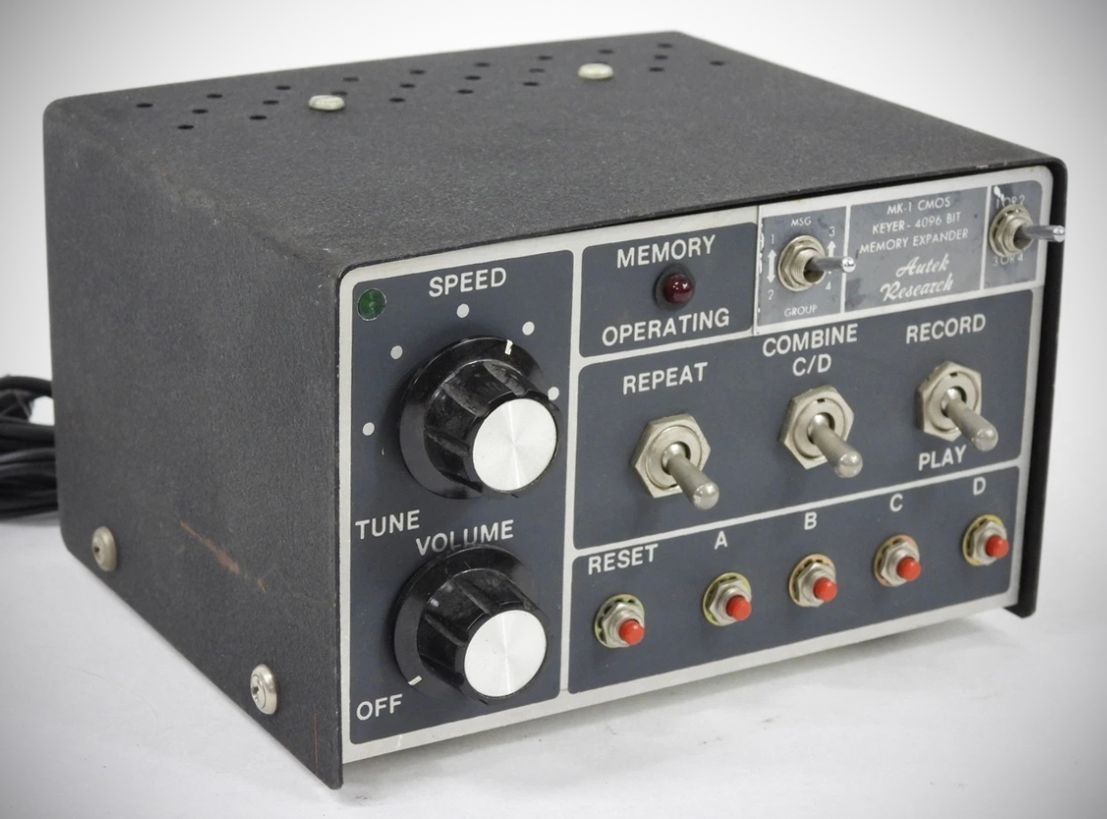
The Autek Research MK-1 is a programmable memory keyer designed to provide precision CW generation and automated message playback. Released in the 1970s, it utilized CMOS logic circuitry to offer high reliability and advanced features like Iambic operation and non-volatile-like memory (via battery backup) for contest and everyday use.
Features
Keying & Operations
• Iambic (Squeeze) Operation: Supports dual-lever paddles.
• Dot & Dash Memories: An internal buffer allows a dot or dash to be "inserted" even if the lever is tapped during the previous element, ensuring perfect spacing.
• Triggered Clock: The internal time base starts immediately upon paddle closure for instant response during normal sending.
• Transmitter Tuning: Includes a "Tune" function (activated by turning the speed control full counter-clockwise) that provides a continuous carrier for rig adjustments.
Memory Capabilities
• Four Message Channels: Four independent memory sections (A, B, C, and D) for storing standard exchanges or contest messages.
• Message Combining: A "Combine C/D" switch allows messages in sections C and D to play sequentially, effectively doubling the length of a single message to approximately 30 characters.
• Repeat Mode: A toggle switch enables a message to repeat indefinitely, useful for continuous CQ calls.
• Real-Time Editing: Supports "punch-in" recording where an operator can play back a message and switch to record mode mid-stream to correct a mistake near the end.
• Paddle Interrupt: Tapping the paddle during memory playback immediately resets the memory and returns control to the operator.
Hardware & Power
• Solid-State Keying: Uses high-voltage transistors for silent, reliable keying of most rigs made after 1963 without the need for mechanical relays.
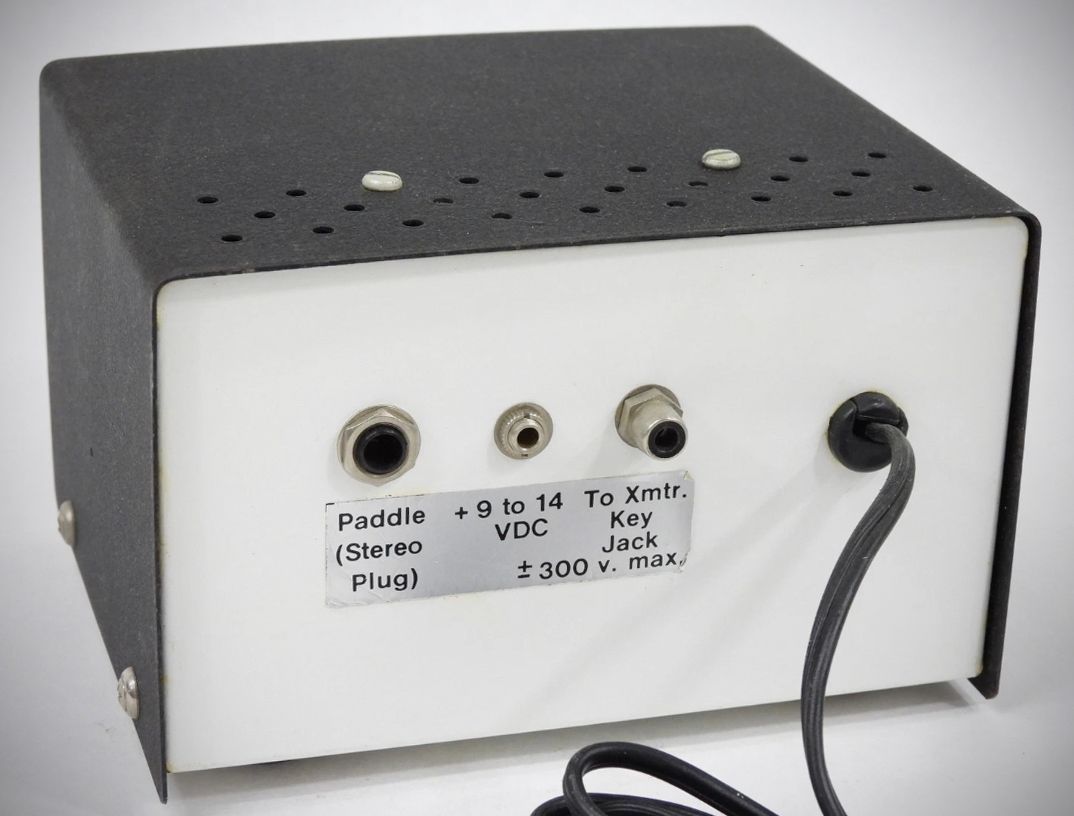
• Battery Backup: Features a 9–14 VDC input for automatic failover during AC power dropouts, preserving recorded messages.
• Internal Monitor: Includes a built-in speaker with adjustable volume and tone trimpots for off-air practice or monitoring.
Specifications
– Code Speed: Adjustable from < 10 WPM to > 50 WPM
– Weighting: Fixed 3:1 dash-to-space ratio; 1:1 dot-to-space ratio
– Memory Capacity: ~15 characters per section; ~30 characters in Combine mode
– Logic Type: CMOS (utilizing CD4011, CD4027, CD4001, 2102 RAM)
– Output Ratings: 300V Max (including spikes)
– Keying Current: 15 mA (Grid-block / Negative); 200 mA (Cathode / Positive)
Power Requirement: 115 VAC standard; 220 VAC via external adapter
Battery Input: +9 to +14 VDC (Miniature phone jack)
Current Drain: 40–60 mA at 9V; 75–95 mA at 12V