Note
QST, Mar 1955, p. 86.
Allied Radio catalog 1956 (copyright 1955), p. 201.
QST, Dec 1956, p. 109. (details)
Walter Ashe catalog 1957 (probably issued in 1956), p. 6. (describes options)
Allied Radio catalog 1959 (copyright 1958), p. 378.
Allied Radio catalog 1960 (copyright 1959), p. 395.
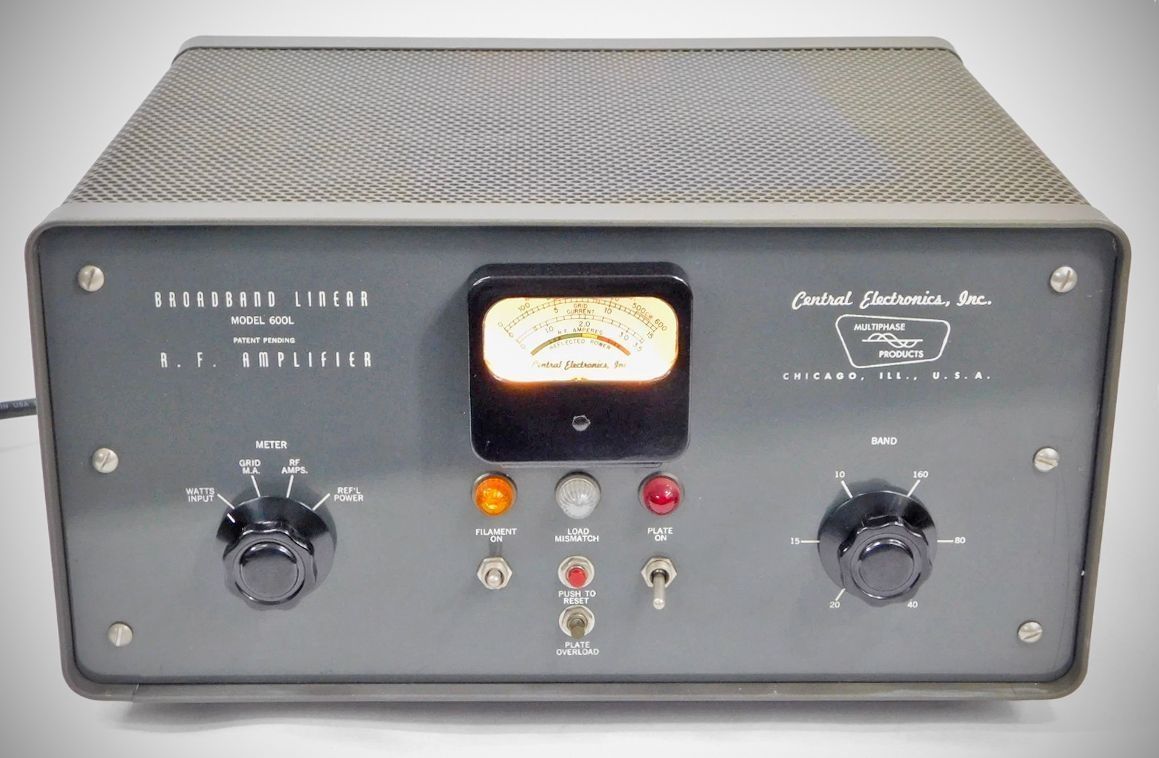
Introduced in1955 by Wes Schum's Central Electronics, the 600L is an HF linear amplifier that was years ahead of its time. Designed to match the low-power SSB exciters of its era (like the CE 10B, 20A, and later the 100V/200V), its ultimate claim to fame is its broadband, no-tune operation.
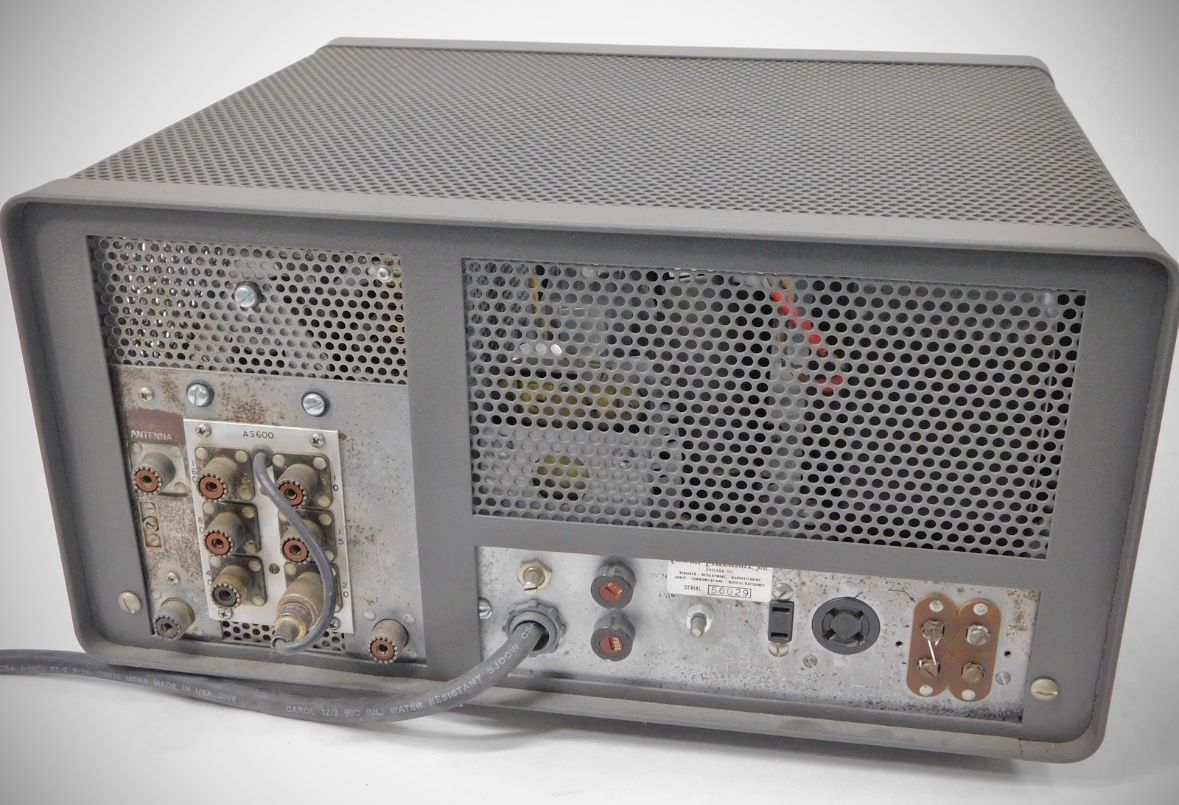
The 600L is a boat anchor in the truest sense, weighing in at over 70 pounds due to its massive, over-engineered power supply. It utilizes separate broadband toroid couplers in both the grid and plate circuits across its coverage bands (160 through 10 meters).
It features a single 813 beam power tetrode, mounted horizontally. The 813 is an exceptionally rugged, forgiving tube that handles abuse well without needing to be pampered.
To ensure maximum linearity for SSB operation, the screen supply is actively regulated to better than 1% variation using an 812A power triode as a series pass regulator—a highly unique design choice for the era.
Power Supply: The power supply features a massive plate transformer, a hefty swinging choke input, and an oil-filled filter capacitor providing roughly 1,800V DC to the plate.
Because it was built for the dawn of sideband, the 600L expects very low drive levels compared to modern gear:
– Input Drive: It requires only 8 to 20 watts RMS of drive for maximum output.
⚠️ Caution: Driving a 600L directly with a modern 100-watt transceiver will instantly fry the input swamping resistors or damage the tube.
Power Input/Output: It is rated for 600 watts PEP input on SSB, averaging 300 to 400 watts on voice peaks. For CW, it handles up to 500 watts input, and around 200 watts for AM.
Efficiency: It delivers a clean signal into unbalanced 25 to 100 ohm loads.
Advanced Features (For the 1950s)
– Automatic Mismatch Protection: The 600L features a built-in SWR bridge that monitors load impedance departures from 52 ohms. If the SWR spikes dangerously (approaching 3:1), an internal protection circuit utilizes a 12AT7 and a telephone-type relay to instantly trip the blocking bias, protecting the 813 from operating without a proper load.
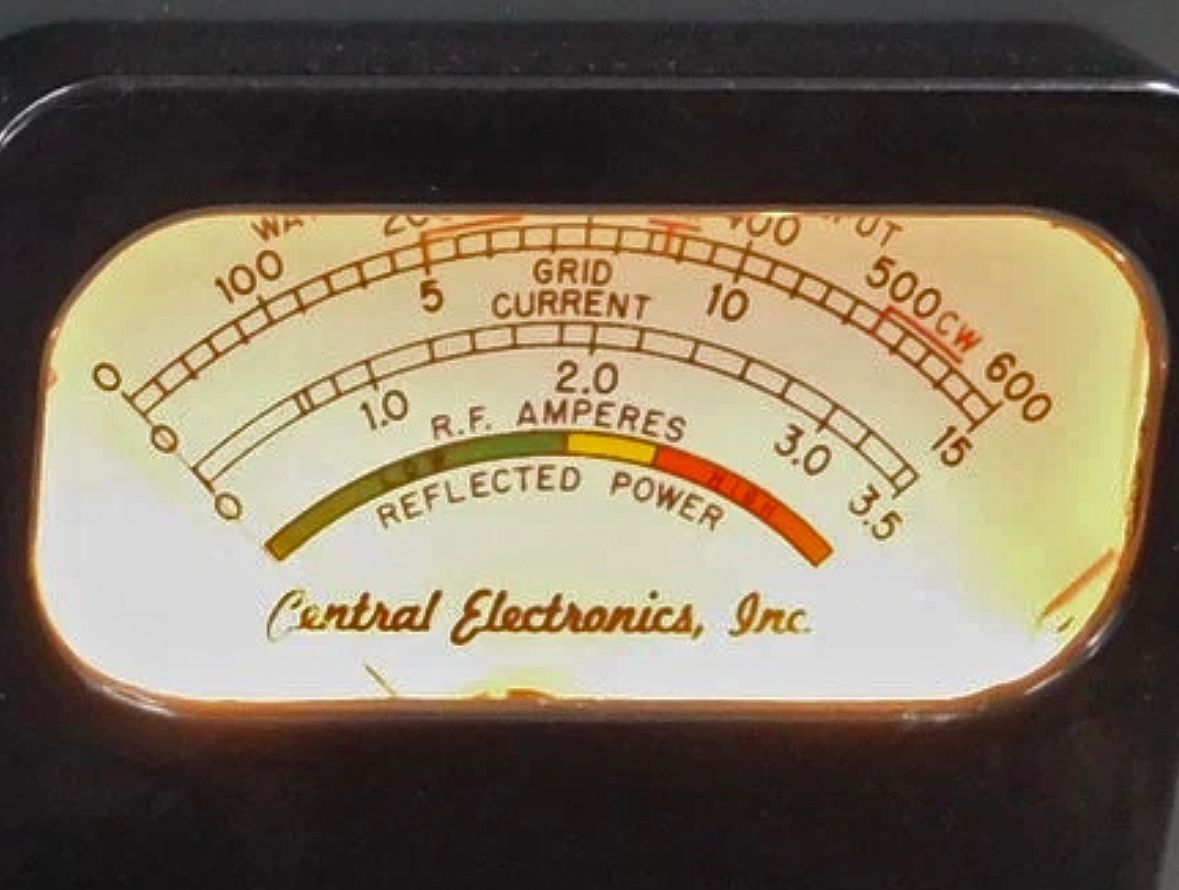
– Fast-Acting RF Ammeter: Instead of using a slow-heating thermocouple meter, the front panel meter monitors the voltage drop across a 1-ohm carbon resistor in the RF output line, providing immediate, real-time feedback of antenna current and SWR.
When fully restored, it remains one of the smoothest, most seamless vintage desk amplifiers to operate—requiring nothing more than selecting the band and turning the exciter dial.