Note
Note: all of what follows are just notes for a future article.
-//////-
Citizens Radio Service (CB) made official in September 1958. (Source: QST, Dec 1958, p. 10)
International Crystal, first with a commercially available transceiver in Dec 1958 (Popular Electronics). In March 1959.
Gonset G-1 and Vocaline were second. See March 1959 (Popular Electronics).
March 1959 was the month things began to happen.
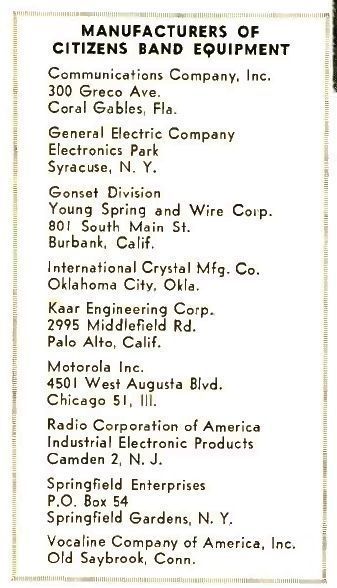
Article: “Citizens Band Radio.” Popular Electronics, Mar 1959, p. 59. General story to introduce CB with a review of some equipment. Included the following list of manufacturers. (see figure 1)
Article: “Build a Citizens Band Transceiver,” by Don Stoner, W6TNS. Popular Electronics, Jun 1959, p. 48.
Globe Citizens Broadcaster, Popular Electronics, Jun 1959, p. 137
Article: “Citizens Band for Small Boats,” by Don Stoner, W6TNS. Popular Electronics, Jln 1959, p. 48.
Hallicrafters CB-1, July 1959, Popular Electronics, Jun 1959, p. 143
Globe - A kit based on the March 1959 article in Radio and Television News. Jul 1959 Popular Electronics, p. 155.
Article: “Tips for Citizens Band Applicants,” Popular Electronics staff. Aug 1959, p. 53.
Column: Tom Kneitel’s “On the Citizens Band” first appeared in Aug 1959 Popular Electronics magazine.
Article: “Listening on the 27-mc Citizens Band, Tom Kneitel. Popular Electronics, Sep 1959, p. 69. “We predict CB will be the hottest thing since the Chicago fire in a very short time."
By mid 1960 the citizens band had already devolved into the chaotic mess it is well know for today. Jamming, foul language, the use of VFOs, excessive power, and unlicensed operation (illegal at the time) were commonplace. Many subsequent columns would bemoan the chaotic state of the citizens band.
“On the Citizens Band,” by Tom Kneite, Popular Electronics, Oct 1960, p. 86.
Dec 1960 PE mag. Special issue “Getting started in Citizens Radio.” By the end of 1960 there were more than 100,000 licensed CB operators—more by half than ham radio operators. The issue provides a good overview of the service, its regulations, and licensing requirements.
In the March 1960 issue of PE, the magazine published the first of what would be a yearly (in August, thereafter) round up of the most recent CB equipment. The 1960 report featured about 45 models from 40 different manufactures.
By the 1961 round up, the number of models had risen to about 60.
In December 1961, Browning began advertising the 23/S-Nine transmitter. It appears to be the first transmitter to offer the 23 channel capability. No transceiver as yet offered this capability.
May 1962 - Polytronics Poly-Comm Senior 23 - probably be the first fully synthesized transceiver. And probably the first to offer all 23 channels out of the box.
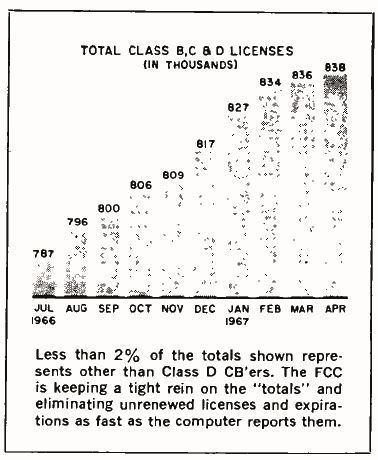
By mid 1966 there were nearly 900,000 CB operators.
Source: Source: Popular Electronics, Aug 1966, p. 47. (and see figure 2)
Government statistics bear out the upward trend in ownership. In 1972, the FCC granted some 127,000 citizens hand licenses, and about three times that number in 1974. In 1975, the number of new licenses granted climbed to 1.7 million, soared to 4.8 million in 1976 and reached 4.6 million last year. Since CB’s inception in 1958 through the end of 1977, the FCC is thought to have issued a total of about 13 million licenses. Source: Popular Electronics, May 1968, p. 26.
Some sense of the number of CB radios being sold can be found in a May 1968 ad for Johnson. That month, the company advertised a contest to give away a number of 24 carat gold plated versions of the Messenger III to celebrate the 100,000th Messenger III produced. Source: Popular Electronics, May 1968, p. 26. Collectively then, it is clear that manufactures were selling CB radios by the millions.
In 1975, CB sales totaled about 4.2 million units. Source: Popular Electronics, Jun 1976, p. 4. By 1976 that number had jumped to a record 11 million before falling to nine million in 1977. Sales for 1978 were predicted to be just 7 or 8 million rigs, worth a total of about 1.8 billion dollars. For comparison, the high fidelity industry amounts to about $2.4 billion. Source: New York Times, “C.B. Radio Industry Is More in Tune After 2 Years of Static,” Apr 17 1978.
It should be noted that very few sellers made their own radios. About 90 percent of all units sold were imported, primarily from Japan. Source: New York Times, “C.B. Radio Industry Is More in Tune After 2 Years of Static,” Apr 17 1978.
Estimates vary widely, but there are probably about 215 million citizens band radios in existence. Source: New York Times, “C.B. Radio Industry Is More in Tune After 2 Years of Static,” Apr 17 1978. With that many units in operation it should come as no surprise that congestion on the CB channels was becoming a real problem—a problem about to get much worse because of the approaching "solar maximum," a period in which greatly increased sunspot activity would make it possible for a radio signal of even a few watts to “skip” for thousands of miles. CB users would have to contend not only with interference from local operators, but also from those all over the country—and even from other countries.
The idea of making additional channels available to the Citizens Band began in 1974 when the FCC issued a Notice of Proposed Rule Making. Source: Popular Electronics, Nov 1974, p. 4.
Forty channels become legal starting Jan 1 1977. Source: Popular Electronics, Nov 1976, p. 94.
Motorola runs a full-color six-page ad for its “Series 4000” radios. “Subject to FCC type acceptance." Source: Popular Electronics, Jan 1977, p. 43.
Johnson runs an ad talking about its crystal filters and shows a photo of a 40-channel unit without referring to a model number. Fine print says all units are subject to FCC approval before they can be sold. Source: Popular Electronics, Jan 1977, p. 15.
Capitalizing on the CB fade, Smokey and the Bandit, a film starring Bert Reynolds and Sally Field, and in which CB was a major plot device, was the second-highest-grossing domestic film of 1977. Only Star Wars made a higher gross that year. Source: https://en.wikipedia.org/wiki/Smokey_and_the_Bandit. (Accessed Nov 2021)
“…approaching 12 million users.” Source: Popular Electronics, Nov 1977, p. 90.
Sales of 40 channel radios were not as strong as anticipated. Additionally, manufacturers had to discount 23 channel radios in an effort to clear their inventory before sales of these rigs became illegal beginning in 1978. Financial losses caused by the the combination of slow sales of 40 channel radios and heavily discounted 23 channel rigs began to clear the field of many of the weaker manufacturers.
From 1975 and 1976, during what could arguably be defined as the peak of interest in CB, some 125 companies were selling CB radios. By the middle of 1978, only 60 or so remained, and experts who followed the industry predicted that fewer than 25 of those would survive. Source: New York Times, “C.B. Radio Industry Is More in Tune After 2 Years of Static,” Apr 17 1978.
Pearce-Simpson declared bankruptcy, while E. F. Johnson Company held a "distress sale" earlier this year of its entire line of 40‐channel equipment, after losing $26 million. Motorola consolidated production at its Texas plant and closed down a line in Illinois. And last month the Hy‐Gain Electronics Corporation suspended operations and turned over its assets to its secured lenders. Source: New York Times, “C.B. Radio Industry Is More in Tune After 2 Years of Static,” Apr 17 1978.
Last “CB Scene” column in Jul 1978 (Popular Electronics)
Sales of 23 channel rigs ended as of 1-1-78. Source: Popular Electronics, Apr 1978, p. 53.
25 million users by mid 1978. Source: Popular Electronics, Apr 1978, p. 53.
By 1979 advertising for CB radios in P.E. had virtually disappeared, as had any mention of CB radio. Computers had taken the spotlight.