Note
QST, Oct 1966, p. 165.
QST, Jan 1967, p. 139.
CQ, Sep 1969, p. 111. (NOS)
QST Apr 1970, p. 143. (NOS)
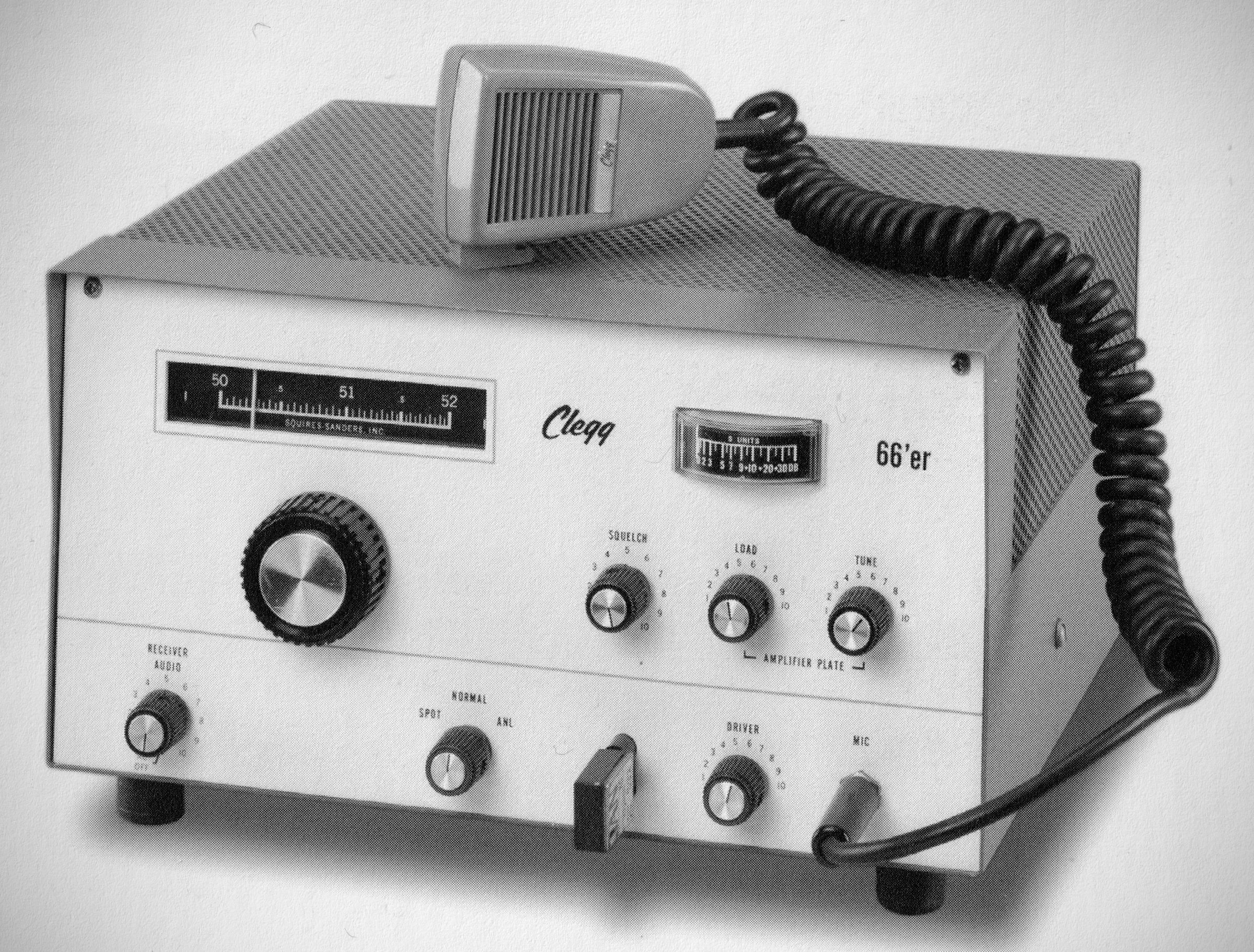
The 10 watt transceiver had a built-in 115 VAC/12 VDC power supply. Its double-conversion receiver tuned 49.9-52.1 MHz and the transmitter was crystal-controlled.
Features
– High-level amplitude modulation and speech clipping.
– Single-package transceiver specifically designed for consistent communication on the 6-meter band (amateur radio, MARS, Civil Defense, and Civil Air Patrol).
– Dual power capability with separate fusing and power connectors for 115 VAC and 12 VDC (positive or negative ground) operation.
– "Leaky" squelch circuit design providing an approximate 20 dB audio increase when unmuted.
– Front-panel "SPOT" function to locate crystal transmit frequency on the receiver dial.
Optional Civil Defense accessories: Crystal Receive Adapter (#800-047), Special CD case (#800-805), Transmit crystal modification padder, and removable tuning control shafts.
Specifications
– Type: Dual Conversion with 10.7 MHz 1st IF and 456 kHz 2nd IF
– Sensitivity: Better than 0.6 uV for 10 dB S + N / N
– Selectivity: 8 kHz
– Frequency Coverage: 49.9 to 52 MHz (Expanded tuning range available on special order)
– Frequency Drift: Typically less than 10 kHz during warmup; less than 3 kHz per hour after a 20-minute warmup
– Spurious Response Rejection: Down more than 60 dB
– AGC: Provides more than 10 dB compression for a 40 dB signal increase
– Squelch Threshold: Adjustable from less than 0.5 uV to more than 500 uV.
– Automatic Noise Limiter (ANL): Switchable; provides more than 20 dB suppression of typical impulse noise
– Audio Output: Greater than 2 watts
– Power Input/Output: High efficiency; 22 watt input, 10 watt or more output into a 52 ohm load
– Modulation: HIGH TALK POWER performance giving high-level modulation to 100% with a typical –56 dB microphone
– Harmonic Outputs: Down more than 50 dB
– Spurious Outputs: Down more than 66 dB (excluding harmonics)
– Exciter Stages: Broadband and multi-tuned for quick QSY and low spurious (TVI) outputs
– Audio Response: 300 to 3000 Hz ±3 dB
– Crystal / VFO Drive: Operates with 8.3, 12.5, or 25 MHz crystals or an external VFO
– Control: Built-in Push-To-Talk and provisions to automatically switch the Apollo Linear and/or an external VFO
Tube Complement (13 total)
– 6EH7 (RF Amplifier)
– 6DJ8 (First Mixer)
– 6BA6 (10.7\text{ MHz} IF Amplifier)
– 6BE6 (Second Mixer)
– 6BA6 (456\text{ kHz} IF Amplifier)
– 12AL5 (Diode Detector / ANL)
– 6AN8 (Two-Stage Audio Amplifier)
– 6AQ5 (Receive Audio / Modulator)
– 6AQ5 (Receive Audio / Modulator)
– 6KE8 (Oscillator / Buffer)
– 6KE8 (Crystal Oscillator / Multiplier to 25\text{ MHz} & Doubler to 50\text{ MHz})
– 12BY7 (Driver - 50\text{ MHz})
– 2E26 (Power Amplifier, Class C)
– Transistors (Q1, Q2): 2N2869 (Inverter power transistors)
Power Requirements
AC Power Supply: Built-in 117 VAC ±5 volts, 50–60 Hz supply utilizing a power transformer, solid-state bridge rectifier, and heavy filtering circuits
DC Power Supply: Built-in 13.8 VDC supply with a DC-to-AC solid-state converter
Power Consumption: Nominally 50 watts on receive and 85 watts on transmit
References
Review. 73, Apr 1967, p. 90.