Note
QST, Nov 1962, p. 109.
QST, Jan 1964, p. 135.
QST, Mar 1965 p. 121.
Allied Radio catalog 1966 (copyright 1965), p. 361.
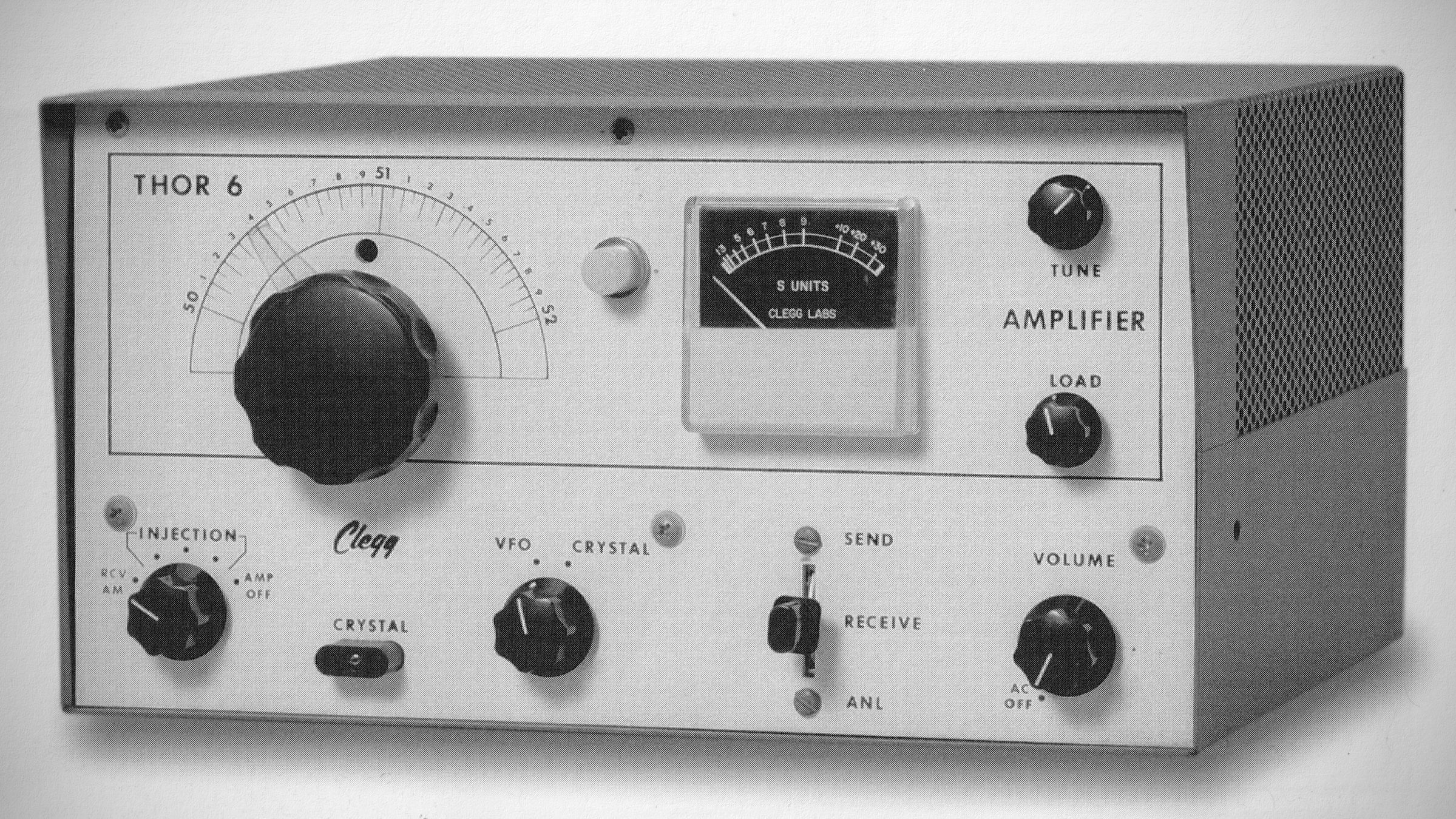
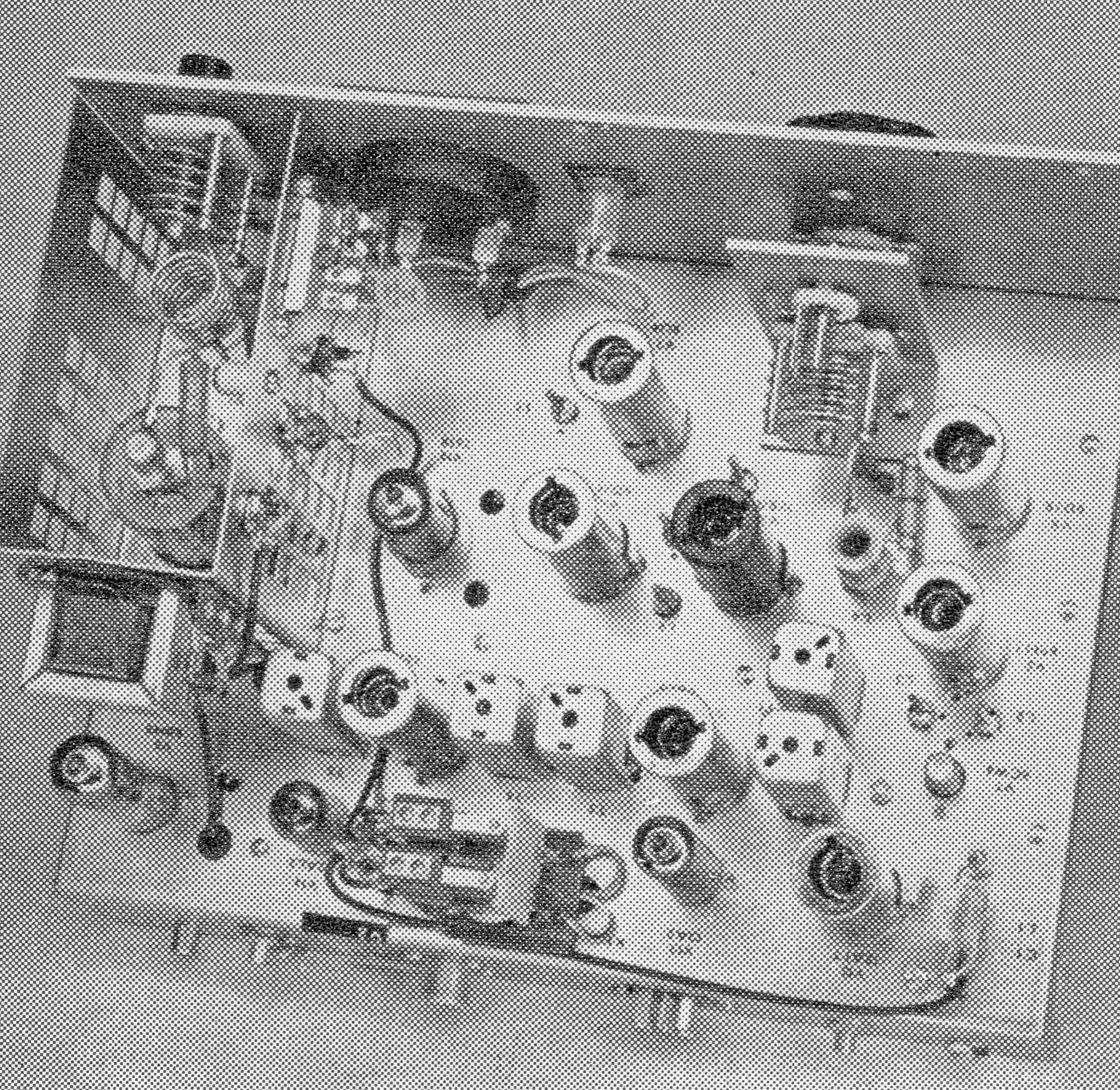
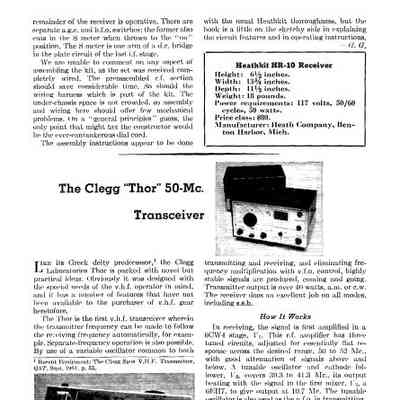
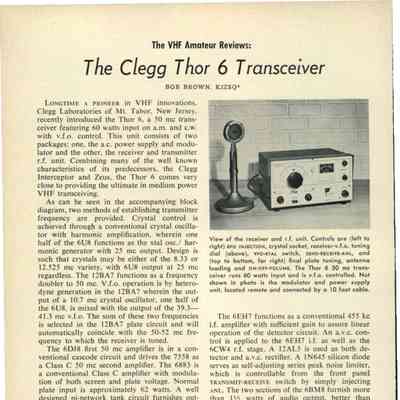
Clegg's 50 MHz Thor 6 transceiver was the first VHF rig to use the same VFO for transmit and receive. Another innovation was the cascade amplifier between the transmitter's mixer and driver stages. Power output was 50 watts on AM and CW. The mode switch offered three levels of receiver BFO injection. The 115 VAC power supply and modulator were on a separate chassis. A transistorized modulator/power supply for mobile operation was available.
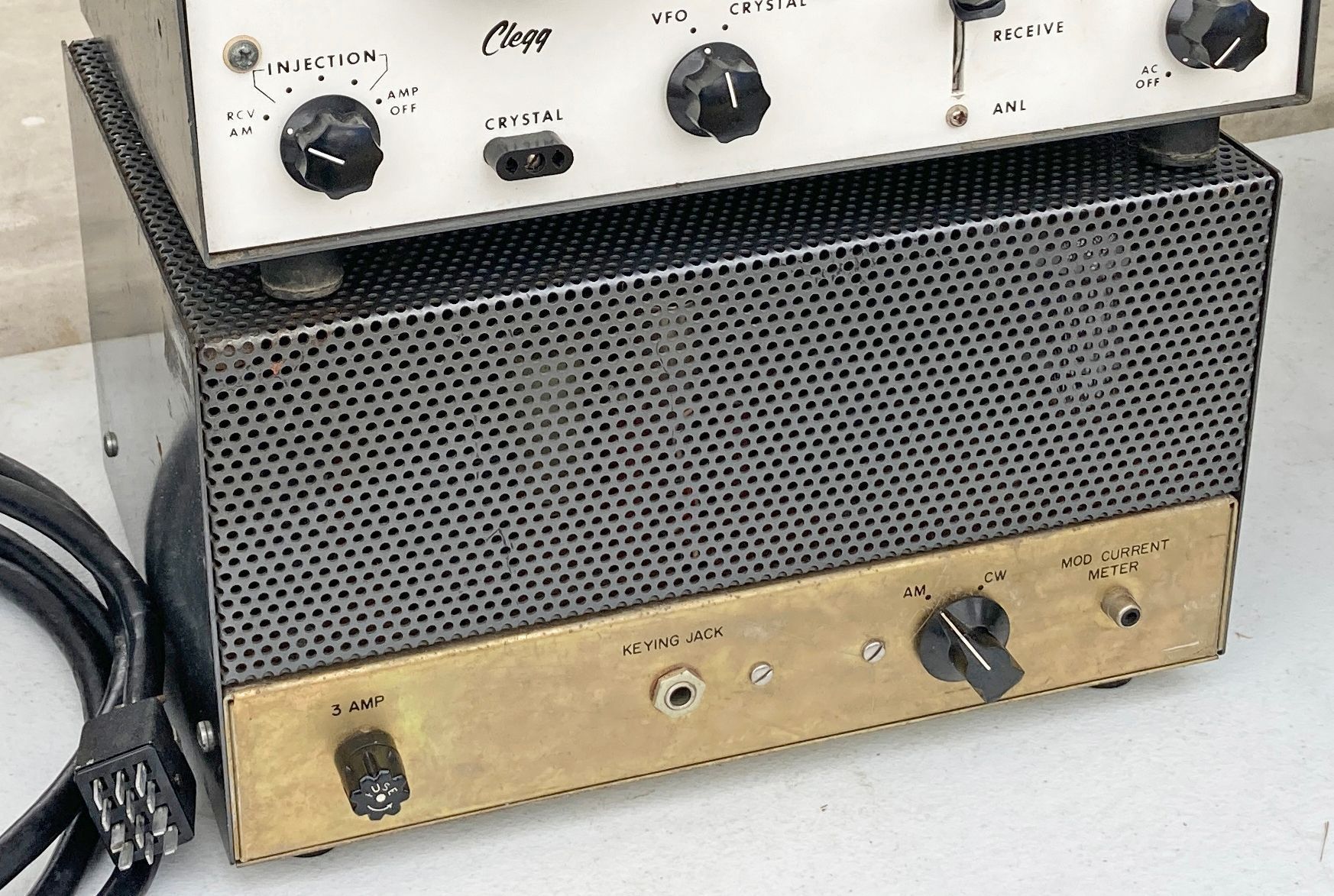
The system is split into two separate chassis connected by a 10-foot interconnecting power cable:
– RF Unit: Sits on the operating desk and contains the main tuning dial, receiver, exciter stages, transmitter driver, final amplifier, and primary front-panel operating controls.
– Model 417 Power Supply / Modulator Unit: Located remotely in a well-ventilated area. It houses the high-voltage power supply, audio modulator circuit, keying jack for CW, and mode selector switch (AM/CW).
– Receive Range: Tunes from 49.8 to 52.2 MHz (calibrated on the main dial from 50.0 to 52.0 MHz in 50 kHz increments).
– Transmit Range: Covers 49.8 to 54.0 MHz.
– Power Output: Delivers approximately 40 watts RF output into a 45 to 75 ohm resistive antenna load.
In VFO mode, heterodyne frequency generation locks the transmitter frequency to match the exact frequency to which the receiver is tuned. In Crystal mode, the transmitter frequency is controlled via front-panel FT-243 crystal sockets accepting standard 8.2 MHz or 12.5 MHz crystals.
Features a 10.7 MHz crystal BFO/injection oscillator for copying CW and Single Sideband (SSB) signals.
Uses a calibrated panel meter functioning as an S-meter on receive and a relative RF output meter on transmit.
Specifications
– Receive Coverage: Tunes from 49.8 to 52.2 MHz, with the main dial calibrated from 50.0 to 52.0 MHz in 50 kHz steps (readable to 10 kHz or less).
– Transmit Coverage: Operates from 49.8 to 54.0 MHz across any 2.3 MHz broad-banded segment.
– Crystal Specifications: Accepts FT-243 type crystals in either the 8.2 MHz range (1/6th operating frequency) or 12.5 MHz range (1/4th operating frequency).
– Warm-up Drift: Initial drift at room temperature is less than 15 kHz during the first 10 minutes of operation following a 3-minute warm-up period.
Short-Term Stability: Drift remains under 3 kHz over any 1-hour operating window after warm-up.
Long-Term Drift: Dial calibration changes no more than 15 kHz over a 30-day period.
– Modulation: High-level plate and screen modulation delivers up to 100% modulation peaks in both positive and negative directions.
– Audio Response: Maintains between 75% and 95% modulation from 500 to 2500 Hz, rolling off to less than 10% at 250 Hz and 5000 Hz.
– Microphone Input Requirement: Requires 100 mV input at 1000 Hz to achieve full 100% modulation.
– CW Sensitivity: Detects a 0.2 microvolt CW signal with better than a 3 dB signal-to-noise ratio.
– AM Sensitivity: Copies a 5 microvolt AM signal modulated at 80% under normal operating conditions.
– Noise Figure: Typical receiver noise figure is under 3 dB.
– Selectivity Bandwidth: Passband measures 5 ± 2 kHz wide at the 6 dB points and 12 ± 2 kHz wide at the 50 dB points.
– S-Meter Calibration: An S9 reading represents approximately 25 microvolts of input signal, with S-units spaced at 6 dB intervals (2:1 voltage ratio).
– Audio Output: Delivers over 1.5 watts audio into a 3 to 5 ohm voice coil load from a 1 microvolt signal modulated at 400 Hz.
– Spurious & Image Rejection: All receiver spurious, image, and IF responses are attenuated by more than 60 dB.
– AVC Action: Maintains audio output within a 10 dB variation across an RF input change from 1 microvolt to 2 millivolts.
– Transmitter Harmonic Suppression: Spurious outputs between 54 and 250 MHz are suppressed by more than 50 dB in VFO mode, with an additional 10 dB attenuation when using crystal control.
Power Requirements: 110 to 125 VAC, 60 Hz, 4 amps.
References
Review: QST, Jul 1963, p. 50.
Review: CQ, Sep 1963, p. 74.
Review. 73, Oct 1963, p.