Note
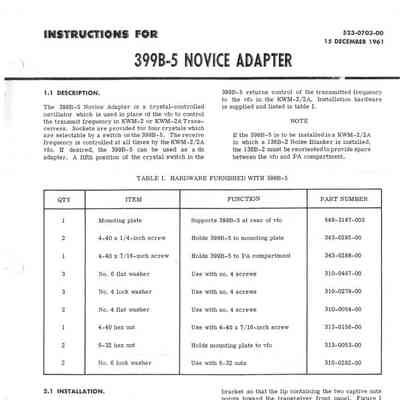
The Collins 399B-5 Novice Adapter is a specialized accessory designed by Collins Radio Company, and engineered specifically for use with the KWM-2 and KWM-2A HF transceivers to comply with FCC regulations of the era regarding entry-level ("Novice class") amateur radio operators.
A nearly identical sibling unit, the 399B-4, was produced with a slightly different physical configuration to mount inside the 32S-1 and 32S-3 series transmitters.
During the 1950s and 1960s, the FCC required Novice class operators to use crystal-controlled transmitters to ensure strict frequency stability and prevent beginner operators from inadvertently drifting outside their designated, narrow band segments.
Because high-end gear like the Collins KWM-2 featured a VFO, it could not legally be used by a Novice for transmitting without modification. The 399B-5 bypassed the VFO during transmission, substituting crystal control to satisfy the FCC rule, while still allowing the operator to enjoy the premium performance of a Collins station.
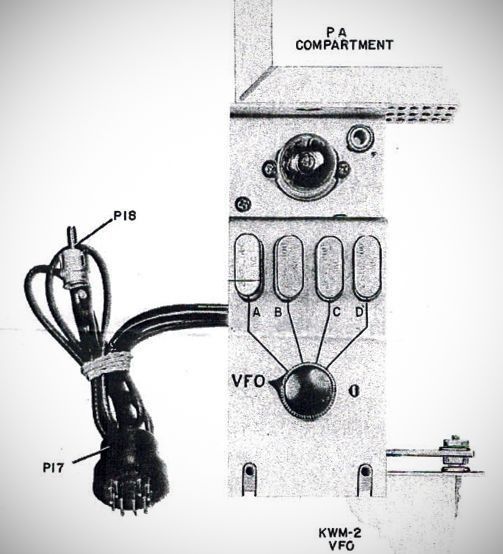
The unit is built on a compact, small chassis designed to mount directly inside the KWM-2 cabinet, attaching via a mounting plate to the rear of the VFO bracket near the Power Amplifier (PA) compartment.
Interconnections: It connects to the transceiver chassis via an octal/molded plug into the `J17` (VFO EXT POWER) jack, routing power to the adapter and switching the injection lines. A separate coaxial cable handles the RF injection.
Calculating Crystal Frequencies
To calculate the crystal frequency required for a specific transmitter output frequency, subtract from 2700 kilocycles the dial reading in kilocycles for that output frequency. For example, if the desired output frequency is 3730 kHz, the bandswitch is set to 3.6 MHz and the dial to 130 kHz. The dial reading, 130 kHz, subtracted from 2700 kHz equals 2570 kHz which is the required crystal frequency.
To calculate the transmitter output frequency on each band for a specific crystal in the 2500 to 2700 kHz total range, subtract the crystal frequency from 2700 kHz. This gives the dial reading which added to the bandswitch setting gives the transmitter output frequency. For example, the dial reading for a 2585 kHz crystal is 115 kHz. The transmitter output frequency for a bandswitch setting of 3.6 MHz is 3.715 MHz. The corresponding output frequency for a bandswitch setting of 21.0 MHz is 21.115 MHz. If desired, each crystal used can be marked with the appropriate dial reading to be added to the band-switch setting. This will serve as a convenient reference for determining output frequency on each of the various bands. For operation outside the normal amateur bands, refer to general coverage instructions in the KWM-2/2A Instruction Book.
Note that the 399B-5 controls only the transmit frequency.
When a crystal position is selected:
– The transmit frequency is locked to the crystal.
– The receive frequency remains fully controllable by the KWM-2's main VFO dial.
Because of this independent control, the 399B-5 found a second life among higher-class operators as a budget DX adapter. It allowed a station to listen for rare foreign DX stations on one frequency using the VFO, while transmitting on a completely different frequency ("working split") via the crystal, without needing the large, external 312B-5 VFO/Speaker console.
Because the KWM-2 was a very expensive transceiver, relatively few Novices bought them new, making the 399B-5 a scarce accessory during its production run. Today, it is a highly prized item for vintage gear collectors and Collins historical purists looking to complete a fully optioned "S-Line" era station.