Note
It is possible that no other radio company has been studied with the fervor of that applied to Collins.
Few names in the history of technology evoke the kind of reverence, borderline mysticism, and absolute devotion that surrounds the Collins Radio Company.
For historians, collectors, and radio amateurs, Collins isn’t just about vintage electronics—it’s an exploration of an era where engineering achieved something akin to art.
The fervor behind the Collins mystique comes down to a few factors.
1. The Mythos of Arthur Collins
Every great legendary brand has a visionary at its center. Arthur Collins was a perfectionist obsessed with quality, signal purity, and rock-solid stability.
He gained national attention as a teenager in 1925 when he was the only radio operator capable of maintaining consistent communication with the MacMillan Arctic Expedition using his homebuilt shortwave gear.
When he founded the company in Cedar Rapids, Iowa, in 1933, that uncompromising standard became the corporate DNA. Arthur didn't care about cutting corners to maximize profit; he cared about building the absolute best radios on Earth.
2. Uncompromising, "Mil-Spec" Engineering
Long before "mil-spec" became a cheap marketing buzzword, Collins defined it.
Walking into the Cedar Rapids factory was famously like entering a surgical suite. The internal construction of a Collins rig is a masterclass in industrial design:
– The S-Line and KWM Series: They introduced the concept of the clean, compact, modular desktop station.
– Mechanical Excellence: Tuning a Collins PTO (Permeability Tuned Oscillator) feels like operating a fine Swiss watch. The dials are perfectly linear, smooth, and completely free of the slop or backlash common in competitor rigs.
– Pride in Construction: If you flip over a 75A-4 or a KWM-2, the under-chassis wiring looks like a work of modern textile art. Wires were perfectly bundled, laced with waxed twine, and bent at crisp 90-degree angles. These details speak volumes about the pride taken in quality construction.
3. Groundbreaking Innovation (The Mechanical Filter)
Collins didn't just build radios better; they advanced the science of communications. The most famous example may be the Collins Mechanical Filter.
Instead of relying solely on standard LC (inductor-capacitor) circuits which had broad, sloppy performance, Collins engineers figured out how to convert an electrical IF (intermediate frequency) signal into physical, mechanical vibrations through a series of precisely machined metal discs. This gave their receivers incredibly steep, "brick-wall" selectivity curves. It allowed operators to slice through heavy adjacent-channel interference with ease, fundamentally altering the viability of voice communications.
4. Where History Was Made
People study Collins because to study Collins is to study the defining moments of the 20th century. The company’s gear was the unseen backbone of global history:
– Aviation: Collins revolutionized commercial aviation, becoming the standard navigation and communication hardware for major airlines.
– Strategic Defense: General Curtis LeMay mandated Collins SSB equipment for the Strategic Air Command (SAC) aircraft, knowing that if a crisis hit, the commands absolutely had to get through.
– The Space Race: When John Glenn orbited the Earth in Friendship 7, when the Gemini astronauts rendezvoused in space, and when Neil Armstrong spoke to Houston from the Moon—every single syllable, bit of telemetry, and television signal was carried by a Collins radio system.
Collectors and historians look at a piece of Collins gear and see the high-water mark of American industrial manufacturing. It represents a brief, golden window in time where a company fiercely refused to compromise on quality, creating hardware so robust and stable that much of it still meets or exceeds its original factory specifications more than a half-century later.
—————————-
Book Review and Abstract
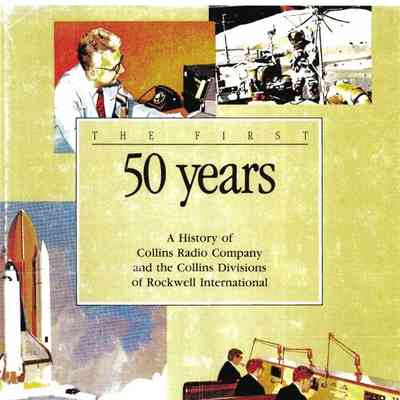
Title: The First 50 Years: A History of Collins Radio Company and the Collins Divisions of Rockwell International
Author: Ken C. Braband (with excerpts from articles by Dr. R.L. Carrel, Arlo Goodyear, Tony Huebsch, Gerald Ozburn, Horst Schweighofer, John Staehle, and Ben Stearns)
Publisher: Communications Department, Avionics Group, Rockwell International, Cedar Rapids, Iowa (1983)
Abstract
This corporate history chronicles the first half-century of the Collins Radio Company, from its genesis as a basement hobby in 1931 to its evolution into a massive aerospace and electronics division under Rockwell International. Founded by prodigy Arthur Andrew Collins in Cedar Rapids, Iowa, the company established an industry-wide reputation for high-quality, precisely engineered radio transmitters and aviation electronics.
The text details the company's critical technical contributions to historical events—such as Admiral Richard E. Byrd's Antarctic expeditions—and its vital manufacturing role as a premier military contractor during World War II and the Korean Conflict. Through proprietary innovations like the Autotune® mechanism and the Horizontal Situation Indicator (HSI), Collins Radio transformed amateur radio, commercial broadcasting, military communications, and civil avionics.
Key Historical Themes & Corporate Evolution
1. The Genius of Arthur Collins and Early Success
– A Young Virtuoso: As a 15-year-old amateur radio operator (station 9CXX) in 1925, Arthur Collins achieved national acclaim by maintaining clear, daily shortwave code contact with the MacMillan Arctic Expedition (including Lt. Cdr. Richard E. Byrd) at Etah, Greenland, outperforming the U.S. Navy's own land stations.
– Up from the Cellar: During the Great Depression in 1931, a 23-year-old Collins commercialized his hobby, building custom transmitters in his basement. He revolutionized amateur radio by clean-packaging components into neat, predictable, and functional units, effectively moving ham radio equipment out of basements and into family living rooms. The company officially incorporated in Delaware in September 1933.
–The Antarctic Breakthrough: In 1933, Rear Admiral Byrd selected Collins Radio to supply the communication link for his second South Pole expedition. Utilizing Class B modulation, a one-kilowatt Collins Type 20B transmitter successfully broadcasted human voices , sled-dog barks, and flagship whistles 10,000 miles back to the United States for the CBS network. This global performance triggered a massive boom in commercial and amateur orders.
2. The Autotune® and Entry into Aviation
– The Innovation: Conceived during a commercial flight from Mexico City in 1935, Arthur Collins envisioned combining mechanical engineering with electronics to solve the tedious process of manual radio re-tuning.
– Aviation Impact: The resulting invention, the Autotune®, allowed pilots to instantly switch between ten pre-set radio frequencies via a remote dialing system. Braniff Airways became the first airline to equip its entire fleet with Collins Autotune radios, followed by American Airlines, firmly embedding Collins into the civil aviation market.
3. The World War II War Effort
– The AN/ART-13: Winning a rigorous Navy competition in 1940, the Collins AN/ART-13 became the flagship military airborne transmitter of WWII. Armed with the Autotune mechanism, it allowed pilots to shift frequencies in 15 seconds, rendering enemy jamming attempts largely ineffective and saving countless allied lives. Collins produced 26,000 units, with total allied production exceeding 90,000.
–Mass Production: Collins mass-produced over 35,000 "TCS" rugged transmitter-receivers for PT boats and jeeps. Notably, a low-powered Collins TCC transmitter buried in the tunnels of Corregidor served as the United States' lone communication link to Honolulu during the early, tragic days of the Pacific war with Japan.
– Homefront Growth: Employment skyrocketed to a wartime peak of 3,332 by July 1945, transforming Collins into the largest war plant in Cedar Rapids. Women comprised over half the assembly line workforce by 1944. Collective bargaining also materialized during this era, with the I.B.E.W. Local 1362 organizing the workers in 1943.
4. Post-War Restructuring and Avionics Leadership
– Navigating Peace: The sudden cancellation of WWII contracts forced massive layoffs and several years of net losses as the company aggressively retooled for commercial markets.
– The UHF Revolution: Anticipating military needs, Collins prioritized the unexplored Ultra-High Frequency (UHF) band while competitors focused on consumer televisions. This gamble paid off when the unified Department of Defense selected the Collins ARC-27 transceiver as the standard military airborne radio, generating tens of millions in revenue during the Korean conflict.
– Integrated Flight Systems: Collins pioneered modern flight safety by creating the Integrated Flight System in 1950. It introduced the Horizontal Situation Indicator (HSI)—invented by Arthur Collins and Horst Schweighofer—which superimposed a course deviation bar onto a compass card. This condensed five separate cockpit instruments into two, laying the foundation for modern flight directors and autopilots used across commercial transport.
Review
Ken C. Braband’s work serves as an enlightening, deeply researched corporate biography that balances technical breakthroughs with compelling human-interest anecdotes. The text portrays Arthur Collins not merely as a corporate executive, but as a genuine scientific visionary who prioritized engineering excellence and uncompromising quality above rapid commercial profit. The narrative effectively captures the high-stakes legal battles—such as employing rocket pioneer Dr. Robert Goddard's 1915 vacuum tube patent to successfully break an aggressive manufacturing blockade by industry giants RCA and AT&T.
While highly celebratory of the company's triumphs, the text provides an authentic look at the chaotic realities of wartime production expansion, component shortages, post-war labor movements, and the stark financial vulnerabilities brought on by steep research and development costs. It stands as a vital record of mid-20th-century American industrial ingenuity, illustrating how a humble Iowa radio hobby shop fundamentally altered the landscape of global aviation and military communications.
———————————-
Abstract
The Collins Radio Company: Ingredients of Success, by F. Parker Heinemann, W1YG
This paper examines the formative years of Arthur Andrews Collins and the early trajectory of his eponymous company from 1920 through 1933. The paper explores how a combination of Collins' innate technical genius, familial financial backing, and pivotal historical milestones propelled a modest basement operation into a world-renowned electronic giant.
Key elements detailed in the historical analysis include:
– Early Breakthroughs: Arthur Collins' early immersion in amateur radio, culminating in his landmark achievement at age 15 when he served as the sole communication link for the 1925 MacMillan Arctic Expedition.
– Technological Shift: The broader transition of the amateur radio art from unstable spark transmitters to precise, crystal-controlled continuous-wave (CW) systems.
– Corporate Genesis: The official founding of the Collins Radio Company in Cedar Rapids, Iowa, amidst the economic challenges of the Great Depression.
– The Catalyst for Fame: The production lineage of early Collins transmitters (including the 10A, 30W, 150B, and 20B) and the critical decision by Rear Admiral Richard Byrd to deploy Collins equipment for voice telephony on his Second Antarctic Expedition.
The paper concludes by showing how the triumph of broadcasting live from the South Pole captured global attention, securing the company's future prominence in civil, military, and commercial aviation markets.
----------------------------
These are just research notes. Pay no attention.
QST, Sep 1974, p. 2. (announcement of merger with Rockwell)
QST, May 1975, p. 2. (S/Line ad)
QST, Jul 1975, p. 2. (51S-1)
QST, Sep 1975, p. 2. (KWM-2A)
QST, Oct 1975, p. 2. (51S-1)
QST, Nov 1975, p. 2. (KWM-2A)
QST, Dec 1975, p. 2. (KWM-2A)
QST, Jan 1976, p. 2. (KWM-2A / 27,000 sold)
QST, Feb 1976, p. 2. (generic)
QST, Mar 1976, p. 2. (KWM-2A / 27,000 sold)
QST, Apr 1976, p. 2. (KWM-2A, 75S-3C, 32S-3A, 516F-2)
QST, May 1976, p. 2. (KWM-2A / 27,000 sold)
QST, Jun 1976, p. 2. (KWM-2A, 75S-3C, 32S-3A, 516F-2)
QST, Jul 1976, p. 2. (KWM-2A / 27,000 sold)
QST, Aug 1976, p. 2. (KWM-2A, 75S-3C, 32S-3A, 516F-2)
QST, Sep 1976, p. 2. (KWM-2A / 27,000 sold)
QST, Oct 1976, p. 2. (KWM-2A, 75S-3C, 32S-3A, 516F-2)
QST, Feb 1977, p. 117. (KWM-2A, 75S-3C, 32S-3A, 516F-2)
QST, Apr 1977, p. 163. (KWM-2A, 75S-3C, 32S-3A, 516F-2)
QST, May 1977, p. 126. (KWM-2A, 75S-3C, 32S-3A, 516F-2)
QST, Jul 1977, p. 121. (KWM-2A, 75S-3C, 32S-3A, 516F-2)
QST, Oct 1977, p. 137. (KWM-2A, 75S-3C, 32S-3A, 516F-2)