Note
Ham Radio, Sep 1974, p. 97.
QST, Mar 1976, p. 112.
QST, Jun 1976, p. 151.
QST, Apr 1977, p. 168.
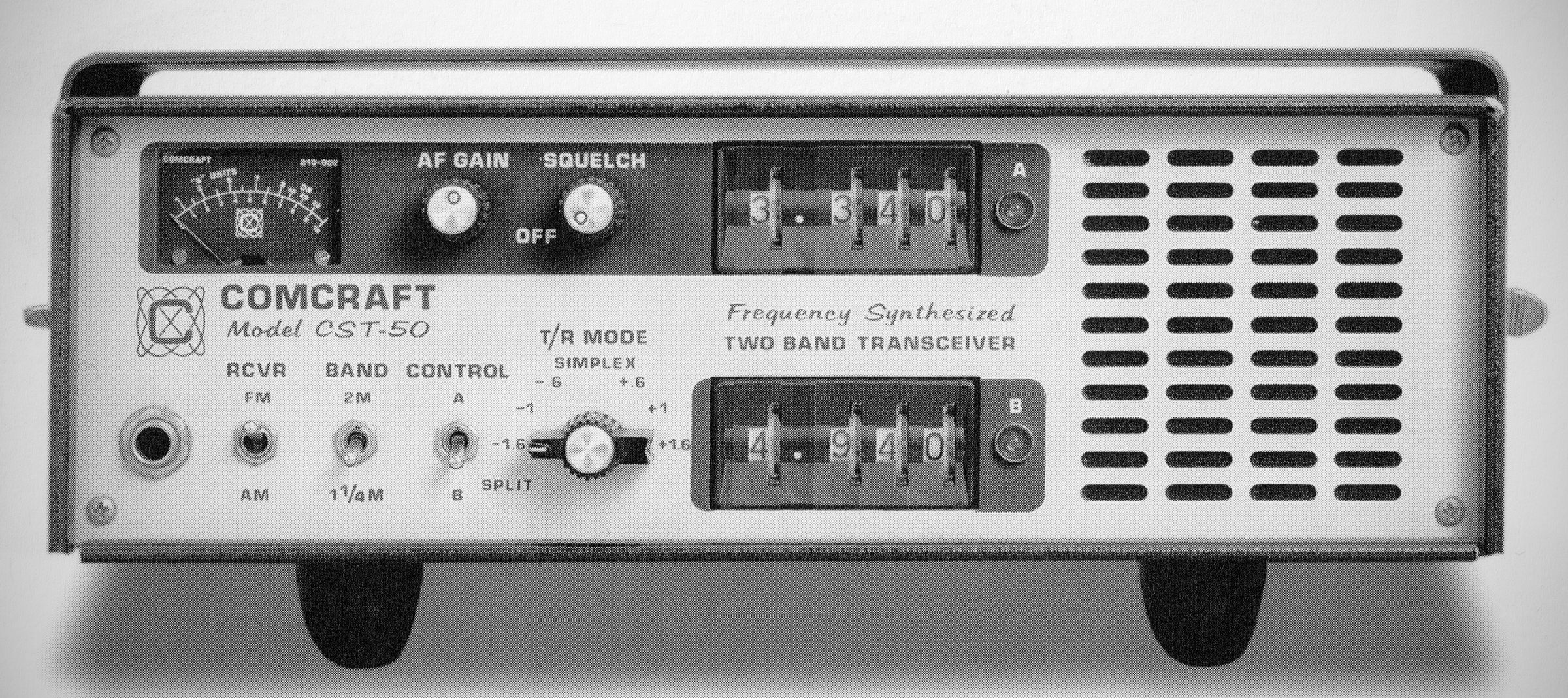
Comcraft's two-band transceiver provided complete coverage of the 144 and 220 MHz ham bands. The repeater offsets were 600kHz, 1 MHz, and 1.6 MHz. The CST-50's synthesizer tuned in 5 kHz steps. Output power on both bands was 25 watts.
Frequency coverage on the 220 band is from 220 to 225 MHz while on two
meters it i s from 142 to 149.995 MHz (to cover most MARS, CAP and CD
frequencies). The frequency synthesizeris a digital type using programmable dividers and phase-locked loops to generate the desired frequencies by reference to a single 5-MHz crystal. Two thumbwheel sets are provided for setting up either transmit and receive frequencies for non-standard repeaters or two separate repeaters when standard offsets are in use.
Additional features of the CST-50 include the use of an eight-pole
10.7-MHz crystal filter in the receiver; transmitter coverage of both bands without retuning; illuminated thumbwheel switches for night mobile work; PTT mike and mobile mount; and construction using epoxy-glass PC boards and vinyl-clad outer cabinet.
– Covers entire 2 meter and 220 MHz bands
– Covers MARS, CAP and CD frequencies from 142 to 149.995 MHz
– Full digital frequency synthesis with 5 kHz steps
– Lighted thumbwheels for night mobile operation
– Built-in repeater offsets of 600 kHz, 1 MHz and 1.6 MHz
– 25 watts output on each band
– No transmitter retuning across either band
– FM-AM receiver
– 8 pole crystal filter
– Front mounted speaker
– PTT microphone and mobile mount included
– Operates on 12 volts DC
– AC supply available
– Accessory connector for tone burst and tone coded squelch