Note
CQ, Apr 1963, p. 80.
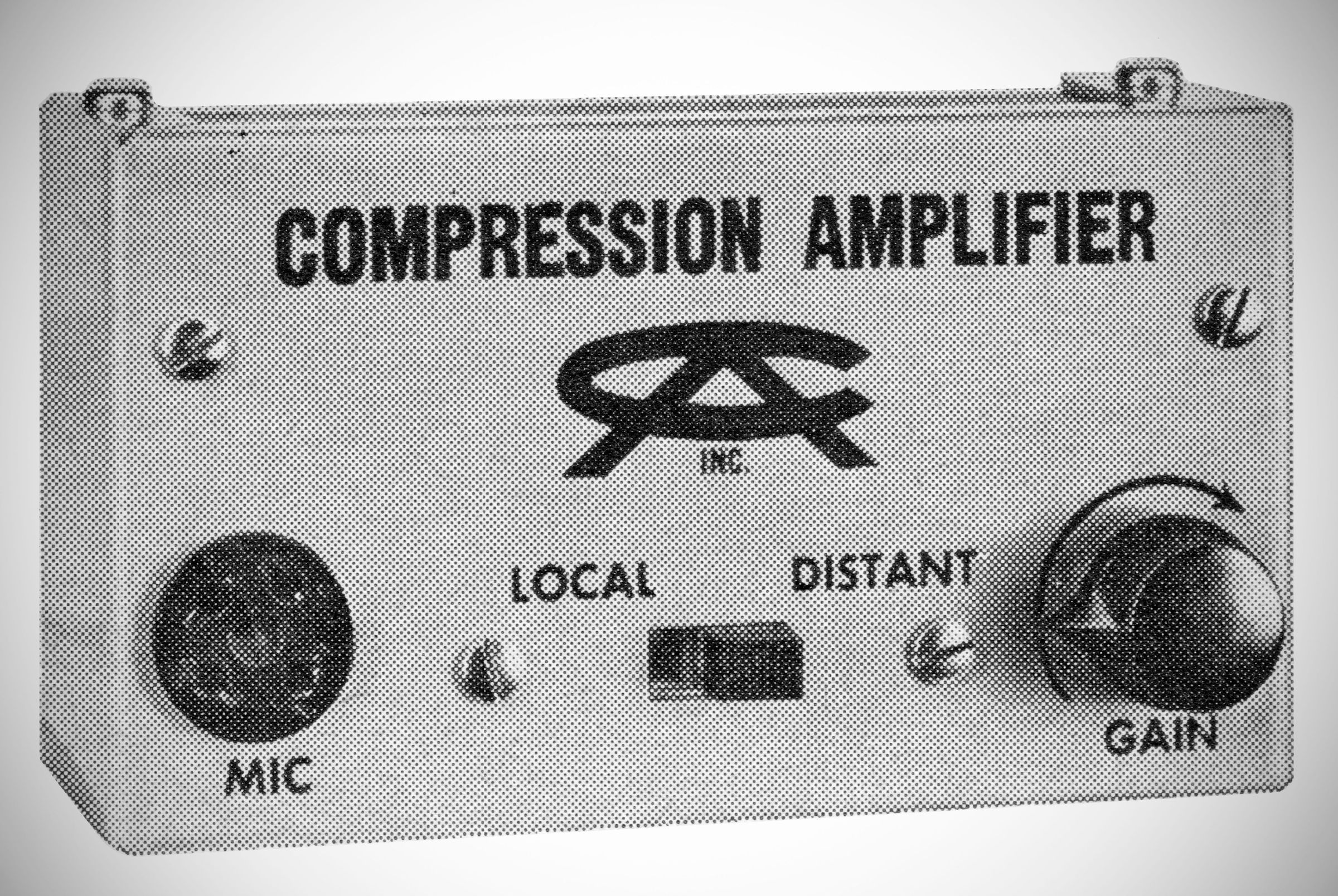
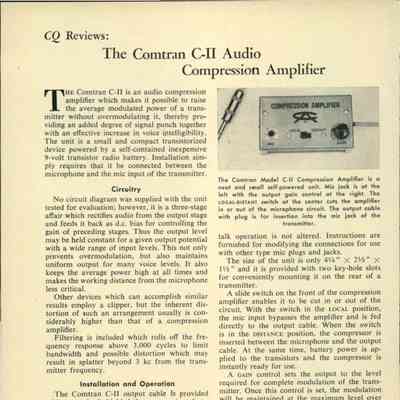
The Comtran Model C-II (or C-11) is a self-powered, transistorized audio compression amplifier designed for amateur radio use. Inserted directly between a microphone and a transmitter's mic input, it raises the average modulated power (talk power) without overmodulating the transmitter. This boosts voice intelligibility and signal punch, making it particularly useful under adverse band conditions or for power-limited mobile operations.
The C-II utilizes a three-stage transistor circuit built on a small printed circuit board. Audio is rectified from the output stage and fed back as DC bias to control the gain of the preceding stages. This keeps the output level constant across a wide variation of voice-input levels, avoiding the high distortion typical of peak clippers.
The unit includes built-in filtering that rolls off frequency response above 3,000 Hz to prevent off-frequency splatter. It also exhibits a noticeable attenuation in low-frequency response, which aids voice punch and clarity at the expense of some natural voice tone.
It is powered independently by an internal 9-volt transistor radio battery.
Features a standard 3-way microphone jack, a rotary output GAIN control, and a LOCAL/DISTANT slide switch.
In the LOCAL position, the microphone bypasses the circuit entirely and connects straight through to the transmitter. Switching to DISTANT engages the compression circuit and applies battery power to the transistors.
On-the-air tests using AM and SSB showed an increase in average talk power between 50% and 75% for a given peak modulation level.
Distortion: Low overall harmonic distortion—measured at 4% at 400 Hz, 1.4% at 1,000 Hz, and 0.85% at 2,000 Hz.
Holds output regulation within roughly 2 dB across a broad range of input levels, though the initial attack transient overshoots by about 6 dB before the compressor response engages.
References
Review, CQ, Jan 1964, p. 38.