Note
Ham Radio, Jun 1970, p. 27.
Ham Radio, Dec 1970, p. 66.
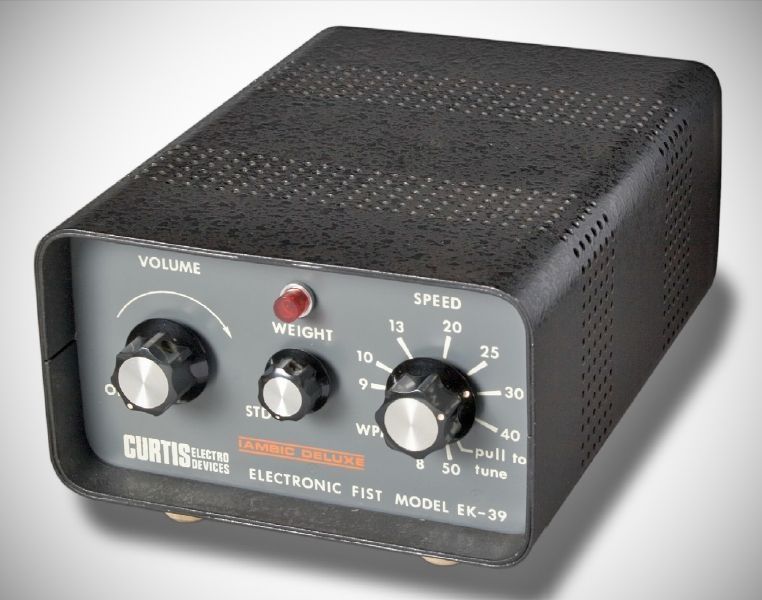
The Curtis EK-39 “Electronic Fist” iambic keyer had an internal AC supply and self-completing dots and dashes. A rear-panel switch selected either transistor- or reed-relay keying. An “M” version had a message memory in the form of a factory-programmed ROM IC.
In December 1970 announced an advanced integrated-circuit keyer that
incorporates an automatic identification message generator in addition to the basic Electronic-Fist circuitry.
In this new keyer, called the Mnemonic, a custom IC ROM
provides permanent memory to generate repetitive calls, especiallu useful in contest operations.
For example, the operator might select any one of the three sequences
below from a single ROM :
1 . C Q C Q D E W l D T Y K
2. CQ F D CQ F D D E W l D T Y K
3. D E W1 D T Y K
Three auto-stop selections allow continuous cycling or a choice of two stopping points. The message can be transmitted once, continuously, or every ten seconds.
In the manual mode the keyer provides 8 to 50-wpm paddle or squeeze
keying with dot memory, independent weight control and iambic character
generation. A tap on the straight key of a Brown Brothers CTL combination key (or external push button ) initiates the automatic program at the exact speed and weight used by the operator in the manual mode. At 20 wpm a full message sequence takes 15 seconds. The sequence terminates either automatically or by a tap on the dash paddle.
The Mnemonic keyer will operate both
grid-block and cathode keyed transmitters. Power supply, CW monitor and
speaker are built-in.
References
Brief description. Ham Radio, Aug 1970, p. 76.