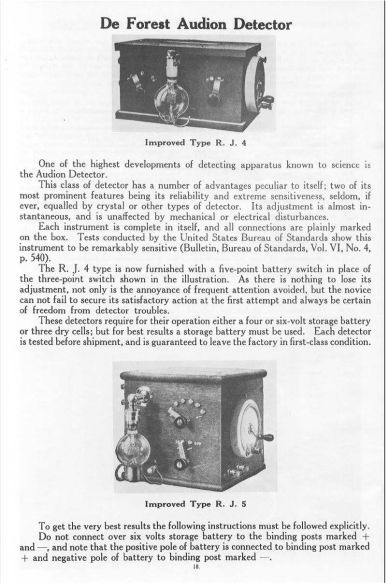
The De Forest Audion Detector (specifically models like the R.J.4 and R.J.5, where "R.J." stands for "Radio Junior") is historically recognized as one of the first vacuum tube radio detector units ever manufactured for general commercial and amateur use. Highly popular with radio amateurs in the early 1910s, these units are considered incredibly rare and significant collector's items today.
Here is a breakdown of its features, operation, and design based on the historical documentation provided by the Antique Wireless Association (AWA):
Key Features and Advantages
High Sensitivity: At the time of its release, it offered extreme sensitiveness and reliability that was seldom, if ever, equaled by crystal or other contemporary detector types.
Stable Adjustment: Its adjustment was almost instantaneous and completely unaffected by mechanical vibrations or electrical disturbances.
The Audion Bulb: The unit utilized a spherical Audion vacuum tube containing a "grid" (a zigzag wire) and a "wing" (the plate). Each bulb was built with two distinct filaments; if one burned out, the second could be connected to double the operating life of the bulb.
Technical Design & Operation
The Enclosure: For a layman, a unit like the R.J.4 was essentially a specialized wooden box designed to house the batteries, a filament rheostat, control switches, and the tube socket. It did not include an RF section, meaning the operator had to provide their own external tuning transformer/section.
Power Requirements: The detector required either a 4- or 6-volt storage battery or three dry cells to operate, though a storage battery was heavily recommended for optimum performance.
Controls: It utilized a rheostat to adjust the filament to normal brightness, alongside multi-point battery switches (a 5-point switch on the improved R.J.4 and a 6-point switch on the R.J.5) to fine-tune the voltage and eliminate any blue glow/gas ionization inside the bulb that could decrease sensitivity.