De Forest Unit Receiving Set
Object/Artifact

-

Radio Alpha

AWA Old Timer's Bulletin Vol 31 No 1 1990. Courtesy Antique Wireless Association

AWA Old Timer's Bulletin Vol 31 No 1 1990. Courtesy Antique Wireless Association

Name/Title

De Forest "Unit Receiving Set"

Description

MF / VLF Receiver

Category

Receiver, MF, Receiver, LF/VLF, VLF

Made/Created

Manufacturer

De Forest

Date made

1920

General Notes

Note

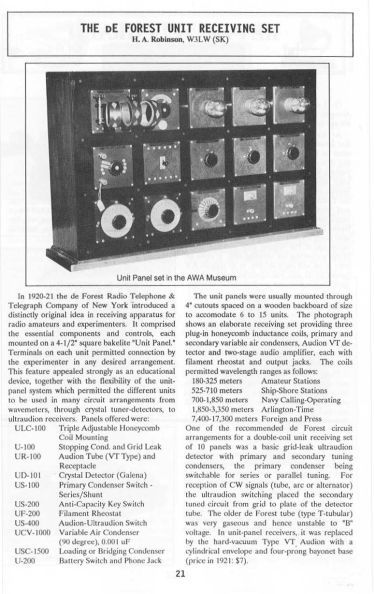
The De Forest Unit Receiving Set, introduced by the de Forest Radio Telephone & Telegraph Company of New York around 1920–1921, was a highly flexible, modular apparatus designed for radio amateurs, experimenters, and educational use. Instead of a single, fixed-circuit chassis, the system broke a receiver down into its essential, individual components. Each individual component or control was mounted onto a square Bakelite panel measuring 4 1/2" on a side. These "Unit Panels" featured dedicated terminals, allowing the user to wire them together in any configuration they chose. This gave experimenters the freedom to build anything from simple crystal tuner-detectors and wavemeters to advanced ultraudion receivers. The individual panels were typically installed on a wooden backboard featuring 4-inch cutouts spaced to accommodate anywhere from 6 to 15 total units. The example shown in the photograph is an elaborate 15-panel configuration organized in a 3-by-5 grid inside a finished wooden cabinet. The system offered a comprehensive menu of specialized modular panels, including: ULC-100: A triple adjustable honeycomb coil mounting. U-100: A stopping condenser and grid leak. UR-100: An Audion tube receptacle designed for VT-type tubes. UD-101: A galena crystal detector. US-100: A primary condenser switch for toggling between series and shunt (parallel) tuning. US-200: An anti-capacity key switch. UF-200: A filament rheostat to regulate tube filament voltage. US-400: An Audion-Ultraudion switch. UCV-1000: A 90-degree variable air condenser ($0.001\ \mu\text{F}$). USC-1500: A loading or bridging condenser. U-200: A battery switch combined with a headphone jack. By utilizing different plug-in honeycomb inductance coils, the receiving set could cover a wide range of frequencies from approximately 17 kHz to 1600 kHz.