Note
QST, Jul 1961, p. 121.
CQ, Jan 1962, p. 17.
QST, Feb 1963, p. 115. (a few details)
QST, Dec 1963, p. 173.
QST, Nov 1964, p. 161.
QST, Jan 1965, p. 99. (optional LF converter 2-LF)
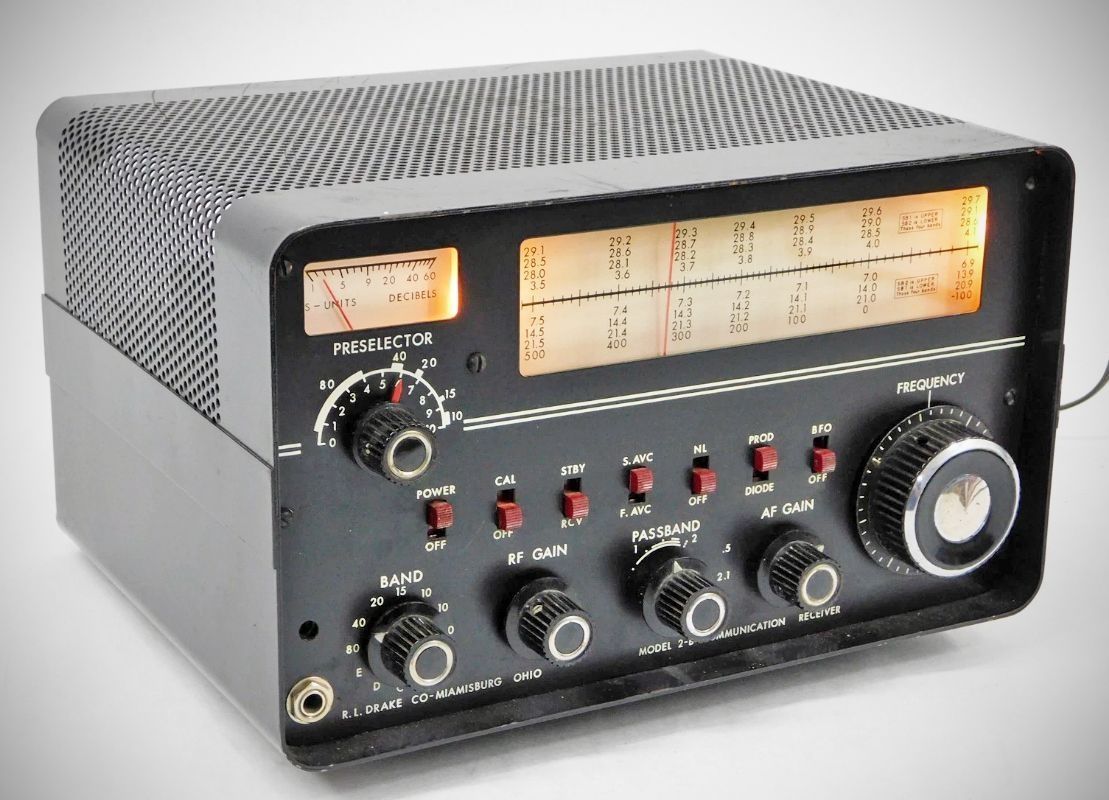
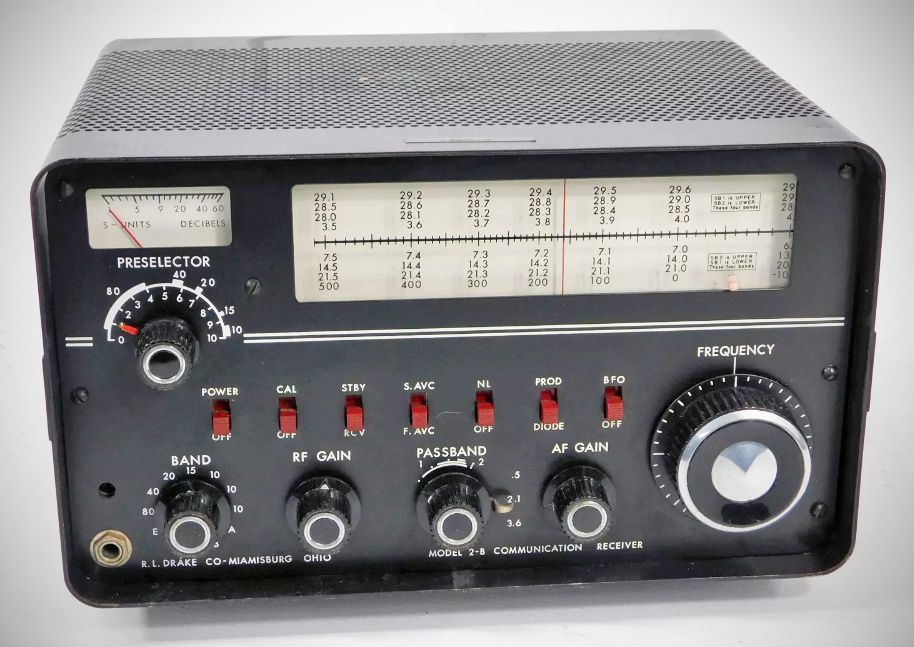
The 2-B built on the strengths of Drake's 2-A model. It offered selectivity in 0.5, 2.1, and 3.6 kHz steps and had an improved passband tuner. It covered 80-10 meters in seven 600kHz ranges. Five others could be used anywhere between 3.5 and 30 MHz with optional crystals.
Utilizing a 6U8 pentode as the first mixer drastically reduces internal tube noise, resulting in an exceptionally quiet receiver compared to conventional models.
The receiver's VFO achieves 90% of its frequency stability within the first 30 seconds of operation, eliminating the need for long warmup periods and showing no noticeable drift during sideband operation.
Advanced Selectivity (The Passband Control): The "heart" of the 2-B is its passband filter/tuner, which offers selectable bandwidths of 0.5 kc, 2.1 kc, and 3.6 kc. A concentric shaft allows operators to move the passband across the signal to easily separate crowded frequencies and isolate interference on CW, SSB, and AM.
The product detector operates via frequency conversion using a fixed BFO. It prevents strong off-frequency signals from capturing or blocking the detector, allowing users to operate at maximum RF gain while using only the audio gain to control volume.
Audio & AVC: Features adjustable "fast attack, slow decay" AVC settings and includes a low-pass filter to restrict high-frequency responses for better communication quality. While the audio fidelity is intentionally limited for better communications performance, the output is adequate for normal use.
Specifications
– Operating Range: Twelve 600 kHz segments can be selected between 3.5 and 30 MHz. The 2-B comes supplied with crystals for five amateur bands:
80 meters (3.5 – 4.1 MHz)
40 meters (6.9 – 7.5 MHz)
20 meters (13.9 – 14.5 MHz)
15 meters (20.9 – 21.5MHz)
10 meters (28.5 – 29.1 MHz)
– Modes: Selectable Single Sideband (SSB) with a product detector, Amplitude – Modulation (AM) with either a diode or product detector, and CW with either detector.
– Selectivity: Three independent switchable bandwidths measured at 6 db and 60 db down:
0.5 kHz at 6 db down / 2.75kHz at 60 db down
2.1 kHz at 6 db down / 7.5kHz at 60 db down
3.6 kHz at 6 db down / 10.5 kHz at 60 db down
– Sensitivity: Less than 0.5 microvolts for 10 db signal-to-noise ratio.
– Spurious Responses: Image rejection and IF rejection are both greater than 60 db on amateur ranges. Internal spurious signals within the amateur bands are less than the signal from a 1.0 uV antenna.
– Frequency Stability: Less than 400 Hz during warm-up; less than 100 Hz after warm-up; less than 100 Hz for a 10% change in line voltage.
– Dial Calibration: 10 kHz divisions on the main dial and approximately 1 kHz divisions on the vernier dial; both dials are adjustable for calibration.
– Automatic Volume Control (AVC): Amplified, delayed AVC featuring a choice of a 0.75 second} or 0.025 second discharge time, with a charge time of less than 100 microseconds.
– Audio Output: 1 watt maximum, and 2 watts at the AVC threshold.
– Audio Distortion: Less than 3% harmonic distortion and less than 0.5% intermodulation distortion.
Tube Complement
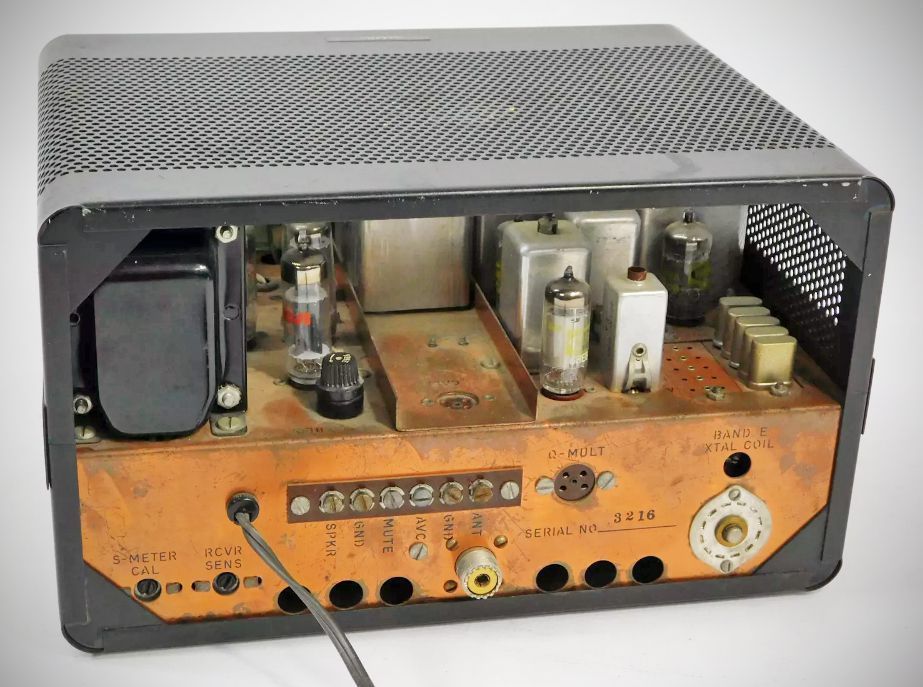
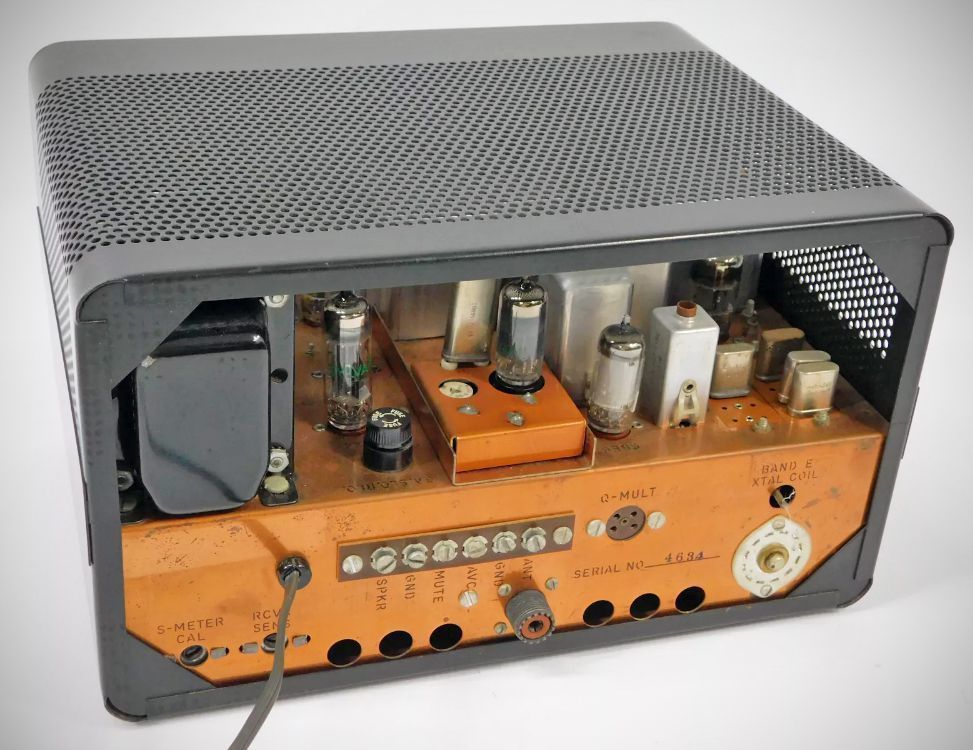
The receiver utilizes a 10-tube circuit configuration:
– 6BZ6 RF Amplifier
– 6U8 Crystal-controlled 1st Mixer & Oscillator
– 6BE6 VFO-controlled 2nd Converter
– 6BE6 Fixed-frequency 3rd Converter
– 6BA6 50 kHz IF Amplifier
– 6BE6 Product Detector and BFO
– 8BN8 1st Audio Amplifier, Bias Rectifier, and AM Noise Limiter
– 6AQ5 Audio Output Stage
– 6BF6 AVC Amplifier, Diode Detector, and AVC Rectifier
– 6X4 Full-wave Power Rectifier
Power Requirements: 120 VAC, 60 Hz, 40 watts
References
All Band Tuning. 73, Aug 1965, p. 26.
Slowing down the tuning rate. 73, Sep 1965, p. 44.
keyword: 2B