Note
QST, Nov 1975, p. 101.
QST, Sep 1976, p. 153. (good photo)
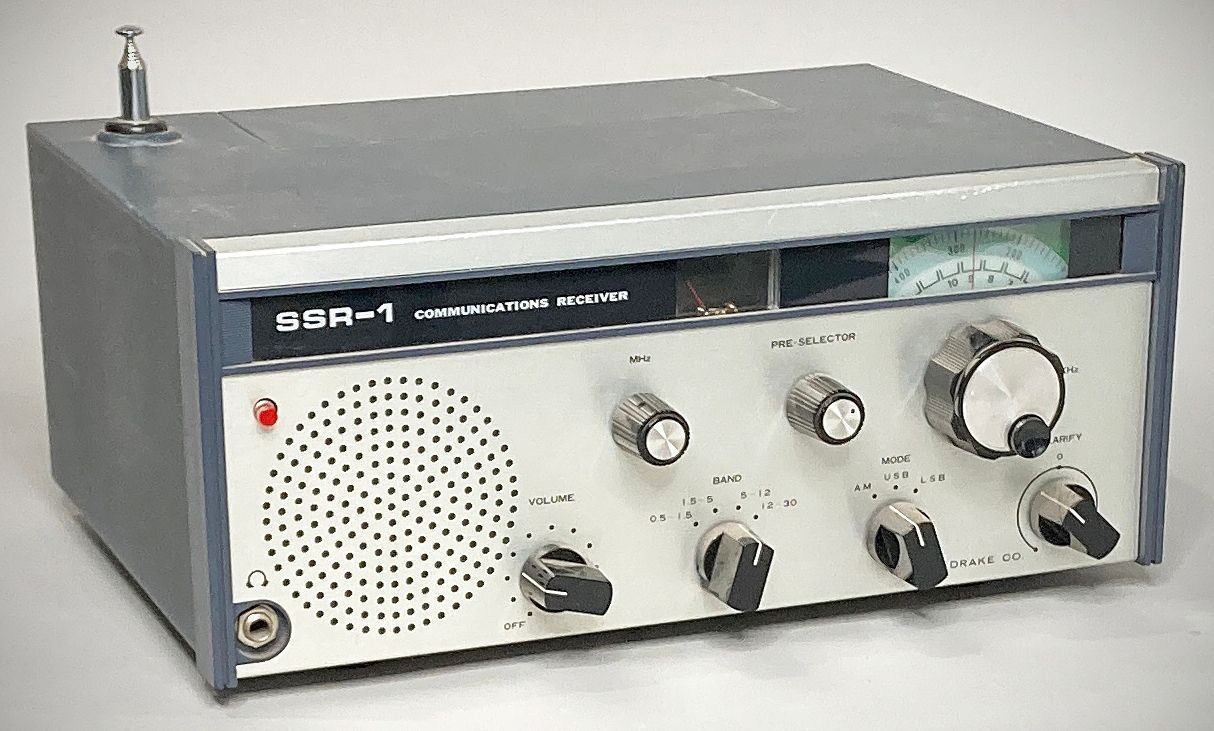
A compact, solid-state, portable general-coverage communications/SWL receiver imported from Japan by R.L. Drake. Power options include AC, internal batteries, or external DC with automatic changeover.
Features
– Frequency Coverage: Covers 500 kHz continuous to 30 MHz.
– Tuning System: Uses a synthesized first-mixer injection circuit (Wadley-loop style design) split into 30 one-megahertz ranges. It provides separate controls for the Megahertz range selection and Kilohertz fine bandspread tuning (calibrated down to 1 kHz).
– Oscillator Note: Employs a single 10 MHz crystal oscillator, resulting in unmodulated marker signals at 1 MHz multiples and minor "birdies" that can easily be tuned out using the MHz control or preselector.
– Modes & Detectors: Features separate detectors for AM and SSB/CW:
– AM: Diode detector paired with a 5.5 kHz filter.
– SSB / CW: Product detector paired with a 3 kHz filter.
– Clarifier Control: Includes a 3 kHz clarifier control that serves as a fine-tuning control for SSB/CW and helps reduce heterodynes on AM.
– Attenuator: Equipped with a selectable 20 dB pad to prevent cross-modulation from exceptionally strong local signals.
– Preselector: Features a front-panel preselector control to peak incoming signals for maximum sensitivity.
– Built-in Telescoping Antenna: Includes a built-in whip antenna, allowing standalone reception across the entire range without external wire antennas.
– Front Panel 8 ohm headphone jack and built-in front-panel speaker.
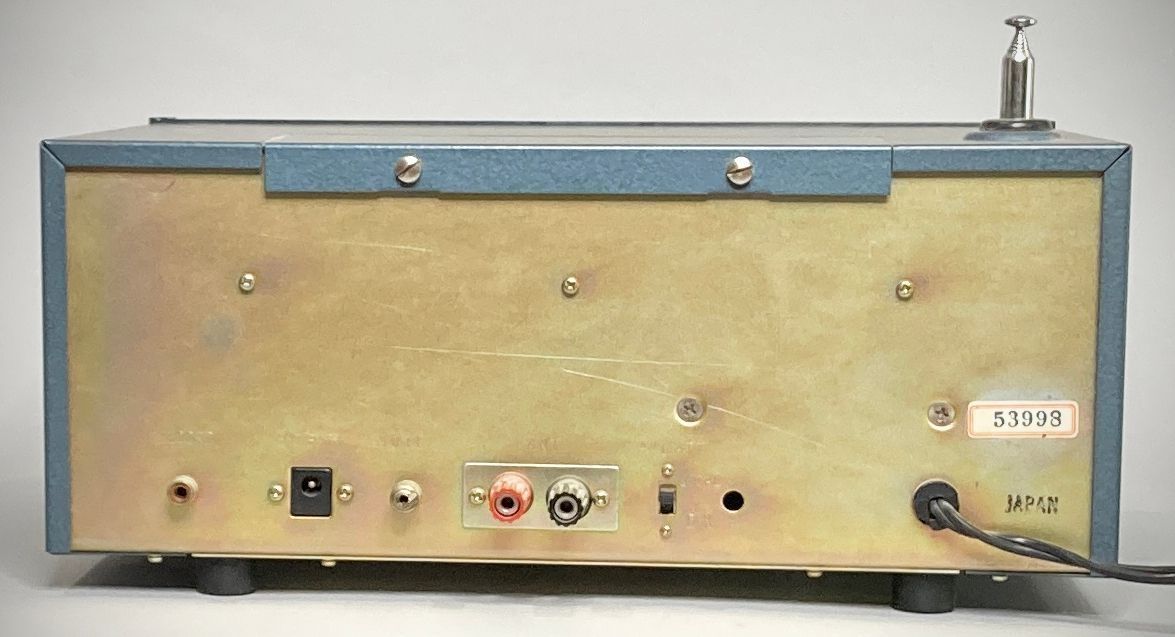
– Rear Apron Connections: Muting terminals (RCA jack) for pairing with a transmitter, and external 12 V DC input.
Specifications
– Frequency Coverage: 0.5 to 30 MHz in 30 ranges, each tunable over a 1 MHz range with a dial having 10 kHz graduations.
– Reception Modes: CW, USB, LSB, AM.
– Sensitivity: At least 10 dB S+N/N under the following conditions:
SSB (0.5–2 MHz): 1.0 µV
SSB (2–30 MHz): 0.3 µV
AM (0.5–2 MHz): 3.0 µV
AM (2–30 MHz): 1.0 µV *(AM: 1000 Hz @ 30% modulation)*
*(Note: These voltages are 1/2 the open circuit signal generator voltage, i.e., the voltage read on the meter of a HP Model 606 Generator.)*
– Output: Capable of 200 mW output on SSB at 2 MHz with input signal of 0.5 µV, and 2 Watts output with 5 µV input.
– Audio Distortion: Less than 5% @ 2 Watts.
– Calibration Accuracy: Within 5 kHz at all frequencies.
– Selectivity (-6 dB Bandwidth):
SSB: 3 kHz ±25%
AM: 5.5 kHz ±25%
– Image Rejection: Greater than 50 dB.
– IF Rejection:
Greater than 50 dB @ f_o below 20 MHz.
Greater than 40 dB @ f_o above 20 MHz.
– Antenna: Self-contained telescopic whip antenna. External connection to terminal strip (75 ohm input impedance unbalanced).
– Audio Output Provisions: Internal 8 Ohm speaker and phone jack on front panel that disables speaker when plugged in.
– Muting Provisions: External mute jack (RCA type) that provides normal reception with closed circuit and mute with open circuit connections.
Power Options:
– AC Power: Internal transformer tap-selectable for 117 V or 240 V AC mains.
– DC Power: Internal battery compartment accepting 8 'D' cell batteries. Automatically switches to DC if AC power drops out.
– External DC Input: Includes a 12 V DC jack on the rear apron for vehicle or boat operation via an optional cable.
– Power Consumption: Draws under 100 mA at 12 V DC.
– Lighting: Panel lights are disabled on DC to save battery power, but a front-panel pushbutton allows for momentary dial illumination
If the AC power source fails the unit switches automatically to the internal battery pack. For reduced current drain on DC operation the dials do not light up unless a red push button on the front panel is depressed.
References
Brief description. Popular Electronics, Sep 1975, p. 16.
Review. Popular Electronics, Jan 1977, p. 83.