Note
QST, May 1965, p. 147.
QST, Aug 1965, p. 102.
CQ, Apr 1967, p. 37.
QST, May 1968, p. 135.
QST, May 1970, back cover.
QST, Nov 1972, p. 127. 1972–1977 (TR-4C) $599.95
QST, Dec 1975, p. 149. (some details)
QST, Mar 1976, p. 113.
QST, Feb 1977, p. 157 (TR-4Cw, admitting that it is old, but...)
QST, Mar 1977, p. 93.
QST, Dec 1977, p. 155. (now with RIT)
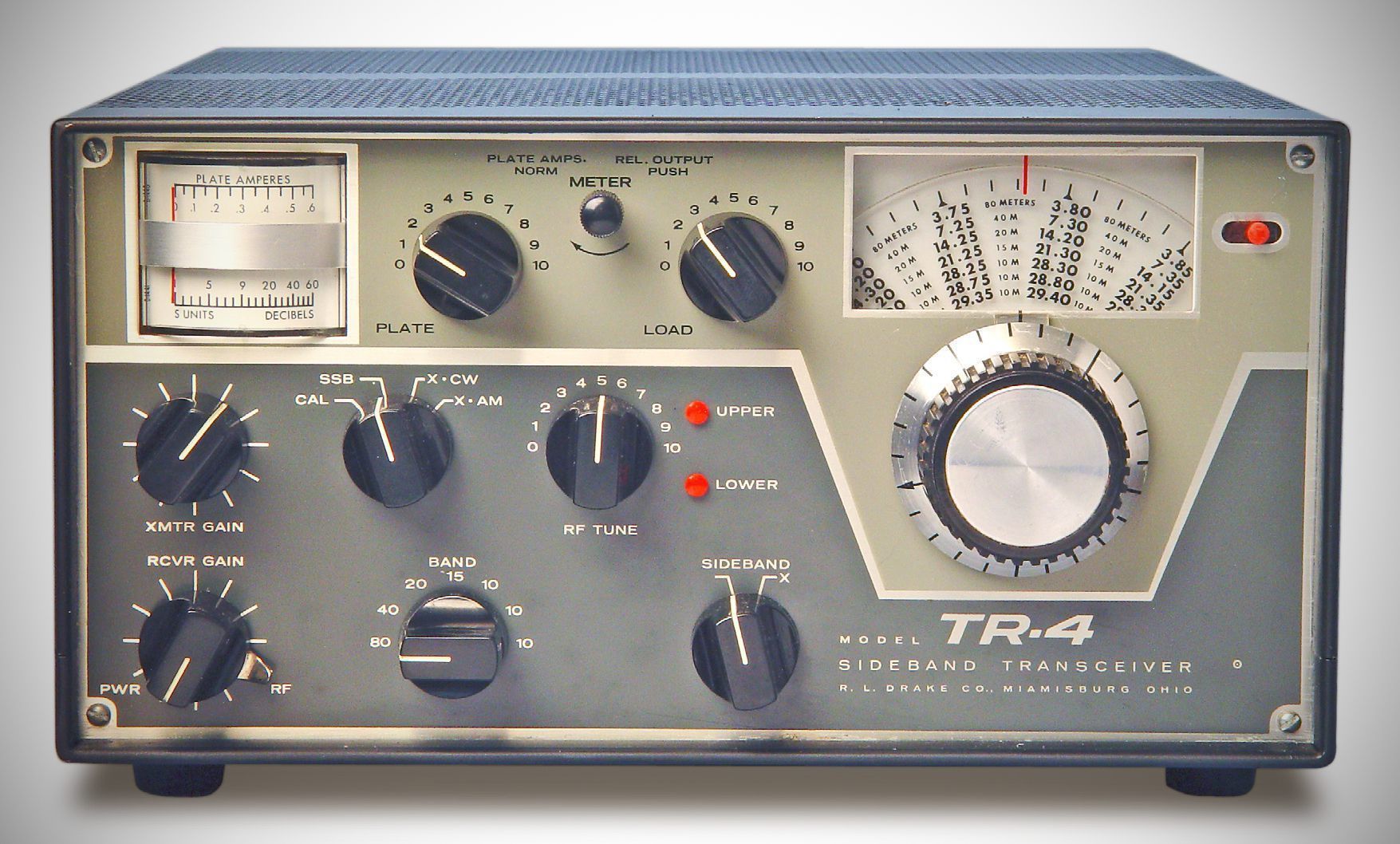
The Drake TR-4 transceiver had a solid-state PTO and used a pair of 9 MHz filters to permit upper and lower sideband selection without shifting oscillators. The TR-4 used three 6JB6s in the final amplifier. Power input was 300 watts PEP on SSB, and 260 watts on both CW and controlled-carrier AM. The transceiver provided full coverage of the 80-10 meter bands in seven 600 kHz ranges.
The TR-4 included the all features of Drake TR-3 and added:
– Solid State VFO with linear permeability tuning
– Automatic Transmit / Receive Switching on CW (semi break-in)
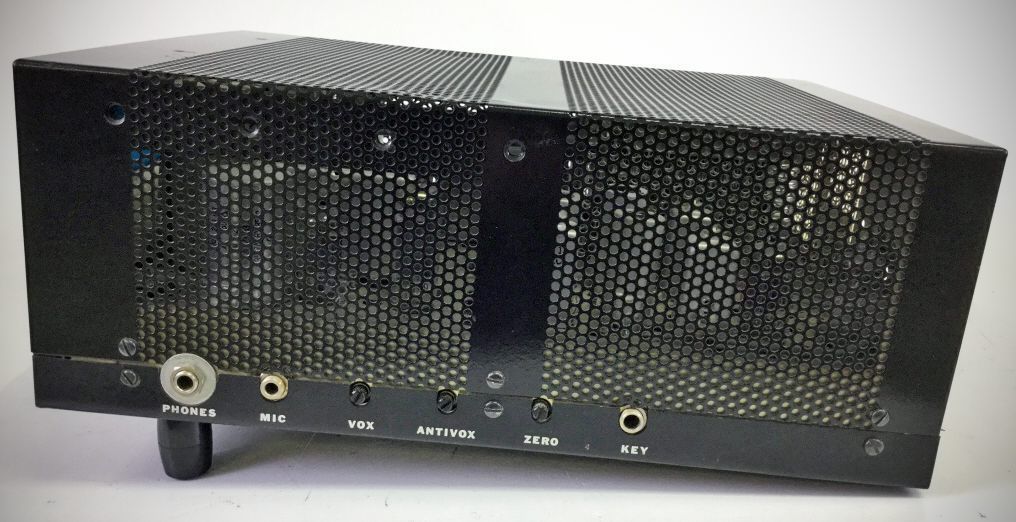
– CW Sidetone Oscillator built-in
– VOX or PTT on AM
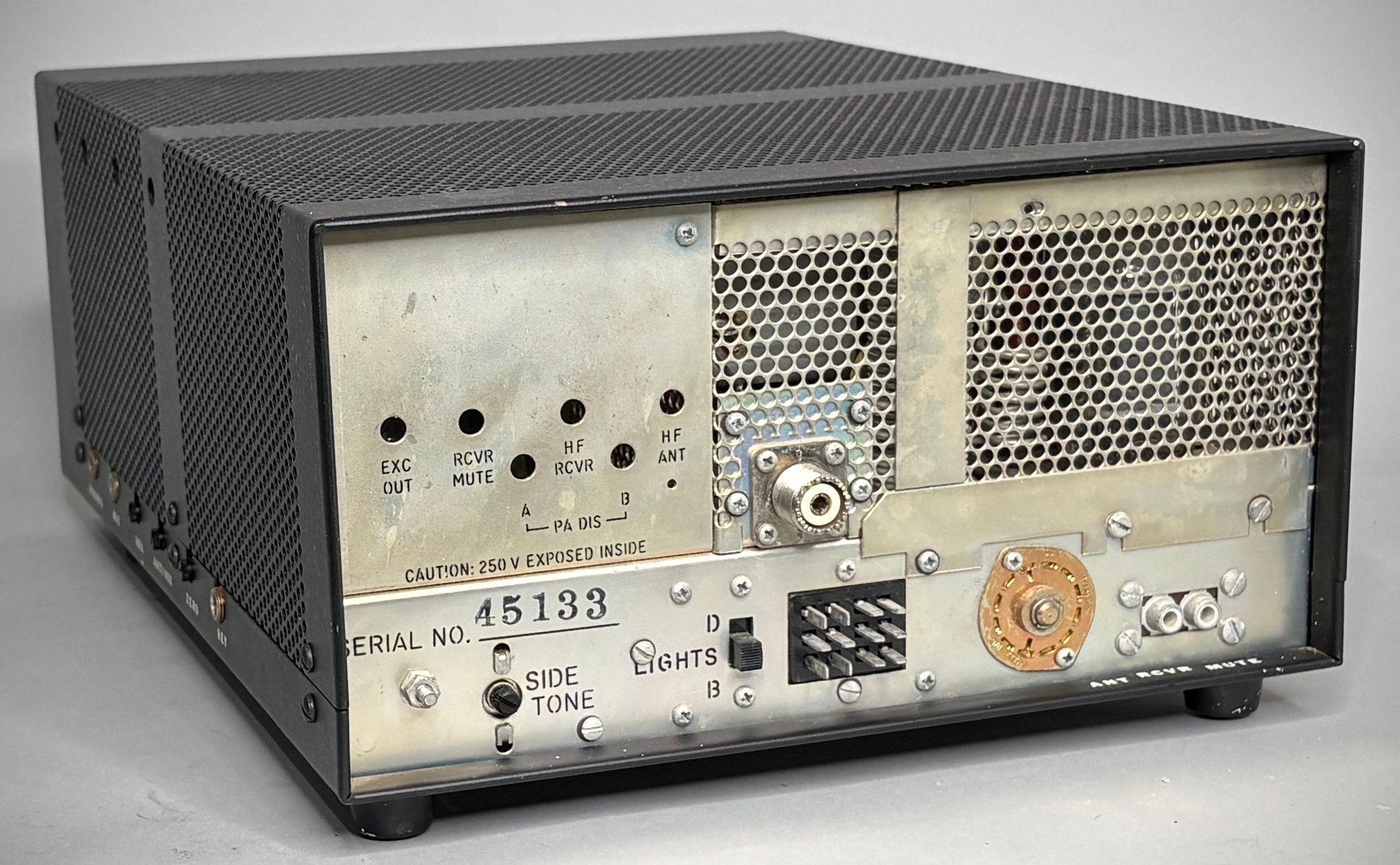
– Connections for External Receiver
– Diode Detector on AM
Starting around serial number 31320 (late in the original TR-4 run, and first advertised in the May 1970 issue of QST), Drake updated the TR-4 chassis to include a dedicated socket to accommodate the 34-PNB (where the "P" stands for Plug-in) noise blanker. Though advertising made it seem like the noise blanker was built-in, it was, in fact, and option. Only the socket was built-in. A front panel control (at lower left) as added to turn the noise blanker on and off.
⚠️ Note: A listing for the TR-4B in the Allied Radio catalog for 1969. p.203, is an error. There was no model TR-4B. The progression was from the TR-4 directly the the TR-4C.
Base Features
– Full Frequency Coverage on all amateur bands 10 through 80 meters. No additional crystals required.
– Upper and Lower Sideband on all bands.
– VOX or PTT built-in.
– Output Impedance Adjustable with pi-network.
– Separate Receiver S-Meter and Transmitter Plate Ammeter.
– 300 Watts PEP input on SSB.
– Controlled-Carrier Screen Modulator for AM built-in.
– Shifted-Carrier CW 260 watts input.
– Two 9 MHz Crystal Filters for sideband selection.
– Separate RF and AF Gain Controls (on later production versions only)
– 2.1 KHz Passband.
– 100 KHz Crystal Calibrator built-in.
Specifications
– Frequency Coverage: Full coverage on all amateur bands 10 thru 80 meters, in seven 600 kHz ranges: 3.5 to 4.1 MHz, 7.0 to 7.6 MHz, 13.9 to 14.5 MHz, 21 to 21.6 MHz, 28 to 28.6 MHz, 28.5 to 29.1 MHz, 29.1 to 29.7 MHz.
– Solid State VFO: Has linear permeability tuning. Tunes 4.9 to 5.5 MHz for all ranges.
– Dial Calibration: 10 kHz divisions on main tuning dial and 1 kHz on tuning knob skirt. Effective length of circular dial scale is over 14 inches.
– Stability: High stability solid state VFO tunes same range on all bands. Overall drift is less than 100 cycles after warm-up, and less than 100 Hz for plus or minus 10% line voltage change.
– Modes: SSB (Upper or Lower Sideband), CW, and AM.
– Mic Input: High-impedance.
– SSB Power: 300 watts PEP input power, VOX or PTT. Two special 9 MHz crystal filters provide upper or lower sideband selection on any band, without the necessity of shifting oscillators. Unwanted sideband suppression of more than 40 db above 750 Hz and carrier suppression of 50 db. Overall audio frequency response 400 to 2500 Hz at 6 db down. Distortion products 30 db down at maximum output.
– CW Power: 260 watts input. Carrier is shifted approximately 1000 cycles into one sideband, and mixer and driver are keyed. Grid block keying is free from chirps and clicks. Automatic transmit/receive switching when key is operated. CW sidetone oscillator for monitoring.
– AM: Controlled carrier AM screen modulator is built-in. 260 watts PEP input. Low carrier power increases 6 times to 50 watts output at maximum modulation. This system is compatible with SSB linears. VOX or PTT. Diode detector used for receiving on this mode. Product Detector can be used by switching manually.
– Output Impedance: Nominal 50 ohms, adjustable with pi-network.
– Sensitivity: Less than 0.5 uV for 10 db S+N/N.
–IF Selectivity: 2.1 kHz at 6 db, 7.5 kHz at 60 db.
– AGC: Full AGC on received modes. Audio output varies less than 3 db for 60 db change in signal level. Any amount of AGC from zero to full can be had by adjustment of RF gain control. Time proven Drake AGC system provides fast attack and slow release with noise pulse suppression. No pumping or popping evident.
– Audio Response: 400 to 2500 Hz at 6 db.
– Audio Output Power: 2 watts.
– Audio Output Impedance: 4 ohms.
Tube Complement (20 total)
– 12AX7: Mike Amp
– 6EV7: Vox Amp/Relay
– 6GX6: 9 MHz Crystal Osc, BFO/Prod. Det.
– 12BA6: IF Amp.
– 12BA6: IF Amp.
– 12BA6: IF. Amp.
– 12AX7: AGC
– 6AQ5A: Anti-Vox, Audio Output
– 6EJ7: Mixer
– 6EA8: Cathode Fol, Mixer/Cath. Fol.
– 6EA8: Pre-Mixer/Xtal Osc
– 12AV6: Sidetone Osc, Diode det/1st AF amp.
– 13DE7: AM Screen Mod.
– 12BA6: RF Amp.
– 12BA6: Crystal Calib.
– 12BY7: Driver.
– (3) 6JB6: RF Power Amps
– 0A2: Voltage Reg.
Power Requiements
– High Voltage (Plate): 650 volts DC at 300 mA average and up to 500 mA maximum. It requires 10% regulation from 100 mA to 500 mA and a maximum ripple of less than 1%.
– Low Voltage (Screen/B+): 250 volts DC at 175 mA with 10% regulation from 150 mA to 180 mA (accounting for load variations if driven by the same transformer as the high-voltage supply). Maximum ripple must be less than 1/4%.
– Bias Voltage: Adjustable filtered bias between -45 and -65 volts DC into a 33k ohm load.
– Filament/Heater Voltage: 12.6 volts AC or DC at 5.5 amps.
Available Accessories
– Remote VF), Model RV-3
– Matching Speaker, Model MS-4
– Mobile Mounting Kit, Model MMK-3
– AC Power Supply Model AC-3
– DC Power Supply Model DC-3