Note
An abstract of E. H. Scott Radio Laboratories, by Kent A. King
Following World War I, New Zealand native Ernest Humphrey Scott immigrated to the United States and accidentally launched a renowned radio manufacturing business after establishing four verified long-distance reception world records in 1924.
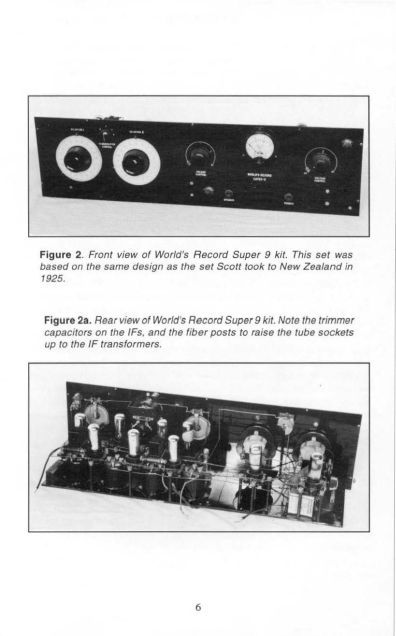
Operating initially under a custom-builder model to navigate restrictive RCA patents, the E. H. Scott Radio Laboratories (and its early iteration, the Scott Transformer Company) earned a formidable reputation for high-performance, multi-tube battery and AC superheterodyne receivers.
Scott’s early technology prioritized minimized signal loss, selective intermediate frequency (IF) matching, and eventual innovations like the copper-clad chassis and the Pfaff-designed turret tuner. As the company transitioned into fully assembled consumer sets during the Great Depression, an amicable 1932 patent settlement with RCA allowed the laboratory to integrate bleeding-edge components.
This era birthed historic high-fidelity landmarks, including the Allwave 15, the prestigious 23-tube Allwave Imperial High-Fidelity, the massive and ultra-custom 40- to 48-tube Quaranta series, and the flagship 30-tube Philharmonic. Under succeeding chief engineers Murray Clay and Marvin Hobbs, Scott expanded into remote-control systems, automobile radios, the highly specialized 26-tube Special Communications Receiver, and licensed Armstrong limiter-discriminator FM development.
This comprehensive technological evolution underscores how Scott pushed contemporary engineering limits to dominate the luxury, high-fidelity radio market prior to World War II.