Note
73, Oct 1974, p. 19.
73, Nov 1974, p. 18.
73, Dec 1974, p. 19.
73 Feb 1975. p. 25.
QST, Aug 1975, p 133.
QST, Jan 1976, p. 91.
73, Apr 1975, p. 105.
73, Nov 1976, p. 156. ("Now shipping daily")
73, Dec 1976, p. 157.
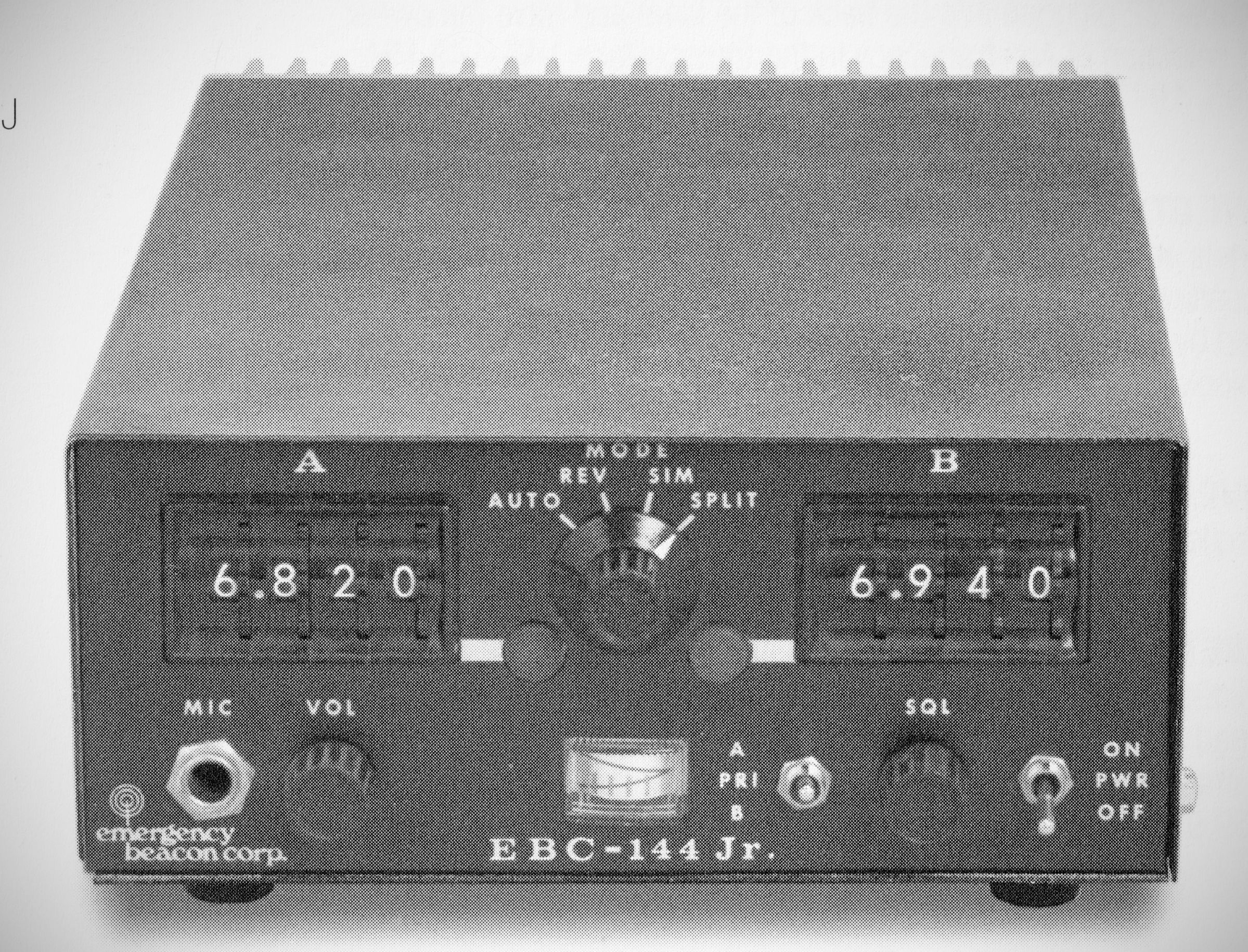
The EBC 144 Jr was made by the Emergency Beacon Corporation in New Rochelle, New York. The company's main business was manufacturing avionics used in search and rescue operations for downed aircraft. The 20-watt EBC 144 Jr was fully synthesized and covered 143.5-148.5 MHz using 5 kHz increments.
(Advertised as having a million channels, 1000 receive x 1000 transmit, calculated by 5 MHz divided by 5 kHz, never mind that that isn’t how the band works.)
It had standard repeater splits, reverse splits, and simplex modes. The receiver used a 10-pole crystal filter.
Developed as a streamlined, secondary project after manufacturing and parts-cost inflation pushed their flagship "Dream Machine" (the EBC-144) to higher price tiers, the EBC-144 Jr. was offered at a starting price of $599. Designed with a professional, commercial avionics aesthetic rather than typical ham gear, it was the first unit to integrate a fully synthesized 2-meter FM transceiver and a 20-watt power amplifier into a single, compact chassis.
Note: While plenty of examples of the EBC-144 Jr have been found, no examples of the larger EBC-144 (see entry) are known to exist.
Construction: Heavy extruded aluminum heat sink forming the rear panel, extensive internal shielding, and factory-sealed chassis ("Warranty Void If Seal Is Broken").
Controls & Display: Features dual set thumbwheel switches ("A" and "B"), indicator lamps showing active switch sets, a 4-position Mode switch, power toggle, signal/power meter, microphone jack, and front-panel volume and squelch controls.
Frequency Coverage & Synthesis
Frequency Range: 143.5 MHz to 148.5 MHz in 5 kHz steps, allowing access to standard amateur 2-meter channels as well as adjacent MARS and CAP frequencies.
Synthesizer Scheme: Single Voltage-Controlled Oscillator (VCO) phase-locked loop (PLL) utilizing a 5 kHz reference derived from a 5 MHz crystal oscillator.
Logic Scheme ("Early Zero Sensing"): Variable dividers program the counter down directly from thumbwheel settings without needing diode matrixes, keeping logic simple and reliable.
Frequency Accuracy: Operates well within specifications, holding receiver tolerances within ~300 Hz and transmitter output within 250 Hz over the operating range.
Dual Frequency Controls: Twin thumbwheels ("A" and "B") allow independent configuration of two distinct channels or splits.
Mode Switch Options:
1. AUTO: Automatically implements standard 600 kHz offsets above 146 MHz (-600 kHz in the 146 MHz segment; +600 kHz in the 147 MHz segment) and reverts to simplex operation below 146.0 MHz.
2. REV (Reverse): Flips the standard 600 kHz offset direction for non-standard repeaters.
3. SIM (Simplex): Transmits and receives on the selected thumbwheel frequency.
4. SPLIT: Uses thumbwheel "A" for receive and thumbwheel "B" for transmit, allowing full flexibility for non-standard split repeaters (e.g., 990 kHz offsets).
Priority Scanning: Monitors the "B" thumbwheel frequency for ~100 ms every 2.5 seconds while operating on channel "A". If a signal appears on "B", it locks onto the channel and switches transmit control to "B" for the duration of the transmission.
Accessories: Includes a rear connector designed to interface with an optional EBC 6-channel scanner accessory.
Receiver Architecture: Single-conversion superheterodyne receiver.
Front End & Selectivity: Dual 3N140 FET RF stage (5 poles of filtering, ~20 dB gain) feeding a 3N341 dual-gate mixer, followed by an 8-pole 10.7 MHz crystal filter (13 kHz bandwidth), two IF stages, and a 2-pole 10.7 MHz crystal filter.
Sensitivity: Rated at 0.35 µV for 12 dB SINAD (0.30 µV for 20 dB quieting); bench tests measured up to 0.24 µV for 12 dB SINAD and 0.20 µV for 20 dB quieting.
Intermodulation & High-RF Immunity: Virtually immune to intermodulation (IMD) in high-density RF environments. Adjacent channel rejection measured 88 dB at 15 kHz, handling tight 15 kHz channel separations with minimal crosstalk. Spurious and image responses are down 70 dB.
Audio Output: CA3089E IC detector/limiter and µA706 IC audio amplifier supplying ~5 watts into an internal speaker or external speaker jack. Accepts up to 7 kHz deviation before audio distortion occurs.
RF Power Output: Nominally rated at 20 watts output (driven by a 2N4427, 2N6080 driver, and 2N6082 final amplifier stage). Test measurements indicated 20.5 W to 25 W output across 143.5–148.5 MHz on a 13.5V supply. Power output varies between 12W and 30W+ across 10.0V–18.6V supply range.
Modulation & Purity: Direct VCO modulation. Harmonics and unwanted spurious outputs are better than 70 dB down (except for symmetrical sideband spurs ~15–18 kHz off carrier at -14 dB).
Duty Cycle: Exceptionally durable heavy-duty heat sink design allows continuous 20W AFSK RTTY transmissions for up to 60 minutes without power degradation or thermal failure.
Temperature Stability: Tested from 20°F to 125°F (and surviving 9 hours in a home freezer) with no performance issues or loss of synthesizer lock.
Current Draw: 1.05 A in receive mode; 5.1 A in transmit mode at 13.5 V DC.
Noted Reviewer Criticism ("Nit-Picks"):
* Unilluminated thumbwheel switches make nighttime operation difficult.
* S-meter/power meter calibration is poor and hard to read in the dark.
* Microphone plug placement is uncomfortably close to the volume knob.
* Transmitter audio response rolls off relatively steeply above 1000 Hz (-13 dB at 3000 Hz), requiring adjustment for optimal AFSK RTTY use.
* Internal receiver self-spurs exist at 144.535 MHz and 146.25 MHz (measured under 0.04 µV, easily squelched out).
References
Review. 73, Oct 1974, p. 16.
Review, CQ, Jun 1975, p. 33.