Note
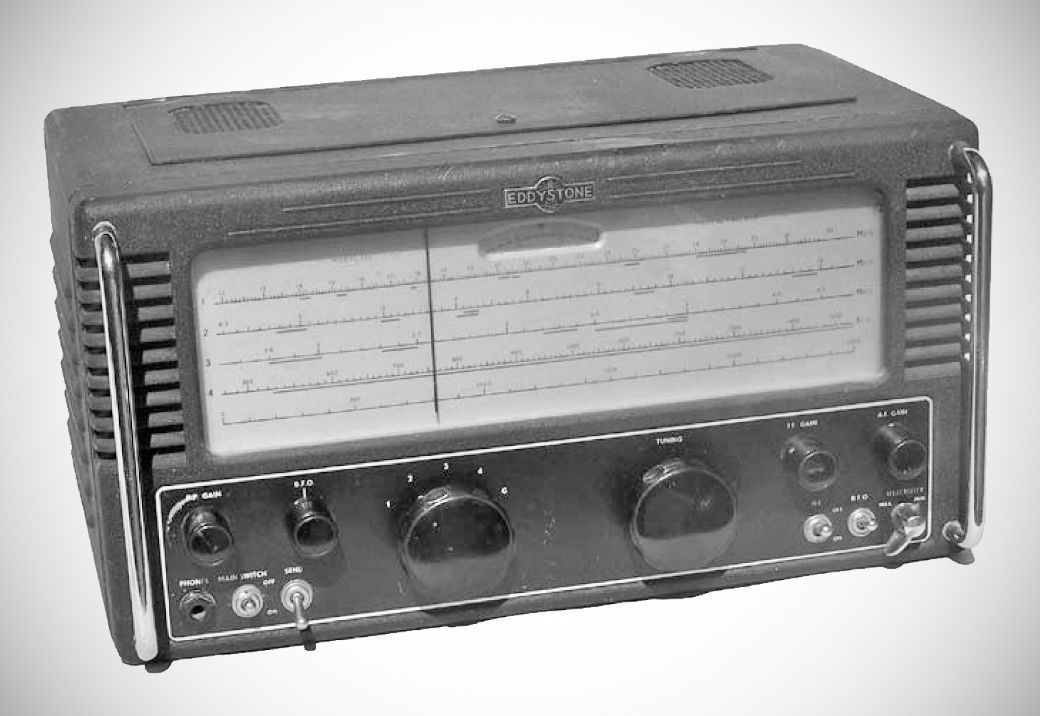
The Eddystone Model 750 is a British-manufactured, dual-conversion communications receiver built in Birmingham, England by Stratton & Company Limited starting around 1951.
In 1951, the Eddystone 750 retailed for £68, which converted to roughly $190 at the time. This placed it squarely in the same price tier as popular mid-range American boatanchors like the Hammarlund HQ-129X or the Hallicrafters SX-71. While American hams often preferred domestic options with amateur-specific feature sets, the Eddystone 750 was highly regarded globally as an exceptionally stable, sensitive, and beautifully engineered general shortwave listening receiver.
Compared to its American contemporaries, the Eddystone 750 is relatively compact, measuring 8 3/4 x 16 3/4 x 9 1/4 inches. Despite its modest footprint, it weighs a hefty 42 pounds, a result of its rugged construction featuring a substantial cast-aluminum front panel and three internal cast sub-chassis.
The radio’s defining feature is the high-quality Eddystone Type 898 slide rule dial, widely regarded by collectors as one of the finest tuning mechanisms ever made for communications receivers. It utilizes anti-backlash gears and a flywheel-weighted knob to achieve a highly precise 110:1 tuning ratio.
Because the receiver relies entirely on mechanical bandspread rather than electrical, it achieves high logging and reset accuracy using a horizontal scale (running 0 to 2500) paired with a small circular dial (running 1 to 100). It takes roughly 14 1/4 turns of the tuning knob to span the 80-meter amateur band.
The 750 is designed as a dual-conversion superheterodyne receiver utilizing an 11-tube lineup. It continuously tunes from 480 kHz to 32 MHz across multiple bands, with only a small gap around its first intermediate frequency.
The first IF is set at 1620 kHz (which helps eliminate image responses), while the second IF drops down to 85 kHz for enhanced selectivity.
The front panel includes a "Selectivity" bandwidth control knob that mechanically alters the variable coupling between the primary and secondary windings of the 85 kHz IF transformers. This provides a variable bandwidth ranging from roughly 6 kHz (broad) to 2.2 kHz (narrow) at 6 dB down.
The radio was originally designed with a mix of British miniature and rimlock-style valves (tubes), though many American equivalents are commonly substituted during restoration:
– RF Amplifier: 6BA6
– High-Frequency Local Oscillator: 8D3 / 6AM6
– First Mixer / Driver: ECH42 / 6CU7
– Second Converter: ECH42
– 85 kHz IF Amplifier: 6BA6
– Detector / AVC / First AF: DH77 / 6AT6
– Audio Output: N78 (often replaced with a 6AQ5)
– Auxiliary Tubes: D77 / 6AL5 (Noise Limiter), 6BA6 (BFO), VR150 (Voltage Regulator), and a 5Z4 (Rectifier).
Rear Apron: Features connections for a 2.5-ohm loudspeaker, a phonograph pickup ("PU"), and Aerial/Earth (A and AE) antenna terminals. It also features two octal sockets intended for running external accessories or vibrator power supplies (labeled for external High Tension/B+ and external Low Tension/filament voltage).