Note
Manufactured and sold from 1962 to 1970. It holds the distinction of being the last tube-type Eddystone receiver in production before the company transitioned to semiconductors.It was designed as a mid-priced, high-performance receiver targeted at "well-heeled shortwave listeners and discerning amateurs." It recycled and modernized the design of the older Eddystone 680 series to keep development costs down.
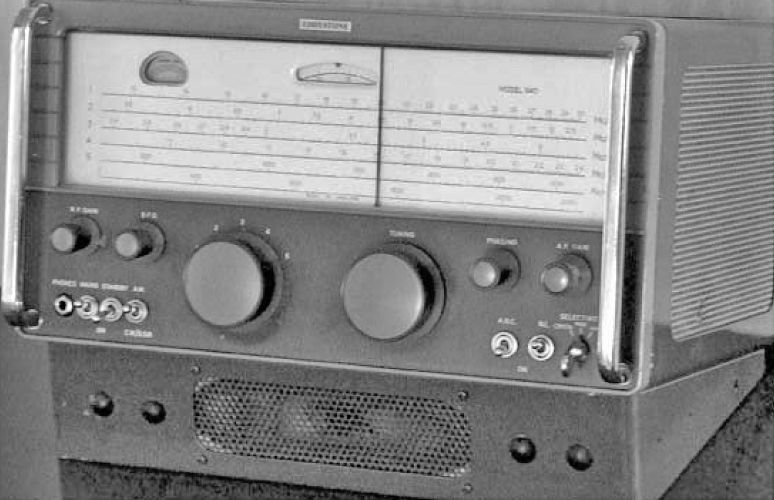
The 940 was one of the best-selling Eddystone models of all time and is considered a common item today. It is not considered one of the classic, large, heavy "boat anchors," packing a lot of tube-era electronics into a small space. It can also be rack-mounted using adapters.
Built to withstand rough usage and extreme climatic conditions. It features an attractive front panel, a modernized cabinet, and omits the traditional lift-up lid found on older models.
Specifications & Features
– Frequency Coverage: Full coverage from 480 kHz to 30 MHz split across five distinct ranges/bands.
– Supported Modes: Reception of AM, CW, and SSB signals.
– Dial & Tuning Drive: Features a large dial with fine, accurate calibrations and a generously sized logging scale visible through a window. The drive system is "silky smooth," utilizing a 140:1 gear ratio and a flywheel-equipped tuning knob that allows users to tune to an accuracy of 1 kHz even at 30 MHz.
– Optional Equipment: A base-mounted speaker was available as an optional extra.
Tube Lineup
The 940 modernized the ancestral 680 superheterodyne design with several tube changes and component simplifications:
Front End (RF Stages): Features two RF stages. Notably, the first RF stage uses an ECC189/6ES8 variable-mu, high-gain double-triode tube configured as a cascode amplifier. This design choice provides high gain with virtually no noise, offering unmatched front-end performance above 15 MHz compared to traditional pentodes. The second RF stage utilizes a 6BA6 pentode tube.
Frequency Converter: Uses an improved ECH81/6AJ8 triode-hexode tube acting as a separate local oscillator and mixer to ensure good frequency stability.
IF Channel: Features a variable-selectivity IF channel equipped with a crystal filter. The variable selectivity was simplified from the continuous configuration of the 680 to a switched configuration on the 940.
Detector & BFO: The traditional pentode BFO was replaced by a 6BE6 pentagrid oscillator/product detector.
Audio Section: Uses a simplified and better-balanced double-triode amplifier/phase splitter rather than the complex double-pentode audio voltage amplifier and phase inverter of its predecessor.