Note
QST, Sep 1955, p. 7.
QST, Feb 1960, p. 91. (technical notes)
Walter Ashe catalog 1957, inside front cover.
Allied Radio catalog 1957 (copyright 1956), p. 241.
Allied Radio catalog 1958 (copyright 1957), p. 265.
Allied Radio catalog 1959 (copyright 1958), p. 371.
Allied Radio catalog 1960 (copyright 1959), p. 387.
Allied Radio catalog 1961 (copyright 1960), p. 387.
Allied Radio catalog 1962 (copyright 1961), p. 275.
Allied Radio catalog 1963 (copyright 1962), p. 281.
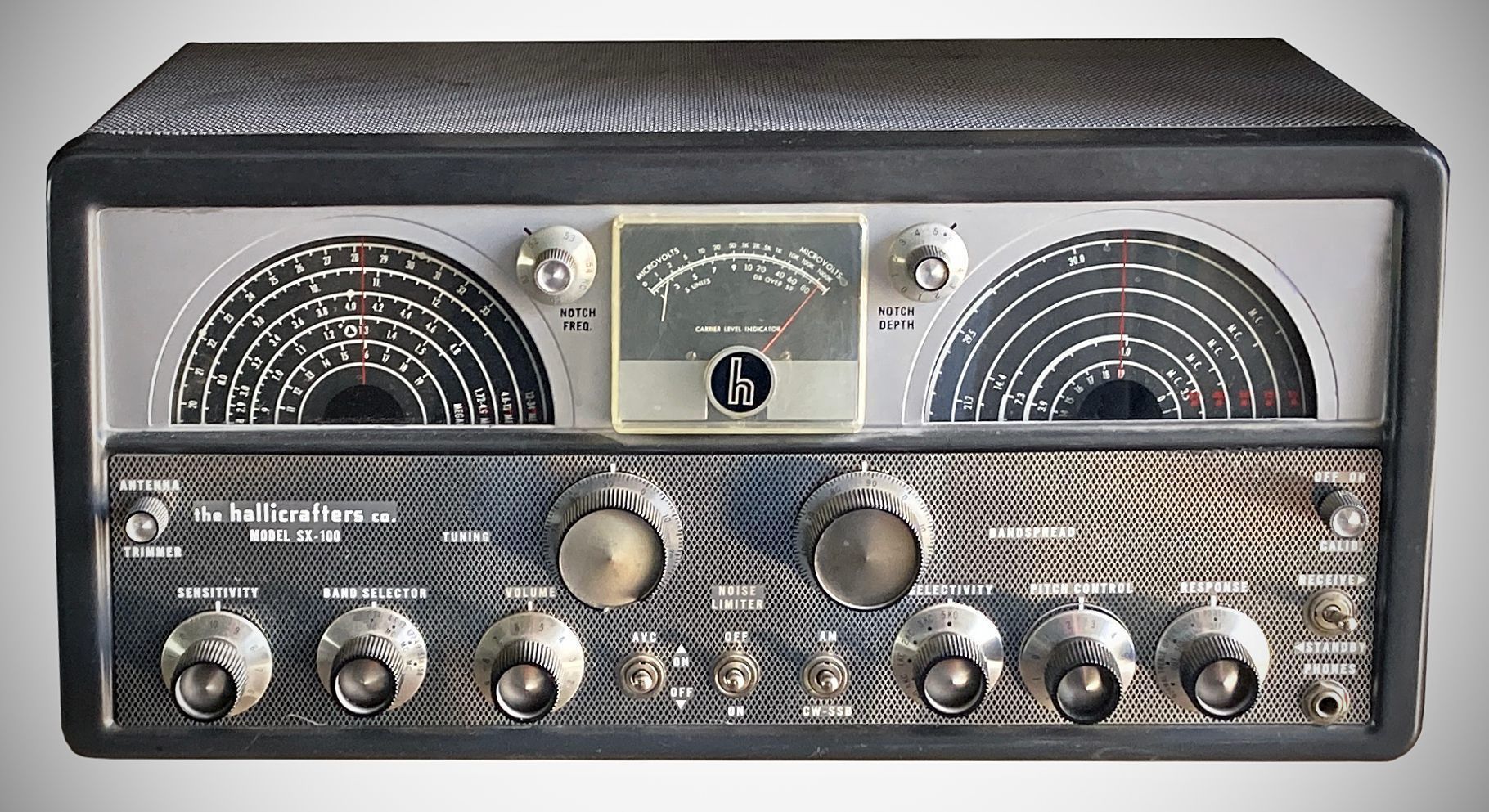
The SX-100 was one of Hallicrafters' most popular receivers, with coverage from 538 to 1580 kHz, and 1720 kHz to 34 MHz. Note the small gap in coverage due to the 1650 kHz first IF.
The second conversion is crystal-controlled for an IF of 50.5 (or 50.75 kHz in the Mark 2). Bandspread is calibrated for the 80, 40, 20, 15, 11, and 10 meter ham bands.
Other features include selectable sideband operation, antenna trimmer, 100 kHz crystal calibrator, logging scales for both tuning controls, gear drive tuning, and what Hallicrafters called a "Tee-Notch" filter. Company literature describes the Tee-Notch as "a stable non-regenerative system for the rejection of unwanted heterodyne. The Tee-Notch also produces and effective steepening of the excellent 50 kHz bandpass...and further increases the effectiveness of the advanced exalted carrier reception."
Differences between the various iterations of the SX-100 are mostly cosmetic, but some minor electrical tweaks have also been made.
The most significant difference between the Mark 1 and Mark 2 is the use of 50.75 kHz for the second IF in the Mark II, replacing the Mark 1's 50.5 kHz IF. A smaller fix changed the AVC action when receiving SSB or CW.
Review: QST Dec 1955.
See Hallicrafters' Notes: QST, Feb 1960, page 91.
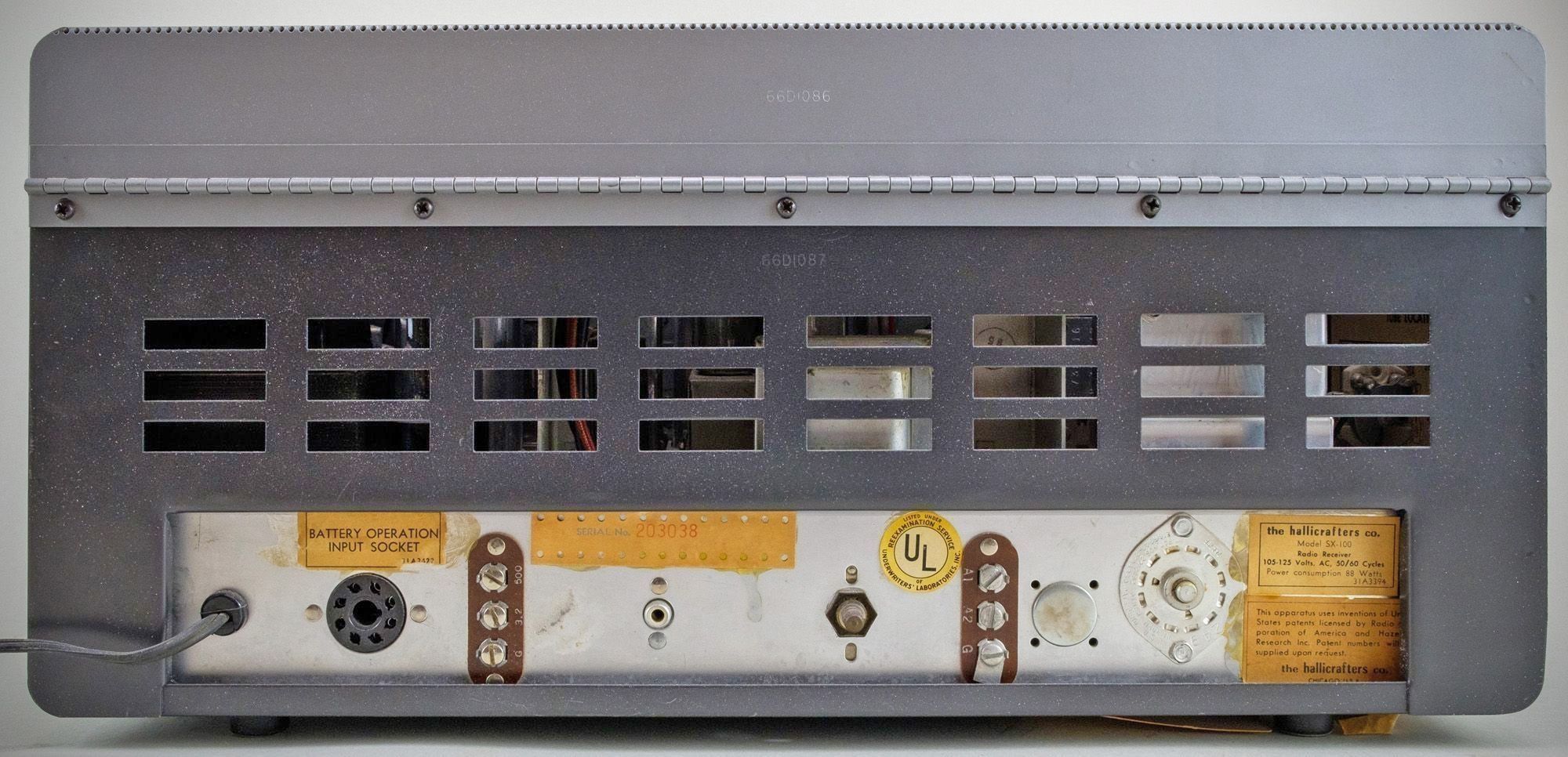
Requires external speaker: 3.2 Ω
Power: 120 VAC
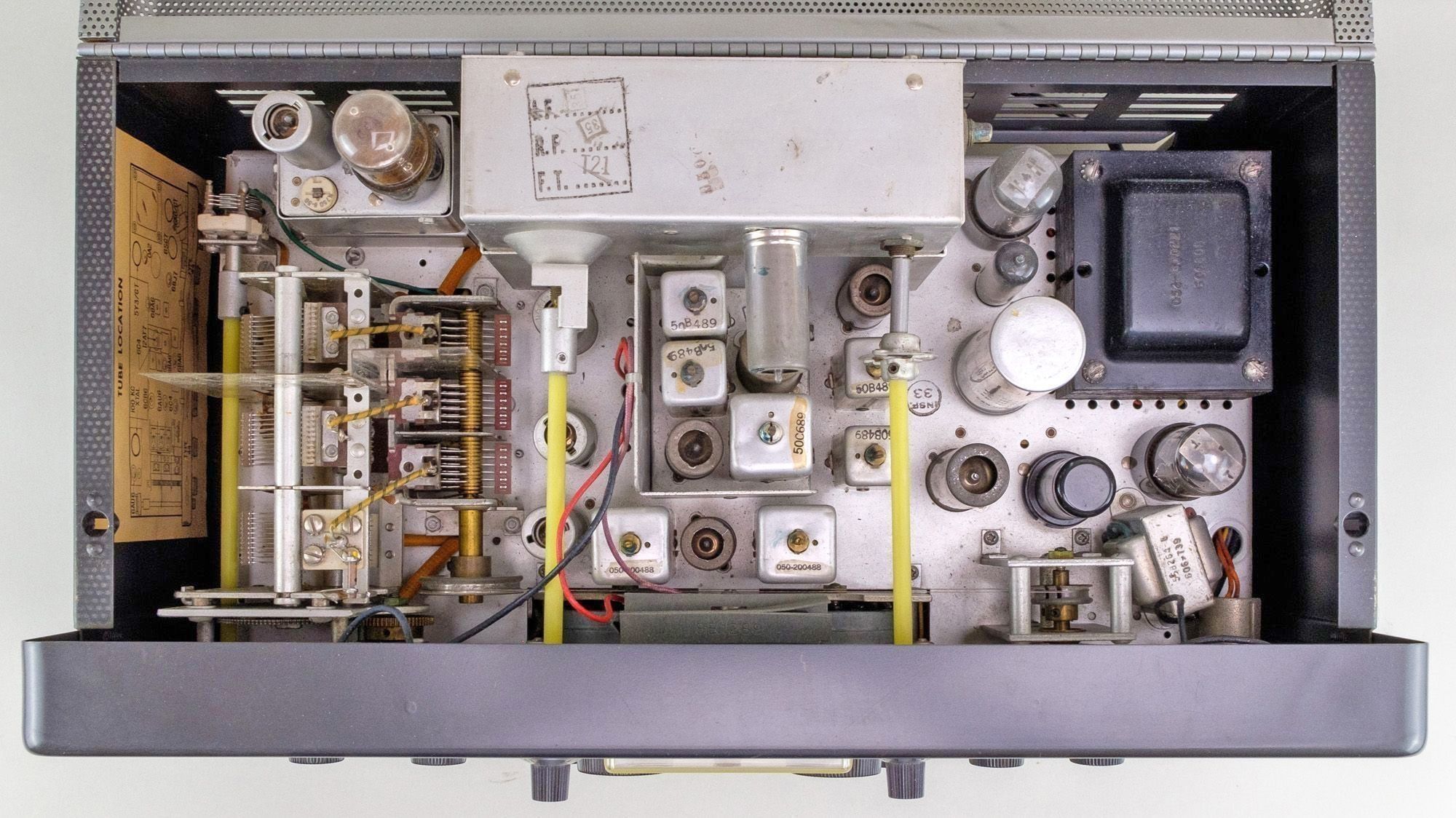
Tubes (14 total): (1) 6CB6, (2) 6AU6, (2) 6C4, (3) 6BA6, (1) 12AT7, (1) 6BJ7, (1)6SC7, (1) 6K6, (1) 5Y3, (1) 0A2