Note
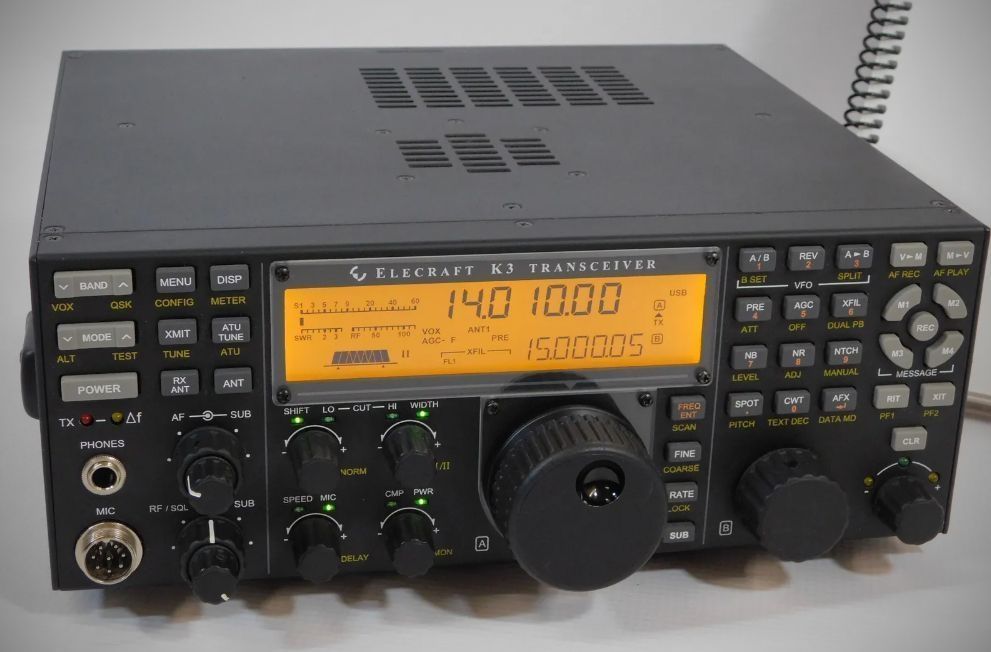
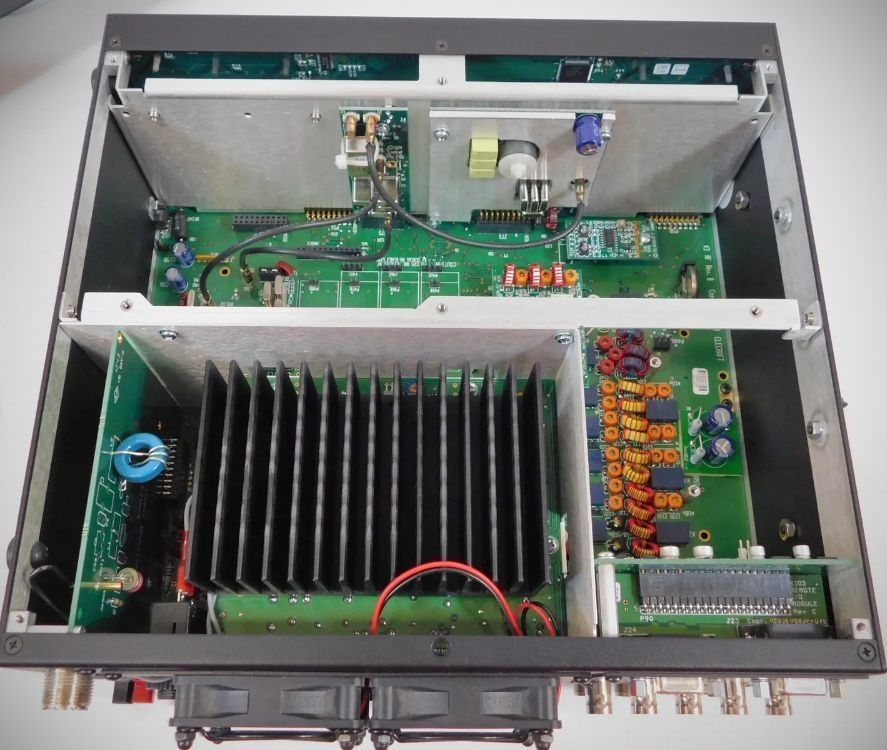
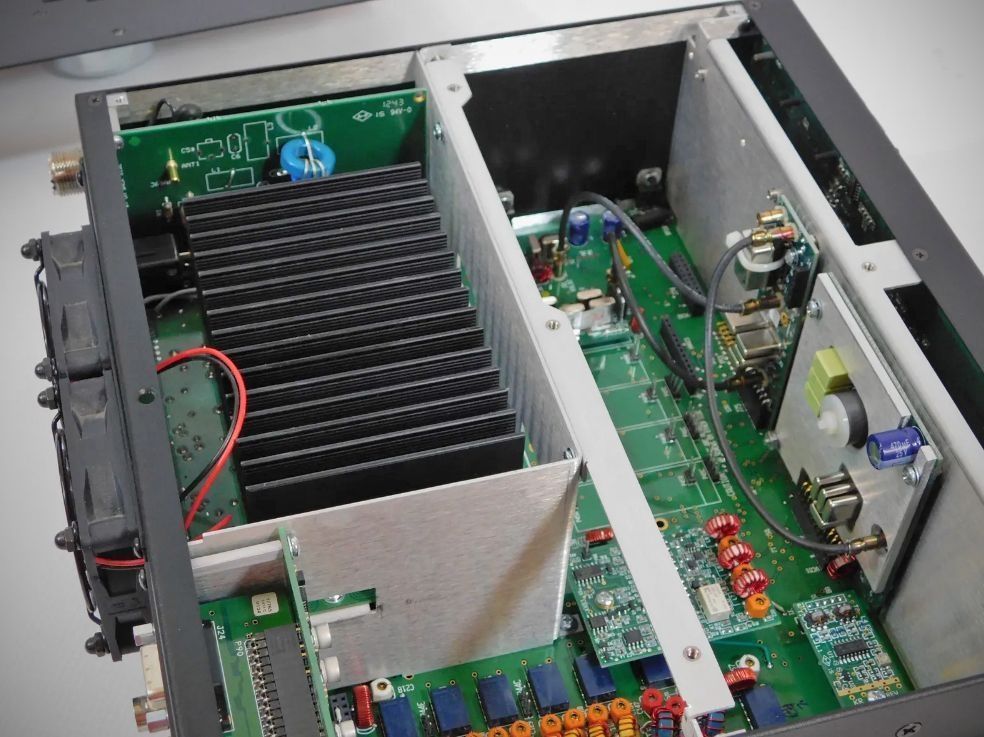
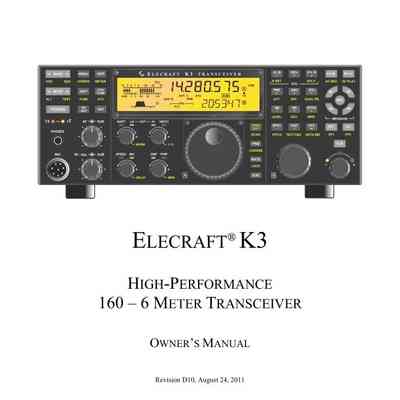
The Elecraft K3 is a high-performance 160–6 meter transceiver designed for both home-station and portable use. It is distinguished as the only rig in its class that can be built by the owner using a modular, no-solder kit format.
The K3 utilizes a high-performance down-conversion architecture with an 8.215 MHz first I.F.. This is combined with a 32-bit floating-point IF. DSP for advanced signal processing. It supports up to five crystal roofing filters with bandwidths as narrow as 200 Hz. These filters are variable-bandwidth and can track DSP settings.
Offers a fully independent sub-receiver (optional KRX3) that allows for true diversity receive using two separate antennas.
Includes dual noise blankers—a hardware-based I.F. pulse blanker (KNB3) for fast pulses like ignition noise and a DSP-based blanker for complex waveforms like radar.
The radio can demodulate and display CW, RTTY, and PSK31 directly on its LCD without a computer. It also features internal CW-to-DATA encoding for transmitting digital modes via a CW paddle.
Features include an Audio Peaking Filter (APF) for weak CW signals, 8-band graphic equalization for both transmit and receive, and binaural audio effects.
Frequency Range: Covers 160–6 meters (0.5–54 MHz) for receive and all amateur bands for transmit.
Power Output: Available in a 10W (K3/10) or 100W (K3/100) base configuration.
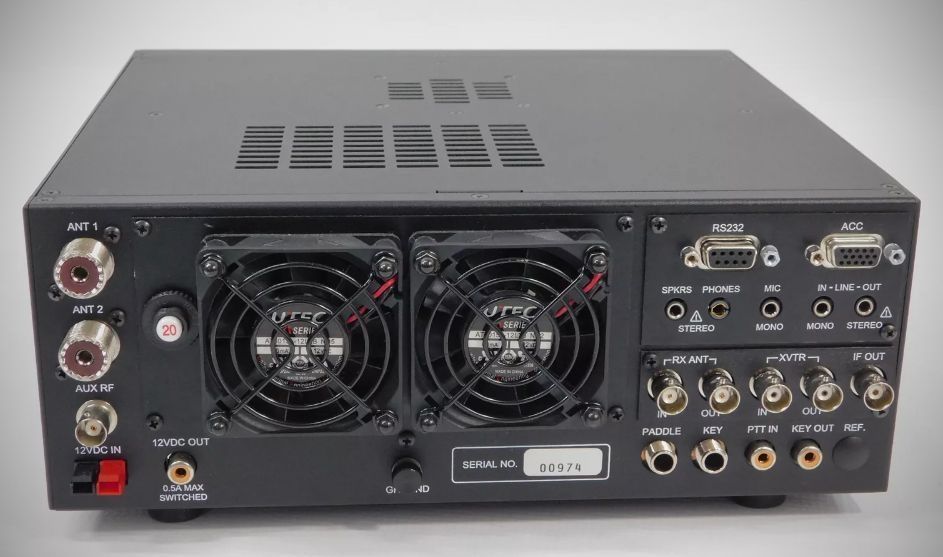
Connectivity: Equipped with an RS232 port for remote control, isolated PC audio I/O, and multiple antenna jacks.
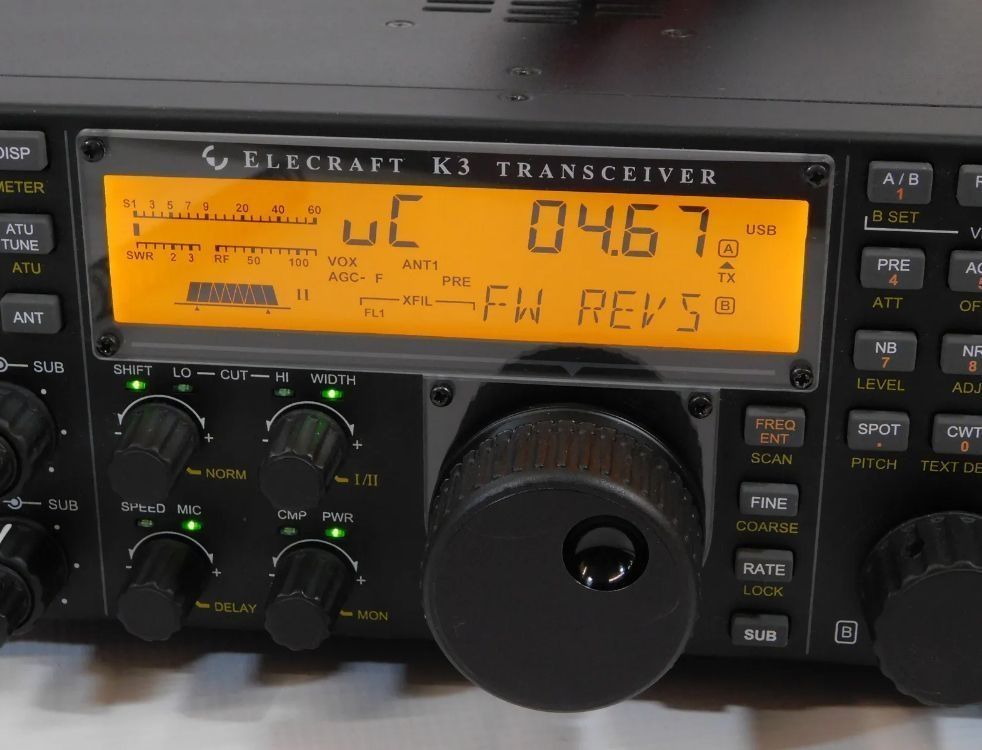
User Interface: Features a high-contrast 240-segment LCD, dual VFOs with independent settings, and programmable "macros" for automating complex operations.
The K3's modularity allows for several internal upgrades:
– KAT3: Internal wide-range automatic antenna tuner.
– KDVR3: Digital voice recorder for incoming and outgoing audio.
– K144XV: Internal 2-meter (144 MHz) transverter module.
– KXV3: Provides a buffered I.F. output and dedicated RX antenna jacks.
The Elecraft K3 (released in 2007) is widely considered one of the most significant amateur radio transceivers in history. It was the first radio to truly master the down-conversion architecture, which allowed it to use narrow crystal "roofing" filters to block out strong nearby interference before the signal even reached the digital processing stage.
At its peak, it sat at the #1 spot on the famous Sherwood Engineering receiver performance list for years, outperforming radios three times its price and size.
Why it was a "Game Changer"
– Modular "No-Solder" Kits: Unlike traditional kits, the K3 used pre-assembled, tested boards. You could buy it factory-built or assemble it yourself with just a screwdriver, allowing you to "build" a world-class radio without being an electrical engineer.
– A "Contester's Rig": It was designed by and for serious DXers. Its front panel is tactile and functional—there are no complex touchscreens; every major feature has a physical button.
– High Portability: Despite being a 100W desktop-class radio, it is remarkably lightweight and power-efficient, making it the "gold standard" for DXpeditions and Field Day events.
– Endless Customization: You could start with a basic 10W receiver and later add a 100W amplifier, a sub-receiver (for listening to two frequencies at once), an internal antenna tuner, and up to five different crystal filters.
Design Philosophy
The K3 represented a shift toward software defined radio that still felt like a "real" radio. While it uses 32-bit digital signal processing for its filtering and noise reduction, it keeps the traditional knob-and-button interface that many ops prefer over computer-screen operation
The Elecraft K3S (released in 2015) is the second-generation successor to the K3. While they look nearly identical at a distance, the K3S replaced almost every internal subsystem to improve the noise floor, signal purity, and connectivity.
The most significant difference is that the K3S comes "standard" with many features that were optional or unavailable on the original K3.
Key Hardware & Performance Upgrades
Elecraft K3 Elecraft K3S
USB Connectivity Requires external adapter (KUSB) Built-in USB
Synthesizer KSYN3 (Standard) KSYN3A (Standard; lower phase noise)
Attenuator Single 10 dB step 5 / 10 / 15 dB steps
VFO Tuning Hard plastic knob Soft-touch rubberized
Preamp Single preamp Two preamps (better for 10m/6m)
Internal Clock Basic High-accuracy TCXO
Noise Floor Very low Even lower (Redesigned RF board)
---
Detailed Breakdown of Differences
– Integrated USB: The K3S features a built-in USB port that handles both CAT control and **Line-level audio**. This means you no longer need an external sound card interface (like a SignaLink) for digital modes like FT8.
– The "S" Noise Floor: The K3S RF board was redesigned with better port-to-port isolation and shielding. This resulted in a noticeably quieter receiver, particularly on the higher bands.
– Synthesizer (KSYN3A): The new synthesizer provides faster T/R switching and significantly lower close-in phase noise. This is critical for contesters who need to hear a weak signal right next to a "big gun" station.
– Physical Feel: The K3S introduced a new molded bezel and a "soft-touch" VFO knob, which many operators find much more comfortable for long sessions than the original hard plastic.
Can you upgrade a K3 to a K3S?
Yes and no. You could buy the KSYN3A synthesizer and the KIO3B (USB/Audio) boards to put into an older K3. However, the RF Board itself (which provides the better attenuators and lower noise floor) is unique to the K3S and cannot be swapped into an original K3 chassis.
Pro Tip: If you are buying used, look at the serial number. K3S units start at S/N 10,000 and above. Any unit below 10,000 is an original K3 (though it may have been upgraded with some K3S parts).