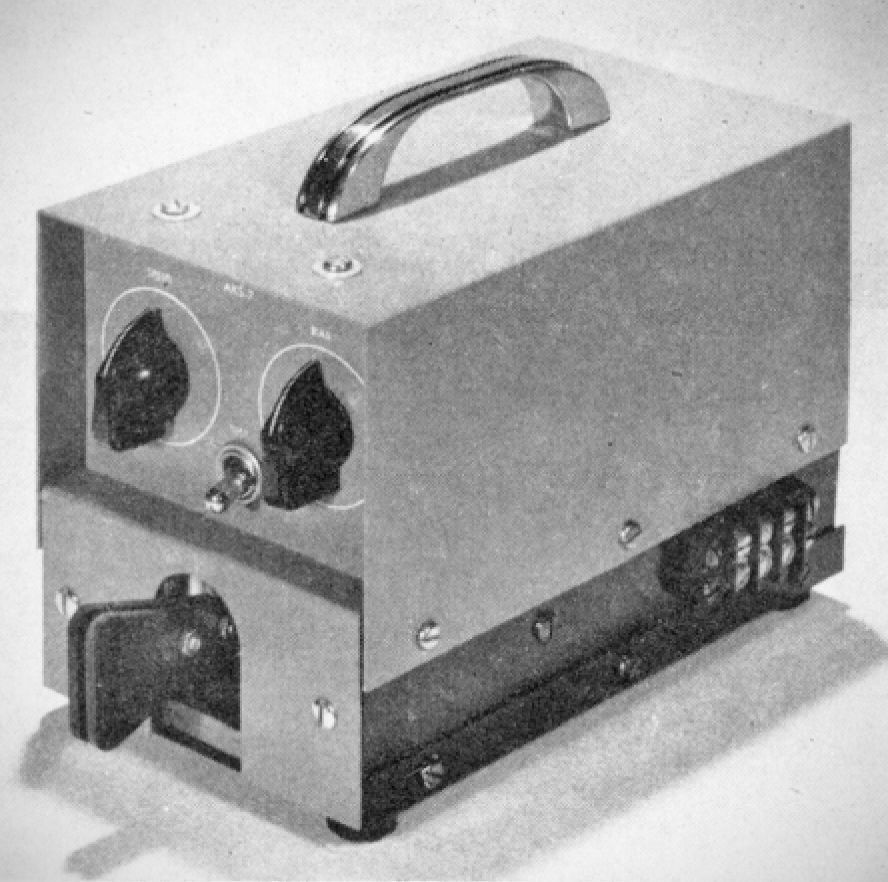
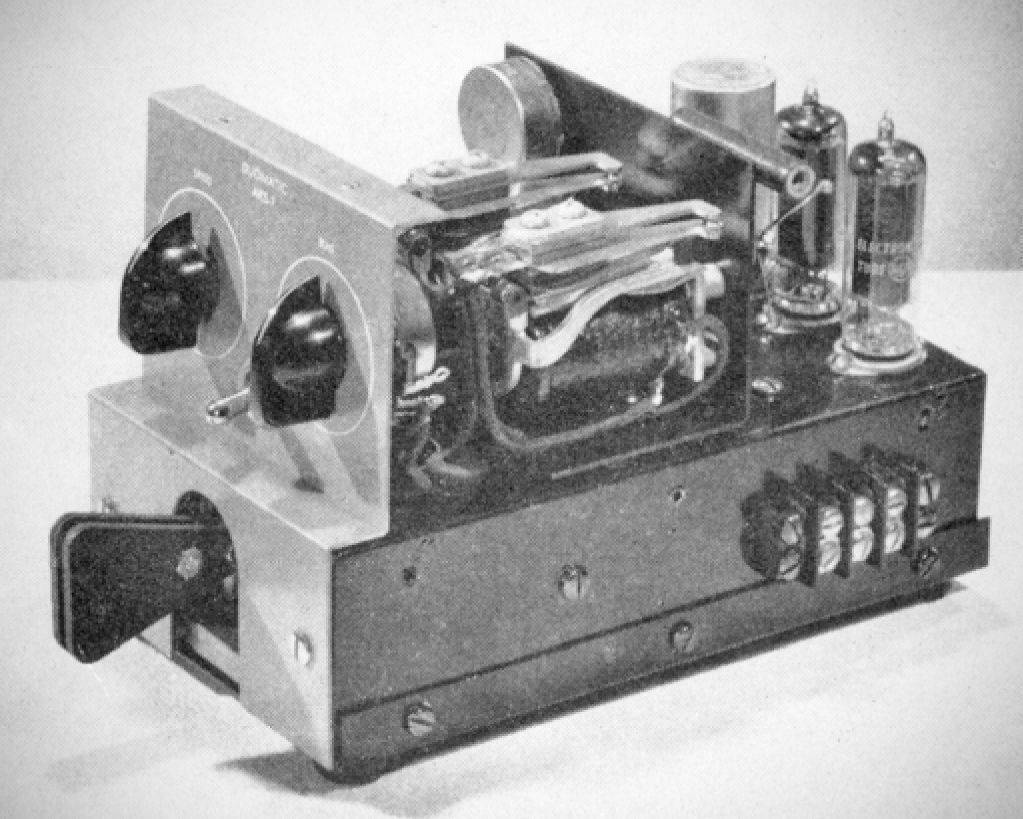
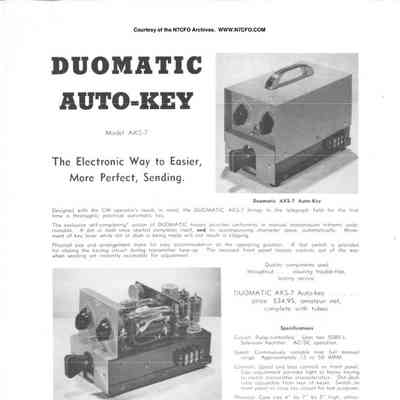
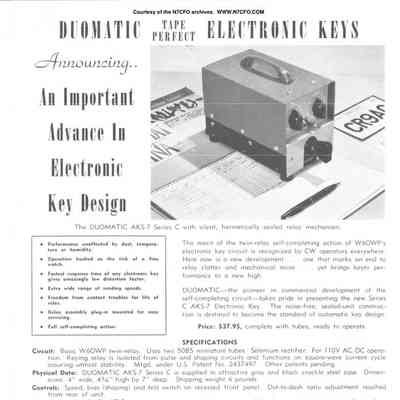
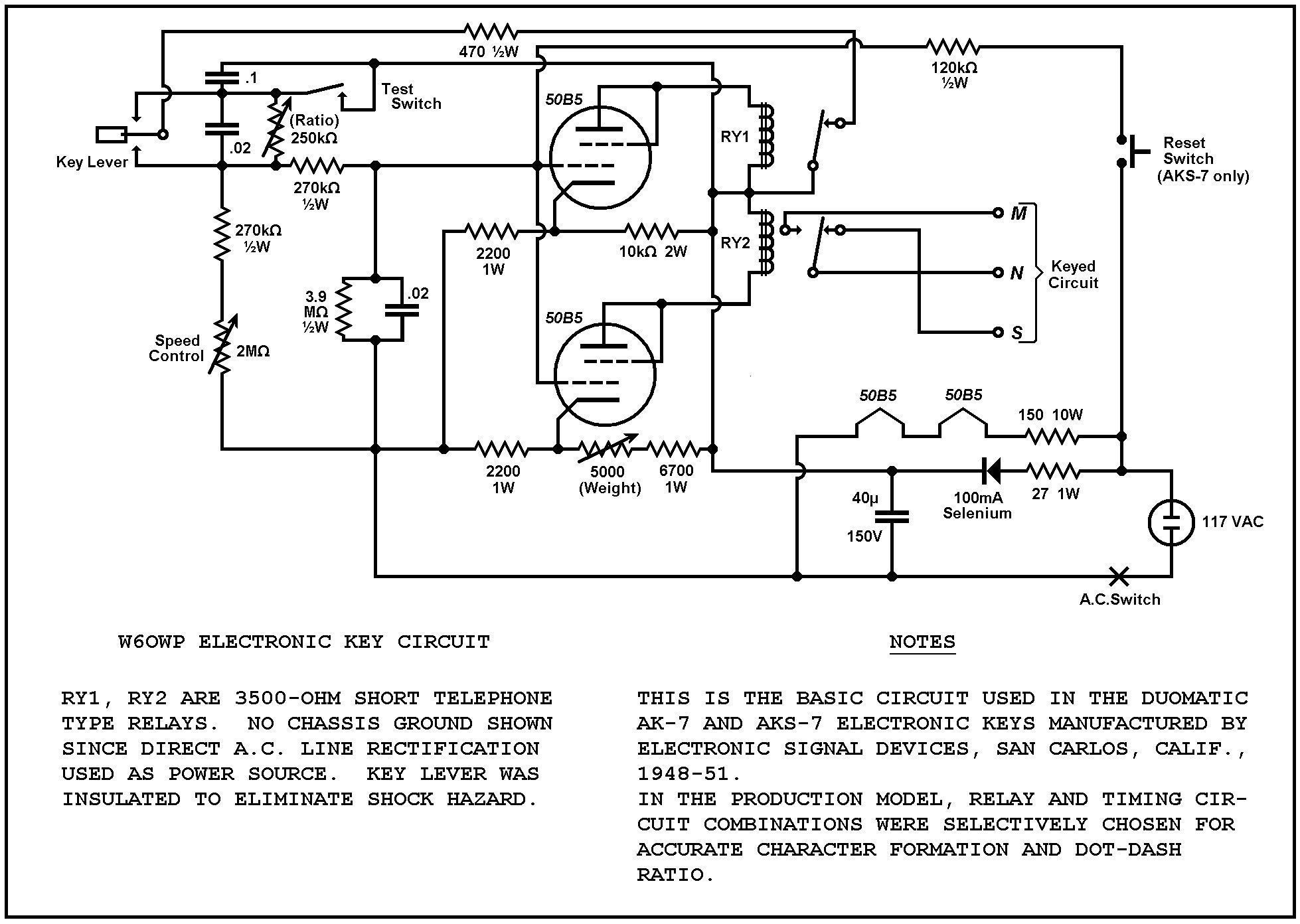
The Duomatic Auto-Key Model AKS-7 is an automatic electronic telegraph keyer manufactured by Electronic Signal Devices of San Carlos, California. Designed to streamline manual CW operation, it introduced a fully automatic keying mechanism built around a pulse-controlled circuit utilizing two 50B5 tubes and a selenium rectifier configured for AC/DC operation.
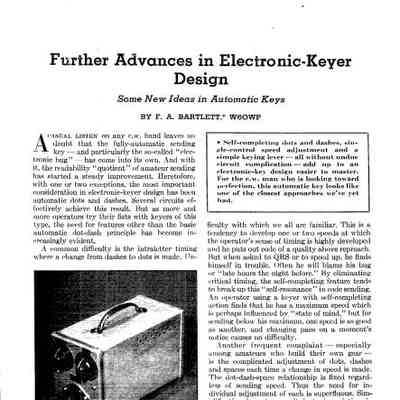
The design is based on the electronic keyer principles described by F. A. Bartlett (W6OWP) in the October 1948 issue of QST ("Further Advances in Electronic Keyer Design") and was manufactured under U.S. Patent No. 2,437,497. The AKS-7 originally sold for $34.95 amateur net, complete with tubes.
Sometime later, a Series C version of the keyer replaced the relays with plug-in mercury wetted types to provide for essentially silent operation
While the company's advertising materials refer to "all Duomatic intruments...", as of this writing, no other models have been discovered.
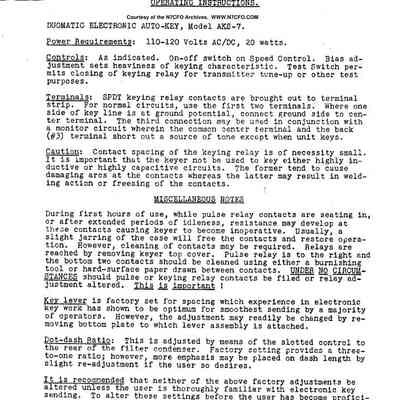
The only apparent difference between the the AK-7 and the AKS-7 is the AKS-7 has a reset switch. The exact nature of the reset switch is not spelled out in company literature, though in the instructions there is this: "Late production units are equipped with a push-button switch on the rear of the chassis. Operating this button applies a switching voltage to the pulse relay allowing the self-cleaning action to restore normal operation should contact resistance develop."
Self-Completing Action: Once initiated, a dot or dash (along with its following character space) completes automatically. Moving the key lever while a character is in progress will not clip the transmission, ensuring uniform timing.
Keying speed is continuously variable across a range of approximately 12 to 50 WPM.
Front panel controls include a speed control, a bias adjustment (to alter character weighting from light to heavy to match transmitter requirements or user preferences), and a toggle switch to close the key circuit for transmitter tuning. Dot-to-dash ratio adjustments are accessible from the rear of the unit.
Power requirements: 110–120 volts AC/DC, 20 watts.