Note
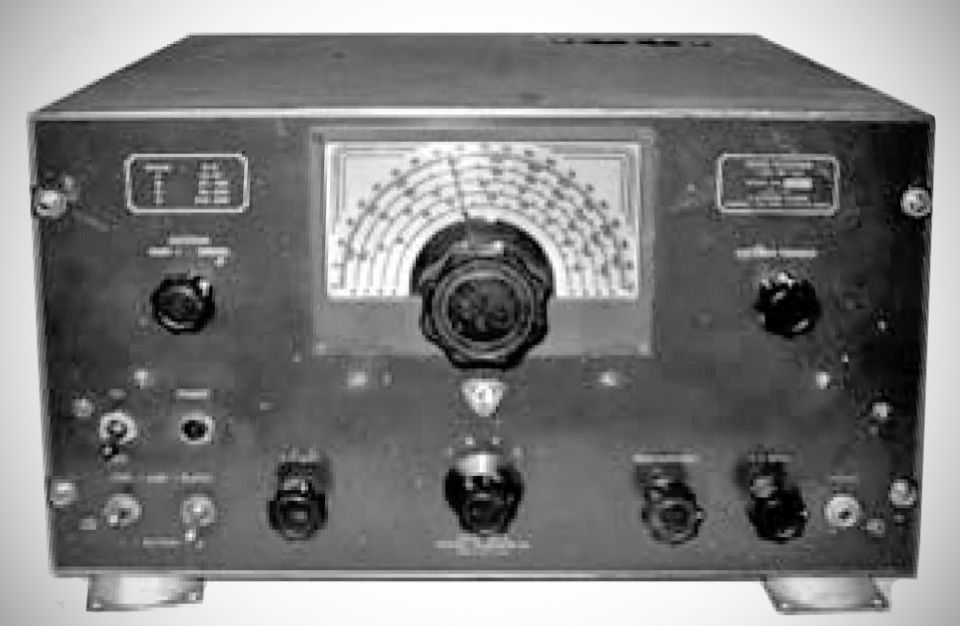
The RC-123 is a communications receiver built by Federal Telegraph (Newark, NJ) during World War II. It was originally designed for the U.S. Coast Guard for both shipboard and fixed station use, and it is identical to the Mackay Radio 128AZ.
Frequency Range: Covers low to medium frequencies from 15 to 650 kHz split across four distinct bands. It uses a tuned-radio-frequency (TRF) architecture using a total of 6 vacuum tubes. This includes:
– A regenerative detector circuit that utilizes a unique layout where a separate triode oscillator tube (a 6J5) handles the regeneration before coupling the signal into the detector tube (a 6SJ7).
Audio Output: Standard 600-ohm impedance with a power output ranging from 70 to 140 milliwatts.
Power Requirements
⚠️The receiver features an AC-DC design built to operate flexibly across multiple power configurations:
– Line Operation: Can run off standard AC or DC lines (drawing about 36 watts / 400 mA on AC). For AC use, a separate filament transformer is mounted inside the cabinet. Both sides of the supply line are filtered, allowing it to hook up to DC sources with either a positive or negative ground safely.
– Battery Operation: Draws 1.9 amperes at 6.3 V for the "A" battery supply, and 8 mA at 90 V for the "B" plate supply.
Emergency Redundancy: The front panel features quick-throw toggle switches allowing an operator to instantaneously flip to battery power if the main power line fails, or switch to an auxiliary emergency antenna if the main antenna goes down.
Cabinet: A totally enclosed metal cabinet with no top lid; internal access is restricted to a few small, rubber-grommeted holes on the rear panel. Long internal cables link the chassis to the cabinet terminal strips via three Jones plugs, meaning the radio can still be fully operated and serviced while slid out of the casing.
Uses a back-lighted National ACN dial paired with a four-gang tuning capacitor manufactured by the Radio Condenser Co. to track accurately across its frequency bands.