Note
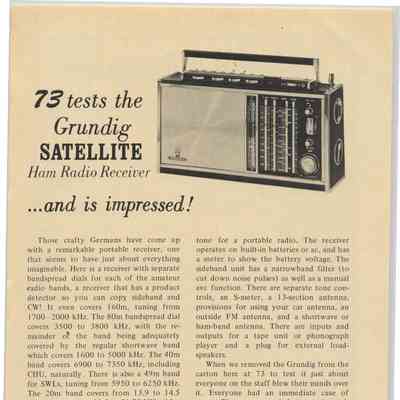
73, Jun 1970, p. 97.
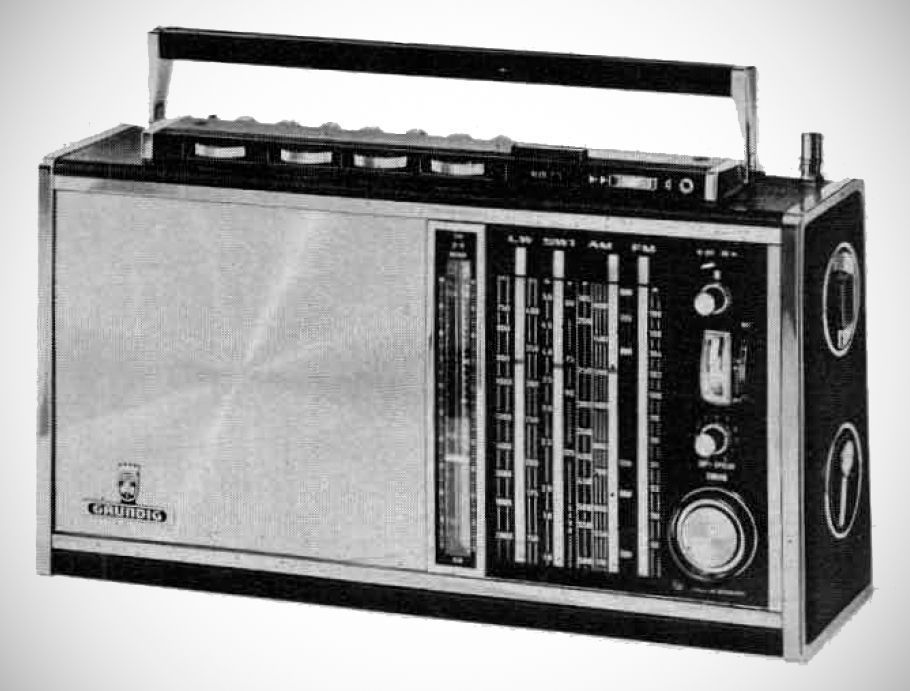
The Grundig Satellit (often spelled Satellite in English-language publications) is a legendary series of portable, multi-band, world-receiver radios manufactured by the German electronics company Grundig, beginning with the Satellit 205 (Transistor 5000) in 1964. Known for their heavy-duty build quality, massive full-range speakers, and exceptional shortwave performance, the Satellit line became a benchmark for shortwave listeners (SWLs), radio amateurs, and DXers from the 1960s through the 1990s.
Features
– SSB / CW Capability: Equipped with a product detector and sideband unit to copy Single Sideband and Morse code.
– Selectivity: Switchable IF response (broad to narrow) for switching between broad FM music fidelity and narrow, crowded shortwave/ham signals.
– Noise Filtering & Controls: Includes a narrowband filter, manual AGC function, separate bass/treble tone controls, and an analog S-meter.
– Antenna System: Built-in 13-section telescopic whip antenna alongside dedicated jacks for external car, FM, and shortwave antennas.
– Inputs & Outputs: Auxiliary inputs/outputs for tape recorders/phonographs and external speaker output jacks.
Specifications & Features
– Operating Voltage: 9 V DC nominal.
– Power Sources:
6 x 1.5 V D-cells .
Grundig AC power adapters/power packs (TN 12 a, TN 14).
Grundig Dryfit rechargeable battery (Type 476).
– Current Consumption: ~25 mA (no signal @ 7.5 V); ~53 mA (normal operating per DIN 45314 @ 9 V).
– Output Power: 2 Watts at 10% distortion.
– Complement: 20 Transistors, 10 Diodes, and 5 Stabilizers/Diodes.
– Intermediate Frequencies (IF):
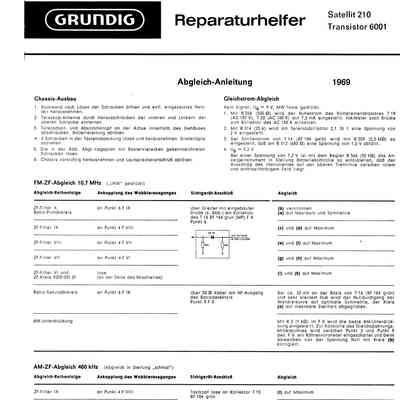
FM IF: 10.7 MHz
AM IF (Narrow/Broad selectable): 460 kHz (3.5 kHz Narrow bandwidth; 5 kHz Wide bandwidth)
2nd AM IF (Shortwave Double Conversion): 1.8 MHz
SSB Adaptability: Compatible with the optional external SSB Unit 210 (210) featuring fine-tuning (±1 kHz) around a 460 kHz BFO.
Power Options: Operates via built-in battery power (with an integrated battery voltage meter) or AC mains power.
– Frequency Coverage & Bands
FM : 87.5 - 108 MHx Alignment at 88 / 106 MHz
LW (Longwave) 145 - 420 kHz Alignment at 160 / 370 / 240 kHz
MW (Medium wave) 510 - 1620 kHz Alignment at 560 / 1450 / 1000 kHz
SW1 (K1) 1.6 - 5.0 MHz (187 - 60 m) Alignment at 1.8 / 4.5 / 2.5 MHz
SW2–SW9 (K2–K9) 5.0 - 30.0 MHz continuously tuned turret tuner (60 - 10 m)
K2: 5.0-7.1 MHz (60-42 m)
K3: 6.05-8.25 MHz (50-36.5 m)
K4: 8.1-11.05 MHz (37-27 m)
K5: 9.95-13.65 MHz (30-22 m)
K6: 12.85-17.5 MHz (23-17 m)
K7: 15.15-20.3 MHz (20-14.5 m)
K8: 18.3-24.5 MHz (16.5-12 m)
K9: 21.5-30.0 MHz (14-10 m)
Band Spread Mode (SW2–SW9): When the "Band spread" button is engaged on bands K2 through K9, the receiver restricts tuning strictly to the shortwave broadcast bands:
– K2 (49 m): 5.95 - 6.25 MHz
– K3 (41 m): 7.07 - 7.38 MHz
– K4 (31 m): 9.47 - 9.9 MHz
– K5 (25 m): 11.67 - 12.2 MHz
– K6 (19 m): 15.05 - 15.7 MHz
– K7 (16 m): 17.65 - 18.35 MHz
– K8 (13 m): 21.3 - 22.1 MHz
– K9 (11 m): 25.55 - 26.7 MHz
Key Technical Evolutions of the Satellit Line
Over its multi-decade production run, the Grundig Satellit line underwent several key technological shifts:
Early Analog (1960s–1970s): 205, 208, 210, 1000, 2000, 2100 | Mechanical turret-tuner bandspread scales, heavy wood/plastic cabinets, high-power audio stages, optional/add-on BFO units.
Digital Readout / Transition (Late 1970s–1980s): 3000, 3400, 1400, 2400 | Digital frequency counters paired with analog tuning dials, built-in SSB units, multi-preset FM pushbuttons.
Microprocessor & Synthesized (1980s–1990s): 400, 500, 600, 650, 700 | Microprocessor control, direct keypad frequency entry, PLL synthesized tuning, automatic motorized preselectors (600/650), synchronous detectors (500/700).
Late Models & Licensing (2000s): Satellit 800, Eton Satellit series | External co-designs (R.L. Drake), digital DSP processing, rebadged units under Eton/Lextronix trademarks.