Note
Abstract: Marconi – The Man and His Apparatus
Authors: James H. Kreuzer and Felicia A. Kreuzer (1995)
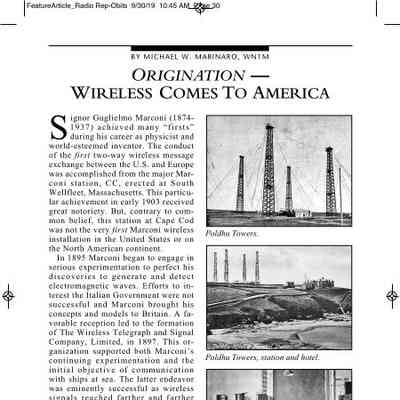
This text explores the life, vision, and technical achievements of Guglielmo Marconi, tracing the birth and commercial expansion of wireless telegraphy. Beginning with his early influences and self-taught experiments at his family’s estate, Villa Grifone, the narrative outlines the progression of Marconi’s hand-made apparatus—from simple doorbells and early grounded vertical antenna systems to revolutionized tuned circuits ("Four Sevens Patent") and the crossing of the Atlantic Ocean in 1901.
The authors provide an in-depth operational and architectural history of the three foundational manufacturing branches that drove the Marconi monopoly:
– The Chelmsford, England Factory: The world's first wireless factory, which pioneered technical state-of-the-art developments such as the magnetic detector, the multiple tuner, and John Ambrose Fleming's thermionic diode valve.
– The Aldene, New Jersey Factory (American Marconi): Charting the absorption of the rival United Wireless Company, the shift from leasing to selling equipment under David Sarnoff, and massive production scaling to fulfill critical military contracts during World War I.
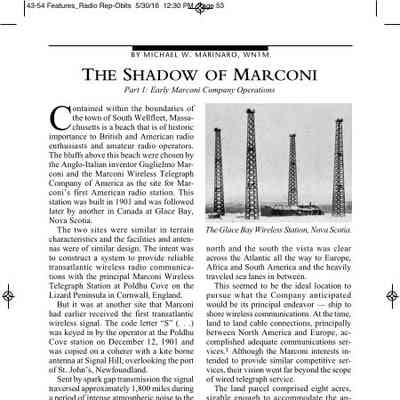
– The Montreal, Canada Factory (Canadian Marconi): Detailing the evolution of manufacturing from the Glace Bay machine shop to the Montreal plants, culminating in World War I production and Canada's first voice broadcasting station, XWA.
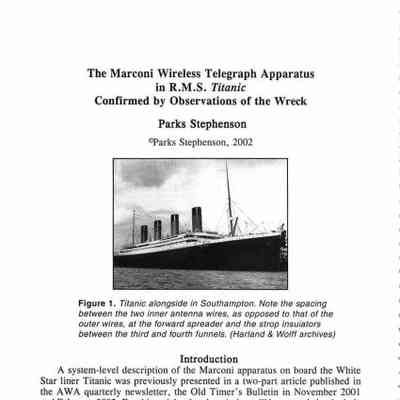
The text concludes by analyzing how maritime disasters, most notably the sinking of the Titanic in 1912, cemented the utilitarian necessity of wireless communication globally, driving historic safety legislation and paving the way for future innovations like radar and television.