Note
QST, Aug 1940, p. 2.
Lafayette catalog number 82, p. 114.
Lafayette catalog number 87 (New York), p. 56.
Lafayette catalog 84 (1944, copyright 1943), p. 91.
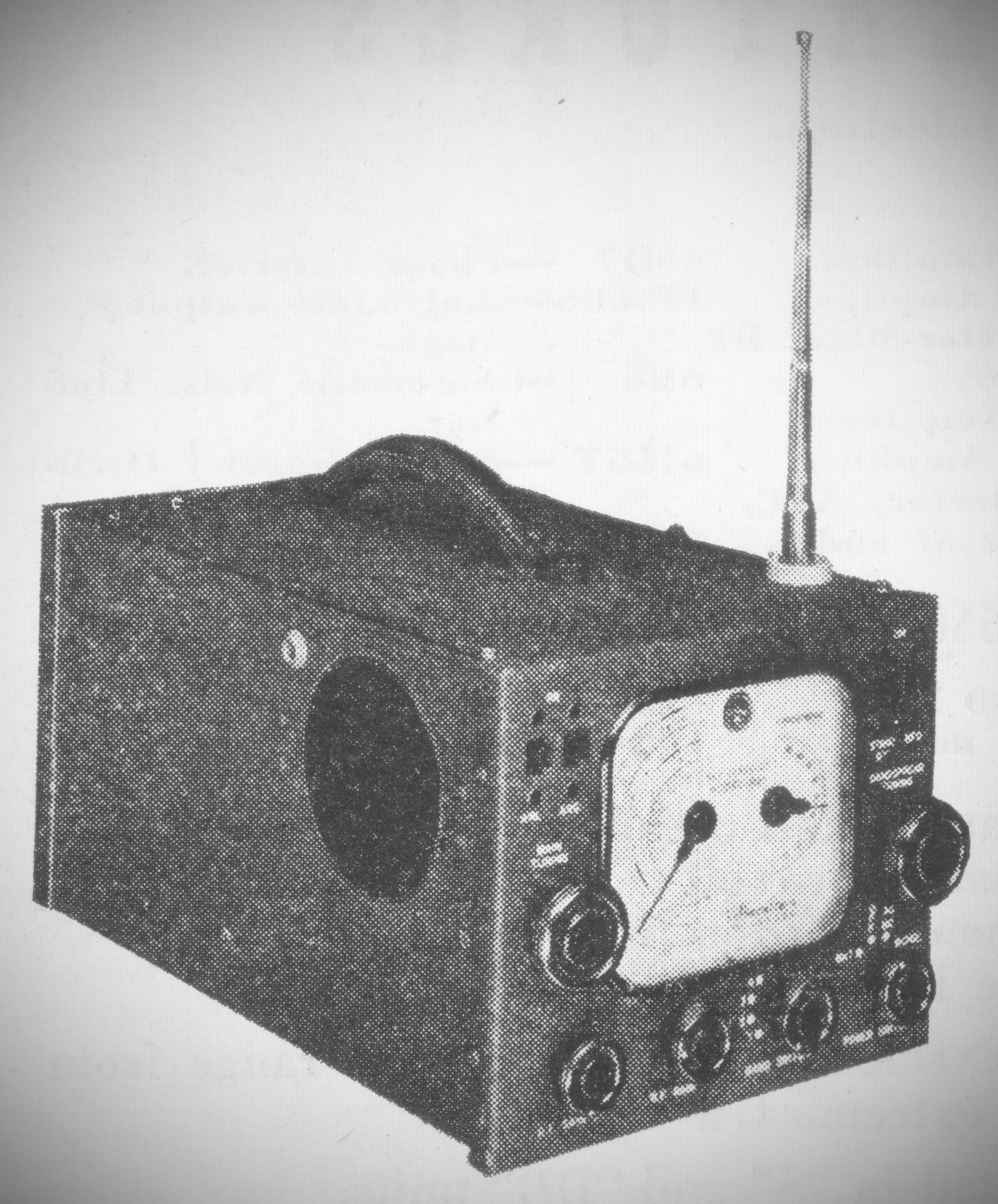
The Hallicrafters S-29 Sky Traveler is a portable, full-coverage HF communications receiver designed in the late 1930s and brought to market just prior to World War II. It was engineered to serve users who heavily relied on HF radio at the time, such as amateur operators, fire and police forces, and forest rangers.
ull HF coverage from 540 kHz to 30 MHz spread across four distinct bands. Includes a non-calibrated (0–100 scale) bandspread feature specifically for the 80, 40, 20, and 10-meter amateur bands.
Equipped with a 24-inch built-in telescoping whip antenna.
The S-29 features excellent electrical characteristics for a portable of its era, utilizing a tuned RF stage, a two-stage IF system, a BFO, and a noise limiter.
The S-29 model marked Hallicrafters' first use of the miniature tubes introduced by RCA in late 1939. They were used sparingly in the high-performance areas (the RF and converter stages), using types like the 1T4 and 1R5 alongside older GT-style tubes (such as the 1P5GT, 1H5GT, 3Q5GT, and 50Y6GT).
The noise limiter circuit is highly unusual; it runs on an entirely separate 1G4GT tube that derives its filament power from its own dedicated 1.5V "D" cell battery, controlled via a front-panel switch.
To accommodate battery operation, it features a low-drain neon-lamp relaxation oscillator that flashes periodically rather than staying continuously lit.
A notable electrical drawback of the S-29 is its use of a dual-section line-cord resistor (two 450-ohm sections) to drop line voltage—one section for the heater of the 50Y6 rectifier and the other for the radio circuit filaments.
While praised for its electrical performance, the S-29's mechanical engineering was notoriously difficult to maintain:
– The front panel does not mechanically attach directly to the chassis; instead, it "floats" on the panel switch wiring until the entire unit is fastened into the cabinet.
– The placement of the whip antenna physically interferes with the AC power switch, often causing misalignment and stiff operation.
– The speaker and external antenna jacks are attached directly to the sides of the outer case rather than the chassis, meaning they have to be wired in after the chassis is pushed into the cabinet.
Originally priced at $69.50 in early 1942, the S-29 saw significant military and government action. It was officially adopted by the U.S. military under the code R-62/PR and was widely used by the FCC as a field-investigation receiver. Because of wartime battery shortages, most civilian-owned S-29s lost their battery portability during the war years as dry cells were prioritized for military contracts.
Its mechanical shortcomings directly birthed its military-focused successor, the olive-drab S-39 "Sky Ranger" (R-80/PR), which fixed the floating panel, antenna placement, and chassis component issues of the original S-29 design.
Specifications
Coverage: 540 kHz to 30.5 MHz
IF: 455 kHz
Built-in speaker
Telescoping antenna
BFO
ANL
Bandspread
Power: 120 VAC or DC, or internal batteries, Note: for 120 volt operation the line cord has a built-in dropping resistor
Tubes: (1) 50Y6, (2) 1G4, (1) 3Q5, (1) 1H5, (2) 1P5, (1) 1R4, (1) 1T4
References
Brief review: Radio, Oct 1940, p. 66.
Brief description. Radio News, Oct 1940, p. 33.
Adding a transmitter. Radio News, Jan 1941, p. 12.