Note
Allied Radio catalog 1965 (copyright 1964), p. 324.
QST, Jan 1965, p. 1.
QST, Dec 1965, p. 1. ("A" versions)
QST, Apr 1966, p. 1. Specs.
QST, Nov 1968, p. 176.
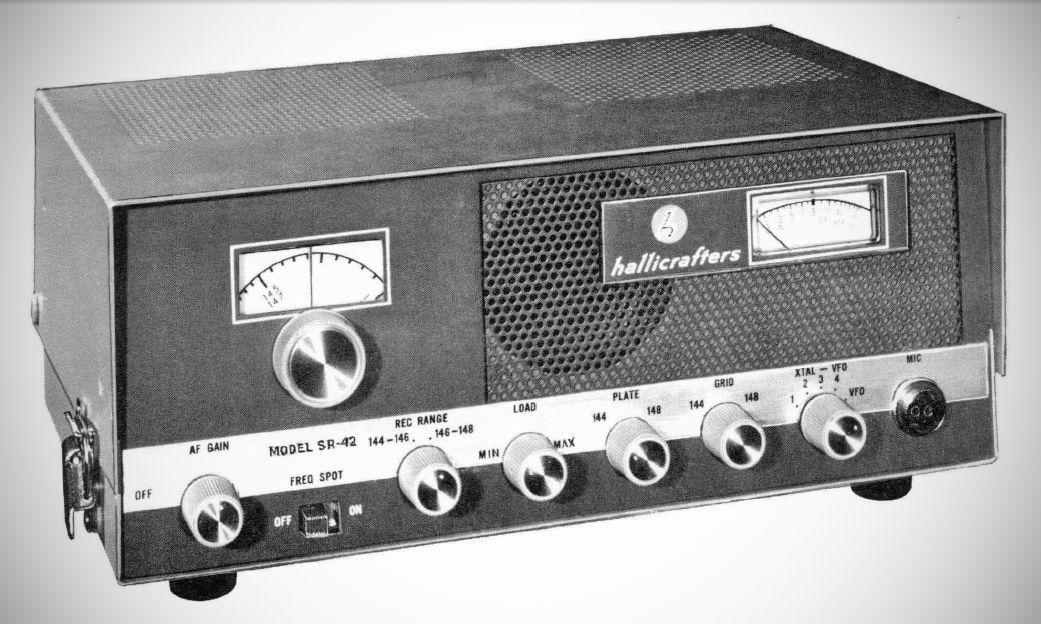
The SR-42 transceiver's two tuning ranges covered 144-146 and 146-148 MHz. Eleven tuned circuits minimized interference from broadcast and commercial services. The 11 tube set had a crystal-controlled transmitter and provisions to use the Hallicrafters HA-26 VFO. The Hallicrafters Model SR-42 is a compact, self-contained, two-meter (VHF) radio transceiver manufactured for amateur radio operations across the 144 to 148 MHz frequency band. It features a universal power supply that allows it to operate as either a 117-volt AC fixed desktop station or a 12-volt DC mobile unit (using the optional MR-40 mounting/power kit).
The SR-42 incorporates a double-conversion superheterodyne receiver alongside an AM transmitter capable of delivering 12 to 14 watts of DC power input. The unit utilizes 11 electron tubes, 4 diodes, and 2 Zener voltage regulators. It includes multi-channel crystal control, support for an external VFO, automatic noise limiting, and dual-range receiver tuning to maximize dial bandspread.
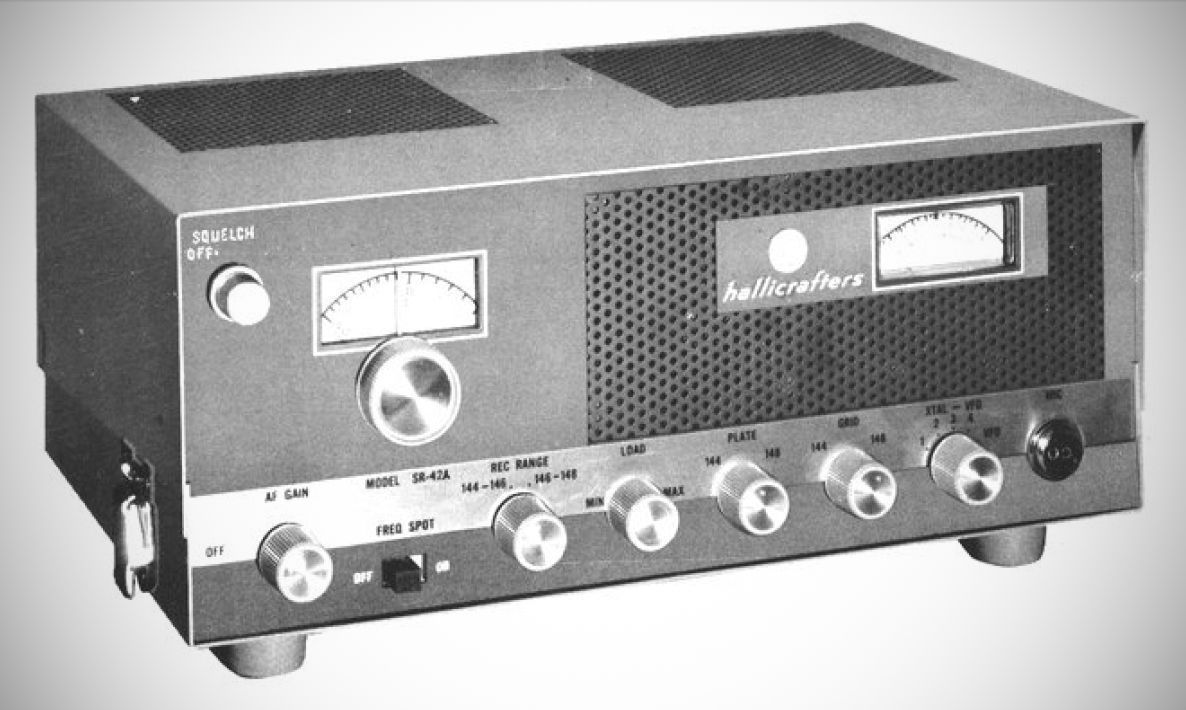
The only change in the SR-42A was the addition of squelch. A control was added at the upper left corner of the from panel.
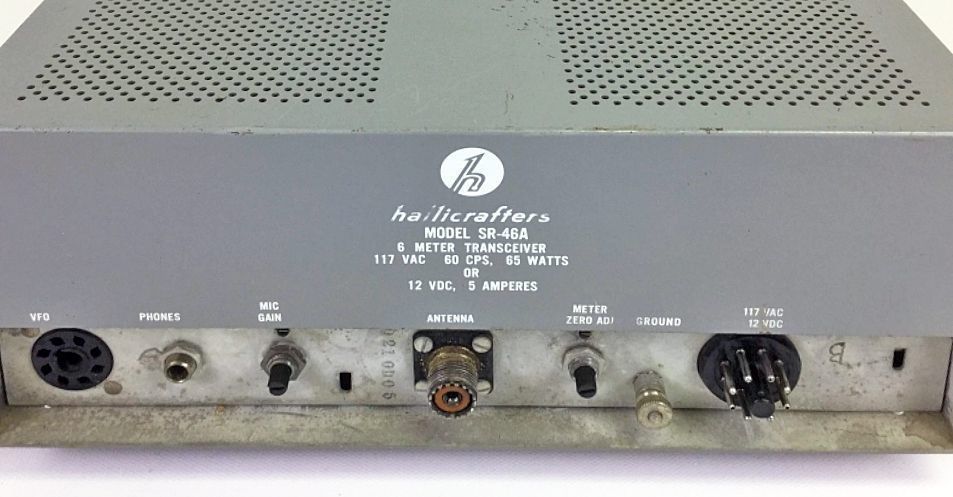
The SR-46 / SR-46A are the closely related 6 meter companions.
Features
– Double-conversion superheterodyne layout with eleven tuned RF and IF circuits.
– Neutralized-nuvistor RF stage (13CW4) paired with a low-noise triode first mixer.
– High-pass input filter and an automatic, full-time series noise limiter (ANL).
– Zener-regulated variable oscillator with planetary drive, double-spaced copper-plate tuning capacitor, and dual selectable ranges for maximum bandspread.
– Calibrated panel meter (serving as an S-meter in receive and relative RF output meter in transmit) and a heavy-duty internal speaker driven by a 1-ounce Alnico V magnet.
– 4-position panel-selected crystal socket array plus inputs for an external VFO. Uses high-frequency CR-23/U crystals (24 to 24.66 MHz) to minimize TVI.
– requency "SPOT" switch to zero-beat transmission frequency on the receiver, adjustable microphone gain control, and push-to-talk (PTT) changeover switching.
Specifications
– Frequency Coverage: 144 to 148 MHz (Amateur 2-Meter Band).
– Microphone: Accepts Amphenol 80-MC2M 2-pin connector.
– Sensitivity: 1 uV for a 10 dB Signal-to-Noise (S/N) ratio at 30% modulation.
– Noise Figure: 5 to 7 dB.
– IF Frequencies: First IF at 20.15 MHz; Second IF at 1650 KHz.
– IF Rejection: Better than 85 dB.
– AVC Figure of Merit: Better than 45 dB.
– Audio Power Output: 0.5 watt for a 1 uV, 30% modulated input.
– Input Impedance: 50 ohms unbalanced.
– Speaker Output Impedance: 3.2 ohms.
– Power Input: 12 to 14 watts.
– Emission Type: AM
– Output Impedance: 50 ohms unbalanced.
– Crystal Specifications: Type CR-23/U, 24.000 to 24.666 MHz (Fundamental frequency = Operating Frequency divided by 6).
– Microphone Input: High impedance with push-to-talk (PTT) switching.
– Audio Frequency Response: –3 dB at 300 Hz and 3800 Hz.
Companion VFO is the HA-26.
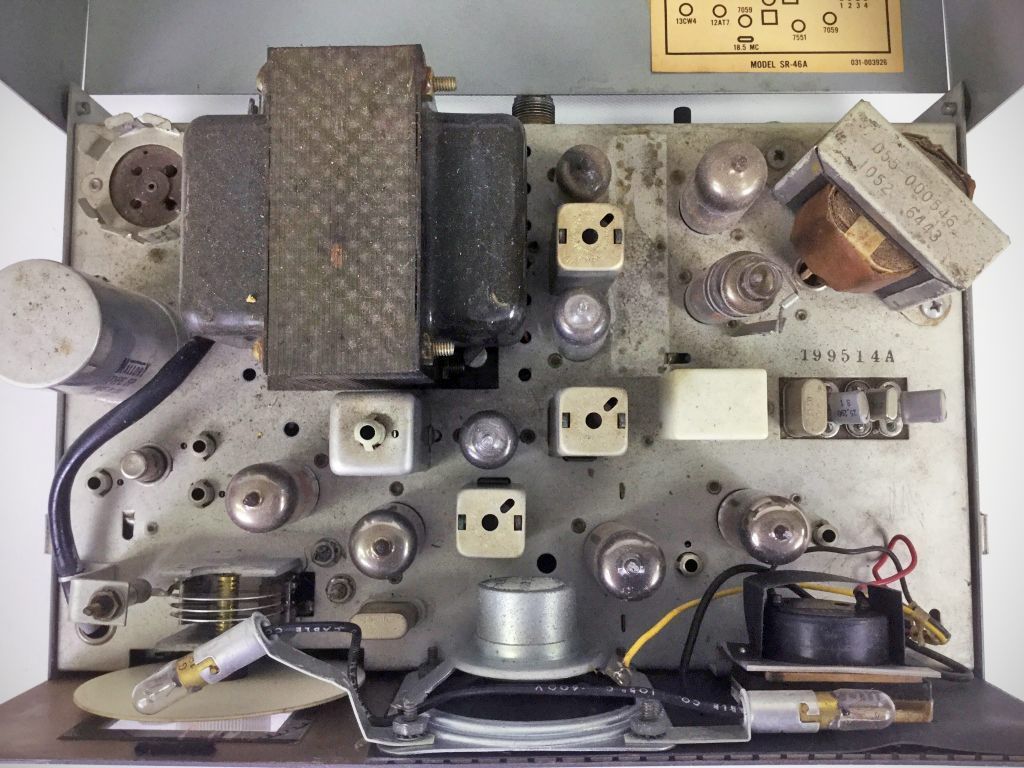
Tube Lineup (SR-42 and SR-42A)
– 13CW4 Nuvistor RF Amplifier
– 6U8A 1st Mixer & 1st High-Frequency Oscillator
– 6U8A 2nd Mixer & 2nd Local Oscillator
– 12BA6 1st IF Amplifier
– 12BA6 2nd IF Amplifier
– 12AL5 AM Detector / Noise Limiter / AVC
– 12AQ5 Audio Output / Modulator (serves as the receiver audio output and transmitter modulator)
– 7059 Transmitter Crystal Oscillator / Tripler
– 12AT7 Transmitter Doubler / Driver
– 12BY7A Audio Preamp / Speech Amplifier
– 7551 Transmitter Final RF Power Amplifier
Power Requirements
AC Power Requirements: 105–125 volts AC, 60 cycles, 65 watts maximum.
DC Power Requirements: 11–16 volts DC (negative ground), 6 amperes maximum.
References
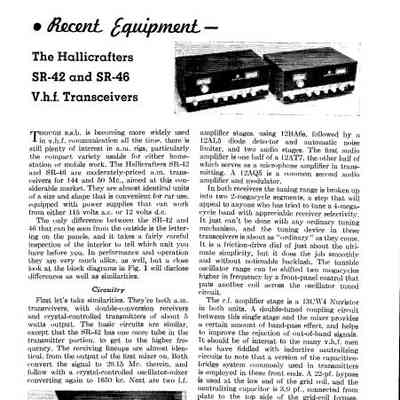
Review. QST, Jul 1965, p. 85.