Note
QST, Apr 1932, p. 96.
Radio News, Apr 1932, p. 879. (shown with the Comet, so some overlap)
QST, Jul 1932, p. 81. (1.5–20 MHz)
QST, Nov 1932, p. 69. ("new and improved")
Radio Craft, Dec 1932, p. 362.
QST, Jan 1933, p. 2.
Radio News, Dec 1933, p. 373. (now with AVC and xtal filter)
Lafayette catalog number 56, p. 65.
Radio News, Feb 1934, p. 487. (ad with info and chart re xtal filter)
Lafayette catalog number 59, p. 99.
Radio, Feb 1935, p. 3.
The Hammarlund Comet Pro is an improved version of the Comet receiver that was introduced in 1932. It has a number of enhancements over the original Comet, including:
* Sharper cutoff RF pentodes in the mixer and detector stages
* Balanced antenna inputs
* Electron-coupled oscillator for improved stability
* Higher-power audio output
* Second filter choke in the power supply for independent operation of the speaker
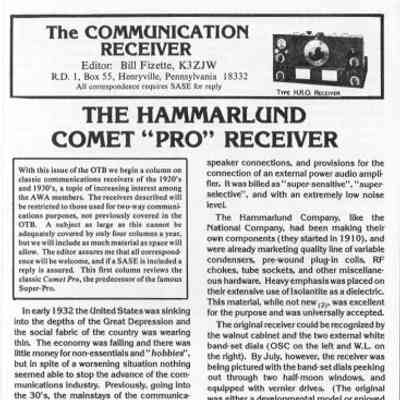
Introduced into the bleak landscape of the Great Depression in April 1932, the Hammarlund Comet "Pro" arrived at a time when hobbies were luxury items few could afford. Yet, despite economic hardships, this custom-built, eight-tube superheterodyne receiver quickly carved out a legendary reputation as a superlative listening device. It laid the groundwork for the future of shortwave listening and served as the direct predecessor to the famous "Super-Pro" line.
The Early Model: Setting a New Standard
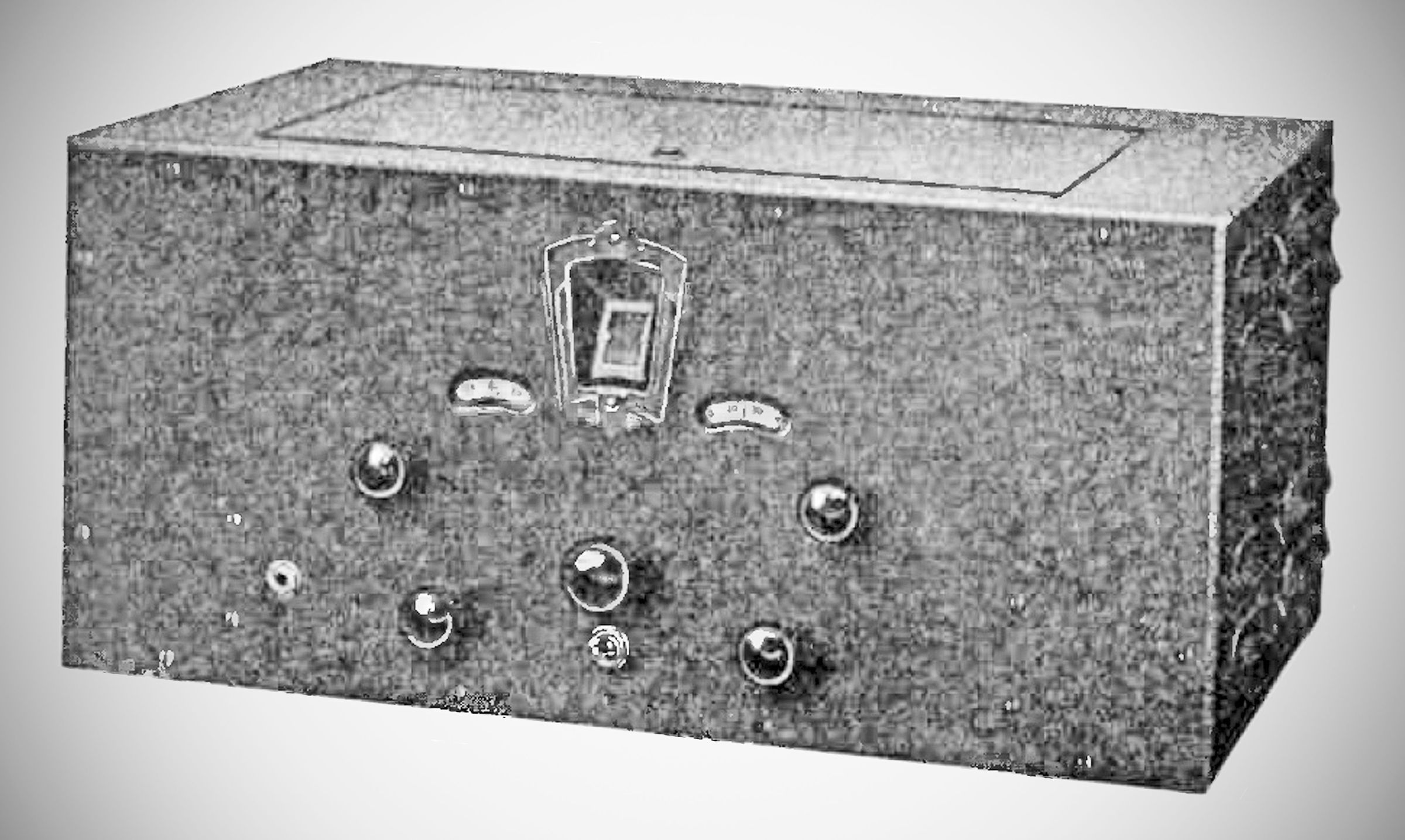
The earliest iteration of the Comet Pro stood out in the radio market with its elegant walnut cabinet and highly unique user interface. Its front panel featured two distinct external white band-set dials—the oscillator control (OSC) on the left and the wavelength control (WL) on the right. Initially covering a frequency range of 14 to 200 meters using four interchangeable sets of two plug-in coils, the receiver was a powerhouse of early 1930s innovation.
Hammarlund equipped the radio with what was then a groundbreaking feature: band-spread tuning. It also boasted a highly stable oscillator utilizing "electron coupling," a dedicated long-wave beat frequency oscillator (BFO) for exceptionally sharp and clean CW (Morse code) reception, and a quiet 227 output tube with dedicated connections for headphones or a speaker. The manufacturer leaned heavily on its 22 years of component-building experience, crafting the receiver out of high-quality, in-house variable condensers, RF chokes, and tube sockets, while extensively utilizing Isolantite as a premium dielectric material.
Marketed as "super-sensitive" and "super-selective," it was sold as a complete unit (minus the tubes) along with its power supply and all four coil sets for a premium price of $88.20.
Evolution and Technical Enhancements
Hammarlund was relentless in keeping the Comet Pro at the cutting edge of advancing technology, executing frequent physical and electronic redesigns over its lifespan:
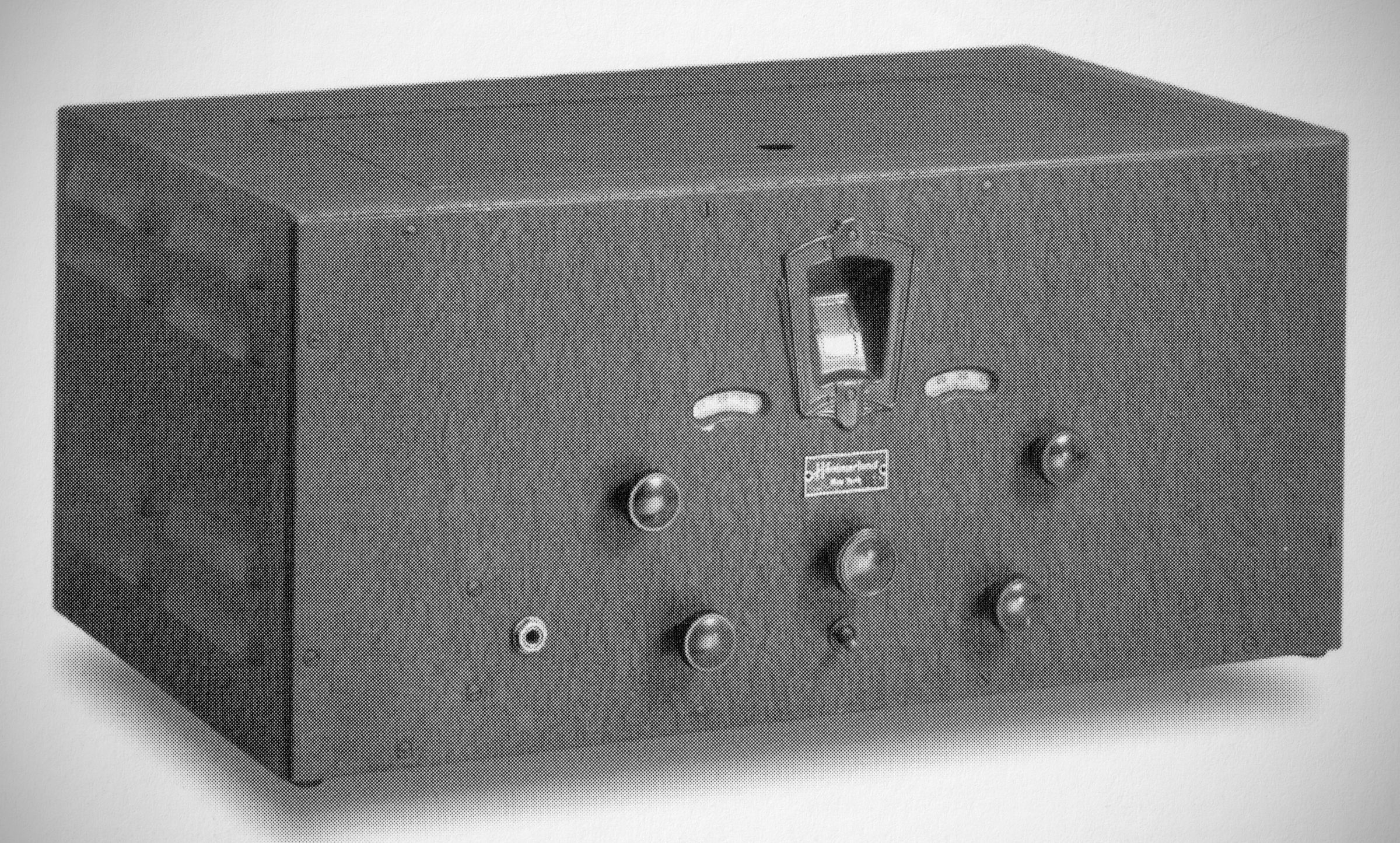
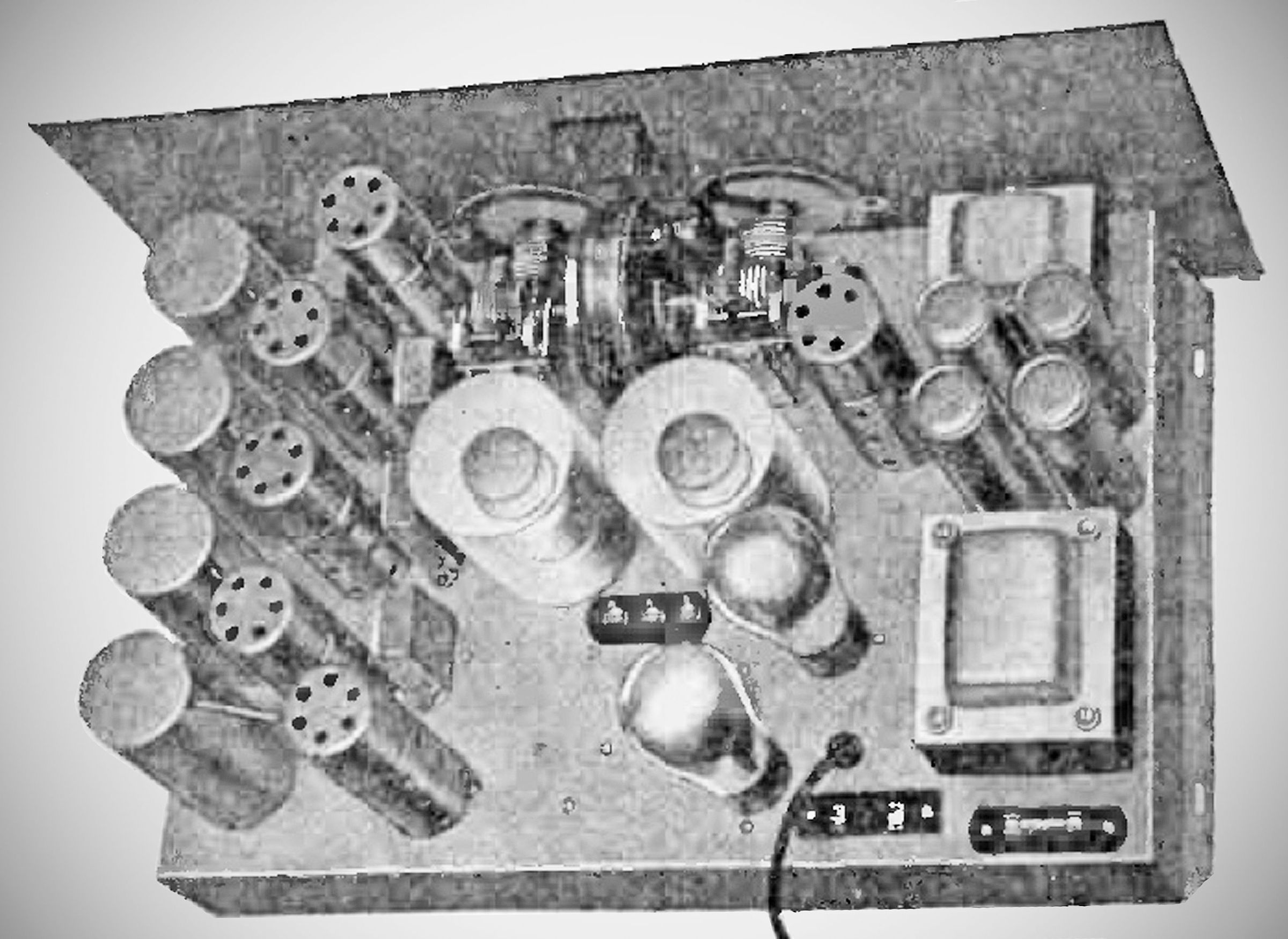
Mid-to-Late 1932 Refinements: By July 1932, the developmental look of the external white dials was replaced; the band-set dials now peeked out gracefully through two half-moon windows equipped with smooth vernier drives. By November, the circuit migrated to a modern metal cabinet, swapping the original layout for an upgraded tube lineup consisting of four 58's, two 57's, a 247, and an 80 rectifier (leaving the wood cabinet and a battery version as options).
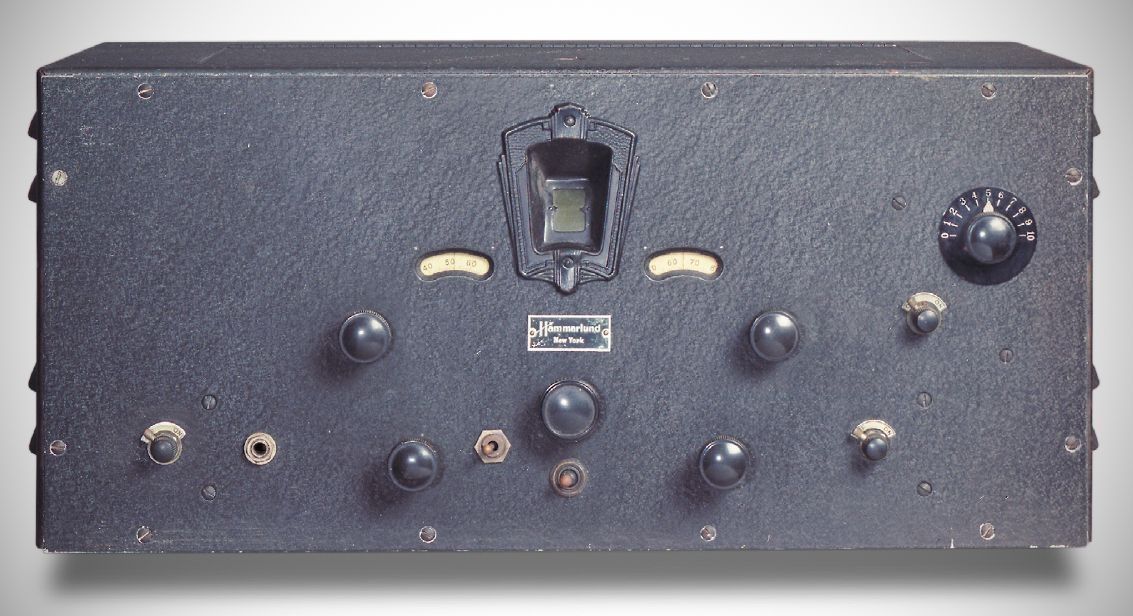
The 1933 Upgrades: February 1933 brought massive upgrades in the form of air dielectric IF tuning condensers and a distinct, pivoting BFO tuning "handle" that swept across a $90^\circ$ range on the chassis. By September, a highly effective quartz crystal filter was integrated to handle single-signal reception, introducing an "elimination control" knob to the upper right corner of the front panel.
The AVC Era: In November 1933, Automatic Volume Control (AVC) was introduced. Because the AVC circuitry required an additional tube and coil can, the antenna terminals had to be migrated to the back of the chassis. Front panels from this era are easily identified by a brand-new nameplate reading HAMMARLUND NEW YORK centered just below the bandspread dial.
To satisfy different power capabilities and operator preferences, the lineup eventually expanded into a family of seven distinct models—including specialized DC variants (running 110V or 220V via 77, 78, and 43 tubes) and a battery-operated model. The frequency coverage also swelled to include everything from 8 to 550 meters across six total coil sets.
A Lasting Legacy
Because of its exceptional sensitivity (0.5 µV) and selectivity (10 kHz), the Comet Pro became an indispensable tool during the 1930s. It wasn't just beloved by amateur "ham" radio operators; it was widely adopted by commercial shipping operators, airport engineers, broadcast stations, police forces, and military entities around the globe.
By 1935, the landscape was changing. Competitors like National were introducing radios with dedicated RF amplifier stages (preselectors) to boost performance. Lacking an RF stage, the aging architecture of the Comet Pro began to show its age. Hammarlund attempted one final continuous variable coupled IF transformer retrofit in early 1935, but the writing was on the wall. In March 1936, the 16-tube "Super Pro" was officially released, and the legendary four-year run of the original Comet Pro came to a close, cementing its place in communications history.
Standard Pro, $88.20
Comet Pro with crystal filter, $105.84
References
Review, part 1. Radio News, Aug 1932, p. 90
Review, part 2. Radio News, Sep 1932, p. 159.
Review, part 3. Radio News, Oct 1932, p. 224.
Review (improved version), part 1. Radio News, Jan 1933, p. 418.
Review (improved version), part 2. Radio News, Feb 1933, p. 483.
Brief description. Radio News, Feb 1936, p. 473.