Note
Concord catalog 4-46 (1946), p. 112.
QST, Oct 1945, p. 9.
Lafayette catalog number 88 (1947, copyright 1946), p. 98.
Allied Radio catalog 1951 (copyright 1950), p. 141.
QST, Jul 1951, p. 86.
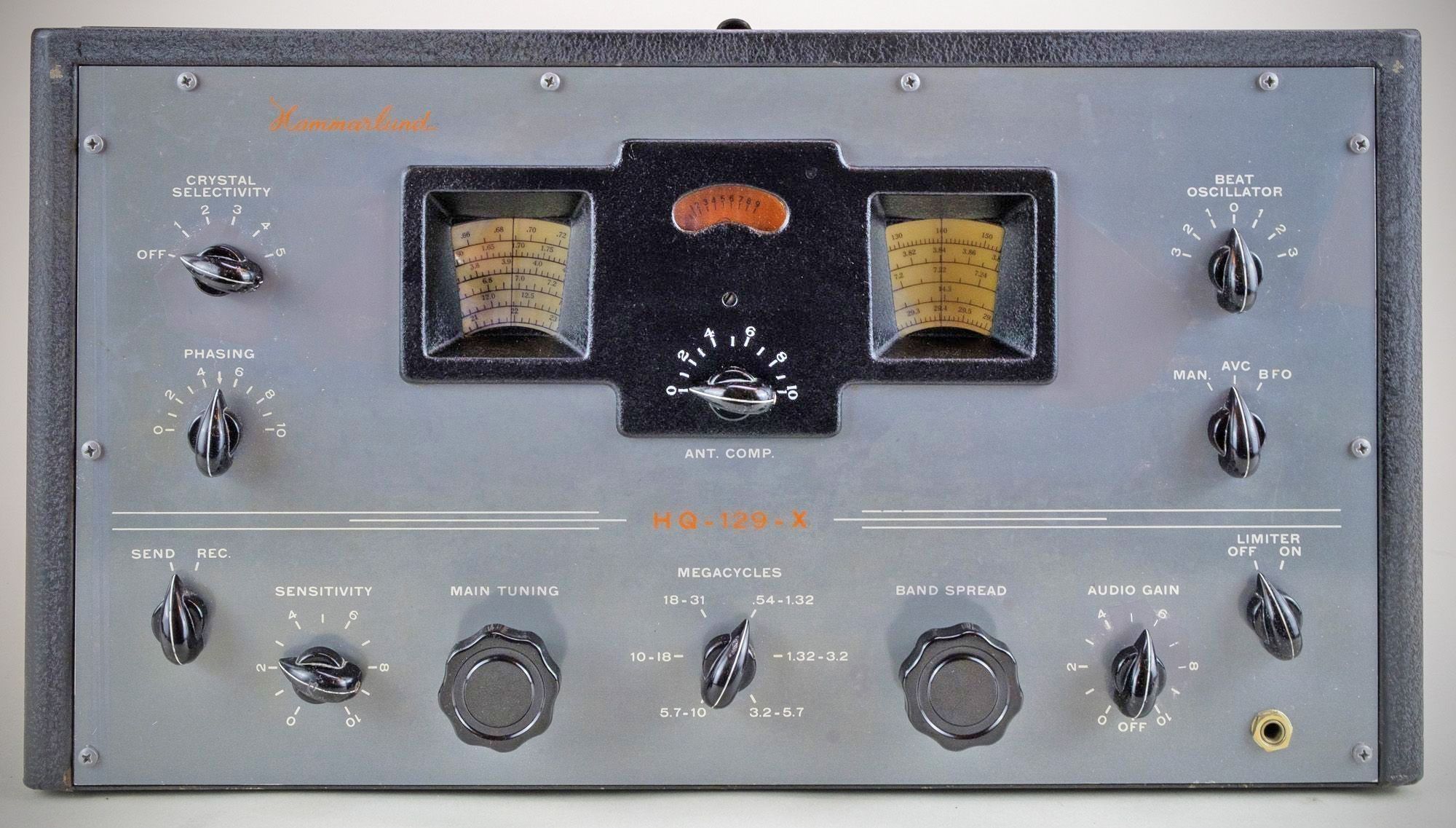
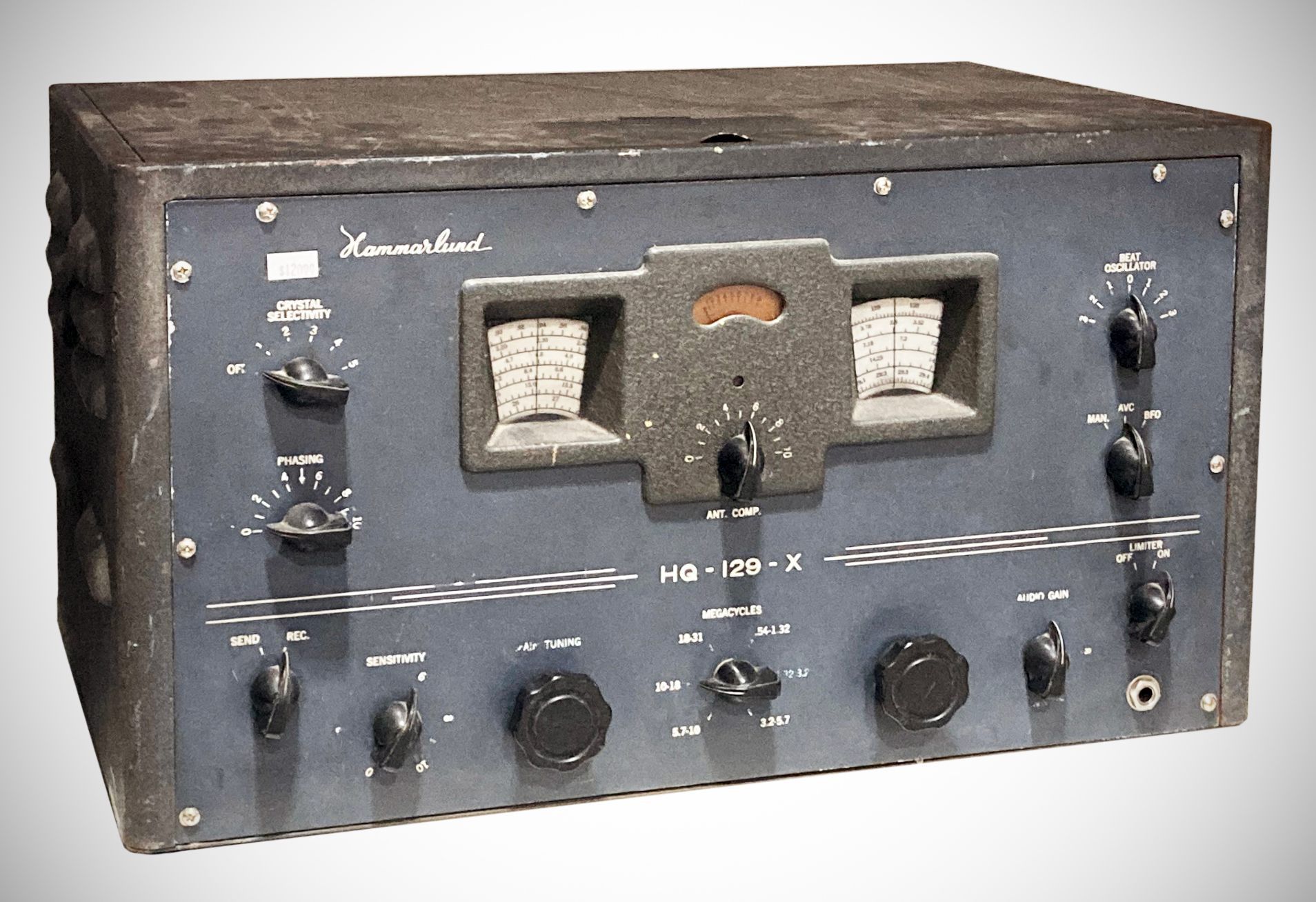
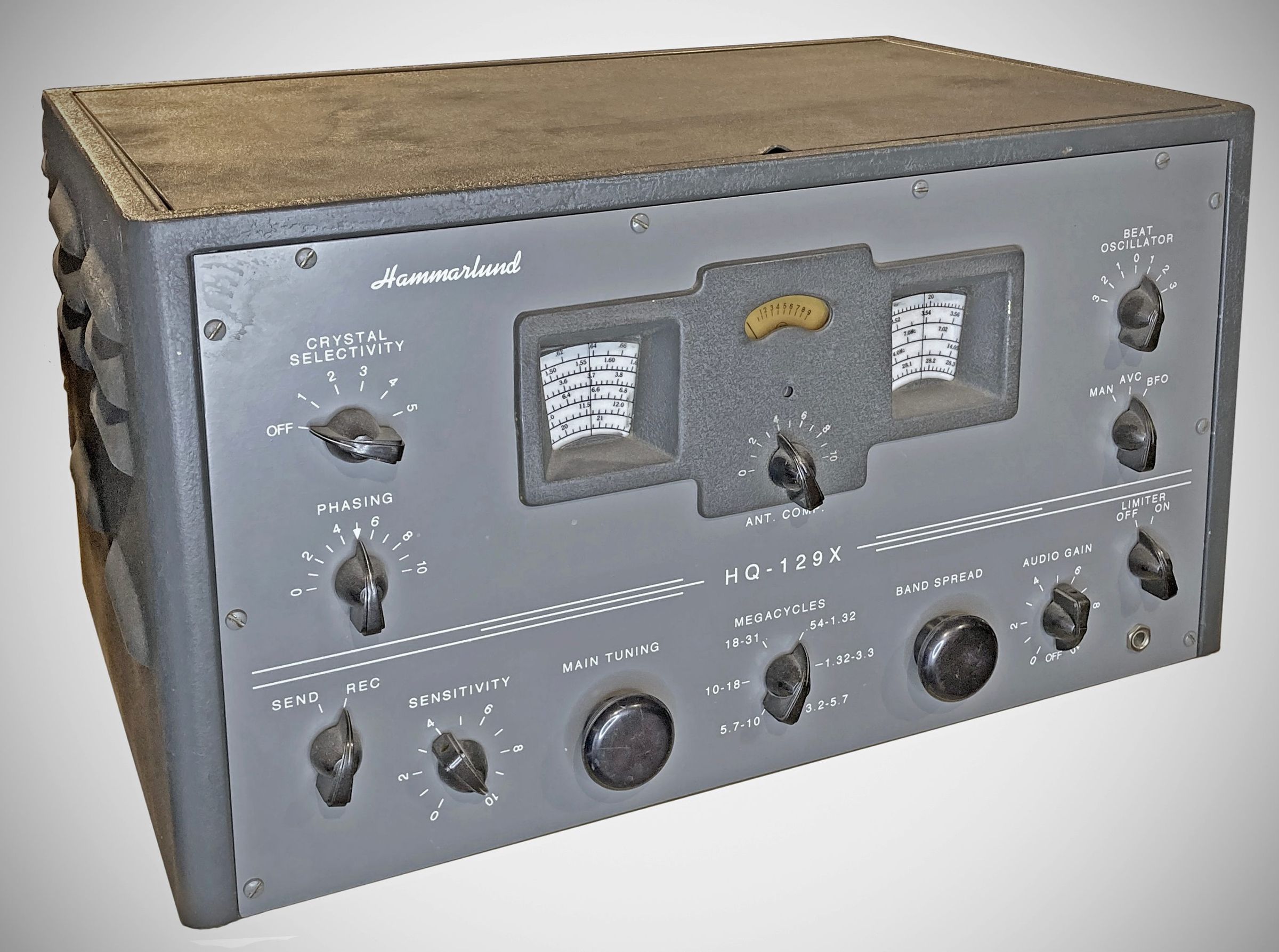
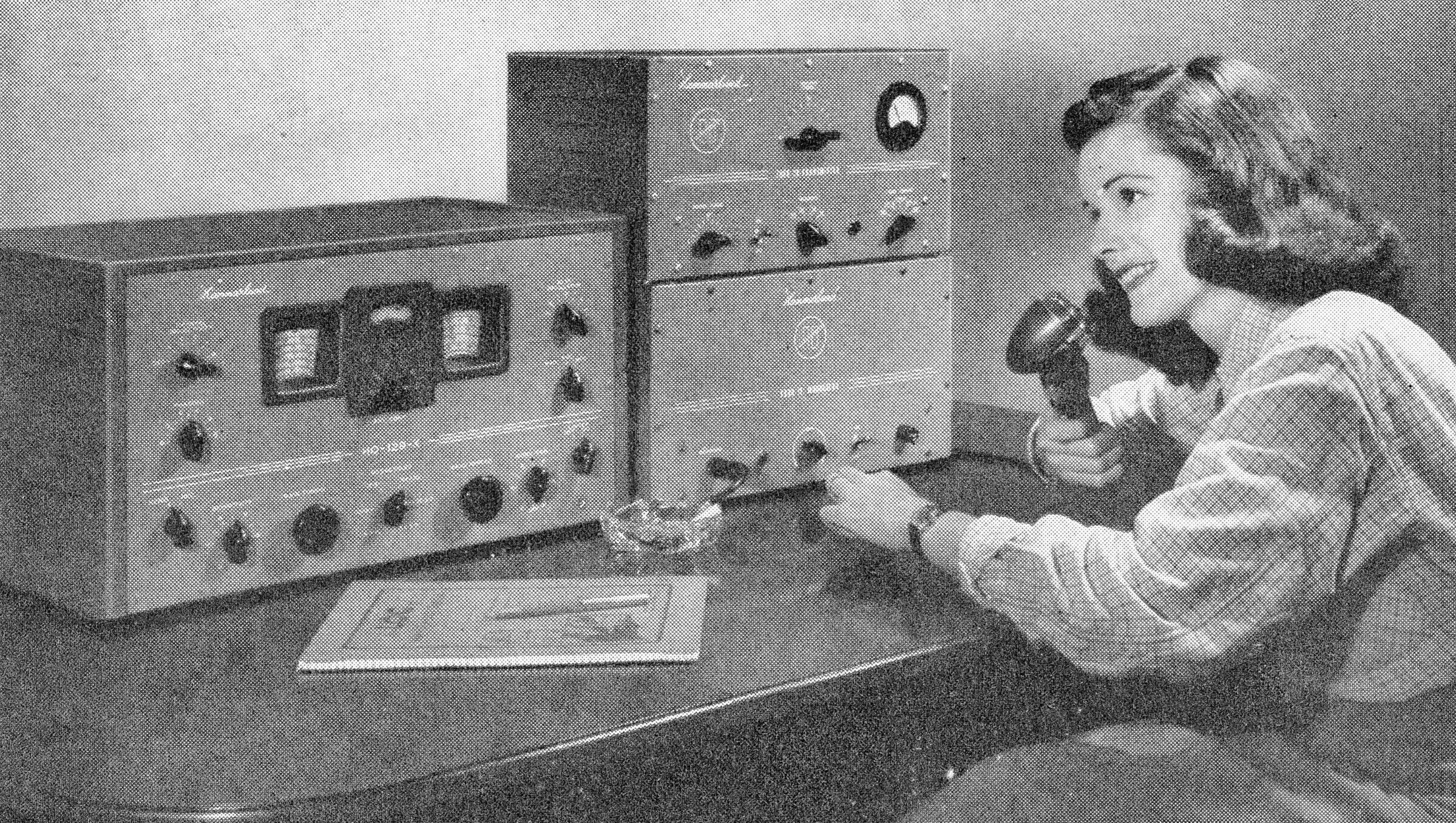
Introduced in 1945, the HQ-129X was an immediate post-WWII favorite for amateurs and shortwave listeners. Production ran until 1953. It is the second member of a receiver family that began with the pre-war HQ-120X, and its design lineage continues through the HQ-140X, HQ-150, HQ-160, and HQ-180.
It was initially priced at $129 in 1946 as a marketing ploy, but due to production costs, the price eventually rose to $180, and finally reached $239 by the end of its run in 1953. Because of its immense popularity, it remains highly common in flea markets today compared to its contemporary competitors.
The 129X is a single-conversion superheterodyne receiver. It covers a continuous range from 550 kHz to 30 MHz spread across six distinct bands, and features calibrated bandspread tuning for the 80, 40, 20, and 10-meter amateur bands, with later production models adding coverage for the 15-meter band.
Unlike competitors that used three-section capacitors, Hammarlund utilized a specialized nine-section bandspread and six-section main tuning capacitor system. The rotor plates are centered in the stator assembly and built with materials designed to minimize thermal expansion, significantly reducing frequency drift during warm-up.
It delivers a modest 3 watts of audio output via a single 6V6 tube.
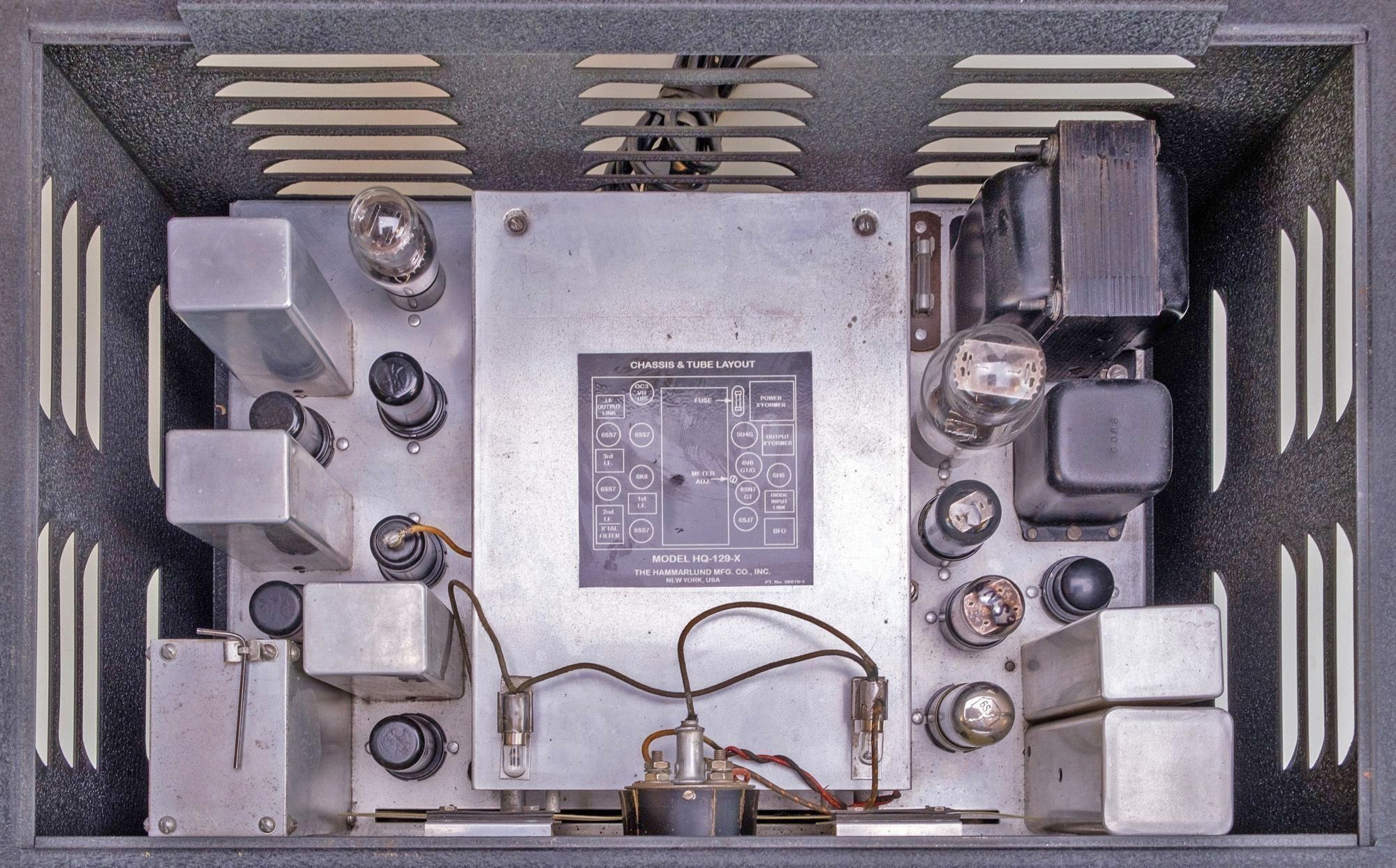
Tube Lineup
The receiver utilizes a single-ended tube architecture (shifting away from the "double-ended" grid-cap tubes of its pre-war predecessor). The specific lineup includes:
– RF Amplifier: 6SS7
– Converter (Mixer/Local Oscillator): 6K8
– IF Amplifiers: Three 6SS7 tubes
– Detector / AVC / Noise Limiter: 6H6
– First Audio / S-Meter Amplifier: 6SN7
– Audio Output: 6V6
– BFO: 6SJ7
– Rectifier: 5U4
– Voltage Regulator: VR105
Strengths
– Mechanical Stability: The radio is described as being built "solid as a rock," making it highly resilient to shock and vibration.
– Excellent Skirt Selectivity: While many competitors used only two IF amplifiers (six tuned circuits), the HQ-129X employs three IF stages with eight total tuned circuits, resulting in noticeably sharper skirt selectivity. However, this requires a sweep generator and oscilloscope to align properly.
– Advanced Crystal Filter: It features a top-notch variable selectivity crystal filter. With the filter off, the bandwidth is roughly 6.5 kHz (ideal for AM phone). Engaging crystal positions 1 through 5 progressively sharpens the bandwidth down to narrow windows ideal for cutting through interference or operating CW (Morse code). The crystal phasing notch can reject off-frequency interference by up to 86 dB.
Weaknesses
– High-Frequency Noise: The combination of a relatively low-gain 6SS7 RF amplifier and a high-noise 6K8 converter means that above 15 MHz, the receiver's internal front-end noise tends to dominate external antenna noise. As a result, it is not considered a sensitivity champion on 20, 15, and 10 meters when compared to period rivals like the National NC-173 or Hallicrafters SX-43 (a limitation operators often mitigated by adding an outboard RF preselector).
References
Improvements. CQ, May 1959, p. 38.
Adding a product detector. CQ, Apr 1963, p. 36.
QST, Sep 1947, p. 87. (interesting photo)
Concord catalog 9-47, p. 153.
Allied Radio catalog 1952 (copyright 1951), p. 138.
Allied Radio catalog 1953 (copyright 1952), p. 37.
Key words:
HQ-129X
HQ-129