Note
Summary: A two-part article by Alan Douglas on the history, rise, and fall of the Adams-Morgan Company and its famous Paragon radio line.
Part I: Foundations and Early Success
Origins: Founded around 1910 by Alfred P. Morgan as a mail-order wireless component business. Morgan was a prolific author of technical books for amateurs (such as The Boy Electrician) and briefly attended MIT.
The Birth of Paragon: In 1914, engineer Paul Godley adapted Edwin Armstrong’s regenerative circuit principles to short wavelengths. Seeking a manufacturer, Godley invested in Adams-Morgan.
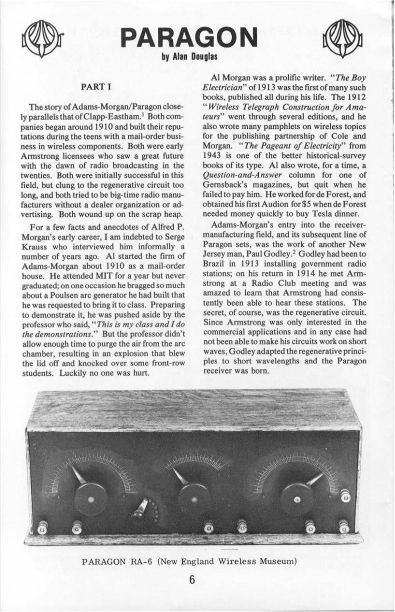
The RA-6: In October 1916, they released the Paragon RA-6 regenerative receiver for $35, which became highly popular among amateur ("ham") radio operators.
Wartime & The Broadcasting Boom: After pivoting to wartime contracts during WWI, Godley returned to design the RA10 receiver to capitalize on the 1920s commercial radio broadcasting boom. To focus strictly on manufacturing, Adams-Morgan partnered exclusively with the Continental Radio & Electric Company to handle all marketing and distribution.
Part II: Evolution, Missteps, and Decline
Product Expansion: Released in early 1921, the RA10 was a major success, leading to companion pieces like the DA2 detector-amplifier and the 2-5-U Radiophone transmitter.
Obsolescence Creeps In: By late 1923, the company introduced the RB2 and the Model III/IIIA. These were the final models Godley assisted with; despite their beautiful craftsmanship, the internal designs were antiquated, causing sales to plummet and prices to be heavily slashed.
Failed Pivot and Receivership: In January 1925, Adams-Morgan attempted to compete with budget manufacturers like Crosley by introducing the lower-priced Paragon Two, Three, and Four lines. However, lacking effective merchandising and choked by a lack of advertising, the line fell flat.
The End of the Company: Adams-Morgan entered receivership on January 21, 1926. It was bought out later that year and renamed the Paragon Electric Corporation, but it failed to regain traction. By June 1928, the operation moved to New York City, fading out entirely as a manufacturer and serving merely as a commercial testing laboratory.
At its peak between 1922 and 1923, the factory employed between 50 to 100 people. True to the era's independent manufacturing style, almost every single part of their radios—with the exception of transformer coils—was fabricated completely on the premises.