Note
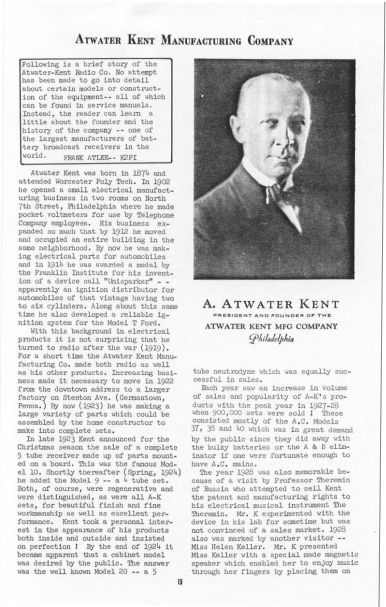
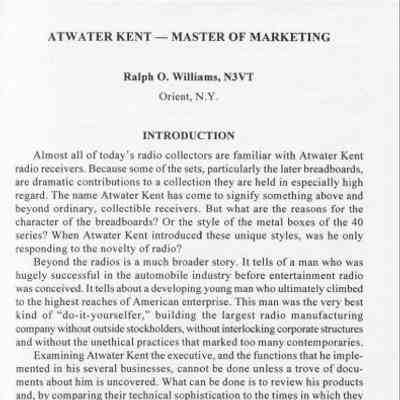
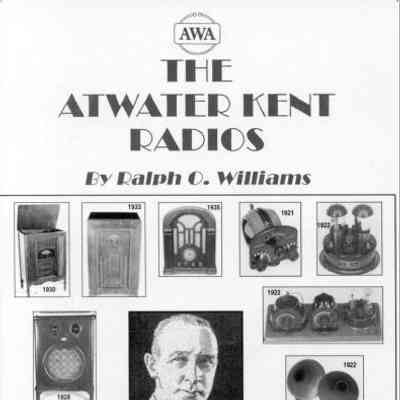
Here is a summary of the article detailing the history of the Atwater Kent Manufacturing Company and its founder, written by former employee Frank Atlee:
Company Origins and Automotive Success
Early Beginnings: In 1902, Atwater Kent opened a small electrical manufacturing business in Philadelphia producing pocket voltmeters. The business grew rapidly, moving to a full building by 1912.
Automotive Inventions: Kent transitioned into manufacturing electrical parts for automobiles. He was awarded a medal by the Franklin Institute in 1914 for inventing the "Unisparker" ignition distributor and also developed a highly reliable ignition system for the Model T Ford.
The Radio Boom (1920s)
Transition to Radio: Following World War I, Kent began manufacturing radio components. By 1923, the company was producing a vast array of parts for home assembly.
Complete Receivers: In late 1923, Kent introduced the popular Model 10 (a 5-tube receiver mounted on a board), followed by the Model 9 in 1924. Recognizing a shift in public demand, he introduced the successful Model 20 cabinet model later in 1924.
Peak Years: The company reached its sales peak during 1927–1928, selling 900,000 sets. Popularity surged due to AC-powered models (Models 37, 38, and 40) that eliminated the need for bulky batteries.
Notable 1928 Visitors: Professor Theremin visited to pitch his electronic musical instrument (though Kent declined the market rights). Helen Keller also visited and was gifted a custom magnetic speaker designed to let her feel music through her fingertips on the vibrating cone.
Decline and Closure
Market Shifts: Though initially resistant to making console radios, competition forced Kent to release a console set with a dynamic speaker in 1930. However, the 1929 stock market crash severely decreased demand for high-priced units. As competitors pivoted to low-cost, low-profit table models, Kent lost his market dominance.
The End of an Era: Losing interest in the business, Kent turned his focus toward hobbies like collecting antique cars and grandfather clocks. The factory closed permanently in June 1936 after a failed attempt to sell the company and its goodwill for $11 million. Longtime employees were given several months of severance pay, with many finding work at competitors like RCA and Philco.
Kent's Legacy: Kent retired to a lavish estate in Hollywood, California, where he passed away on March 4, 1949, at age 75. He established the free Atwater Kent Museum in Philadelphia to preserve marine history.
##########
From the AWA Old Timer's Bulletin Vol 9 No 1, 1968. Courtesy Antique Wireless Association
LOS ANGELES, April 22 [1949] (AP) —The estate of A. Atwater Kent will total approximately $8,500,000, it was indicated today. [about $118 in 2026]
The will of the retired radio manufacturer and philanthropist, which included many bequests to film star friends, was admitted to probate today. He died March 4 in his Bel-Air home.
The court ordered executors of his estate to post a surety bond of $8,500,000, pending distribution of his property. The amount of bond fixed indicates the value of an estate.
The largest single bequest was $2,000,000 to Mrs. Mabel Lucas Kent, from whom he had been legally separated for years.
Amounts ranging from $3,000 to $18,000 were left to many persons of the film and stage world, including Edgar Bergen, Greer Garson, Claire Windsor, and Cornel Wilde, and other prominent persons, among them Sir Charles Mendl, Lady Elsie DeWolfe Mendl, Gloria Morgan Vanderbilt, and Thelma Morgan Furness.
#######
Also see Popular Electronics, July 1969, p. 33. "Whatever Happened to Atwater Kent."