Note
Here is a summary of the article detailing the history of the Clapp-Eastham Company:
Company Origins and Leadership Shifts
Founding: The company began in 1906 when Melville Eastham, sales engineer J. Emory Clapp, and chief engineer William O. Eddy partnered to manufacture X-ray equipment.
Early Pivots: In 1908, Eddy left, and the firm officially became the Clapp-Eastham Company, shifting its concentration heavily away from X-ray technology to wireless radio components.
Founder Departures: Clapp sold his stake in 1910 to O. Kerro Luscomb. In 1915, Eastham and Luscomb co-founded the General Radio Company to pursue radio measuring instruments. By 1917, they exchanged interests, leaving the Clapp-Eastham Company running with neither Clapp nor Eastham involved.
Product Development and Peak Success
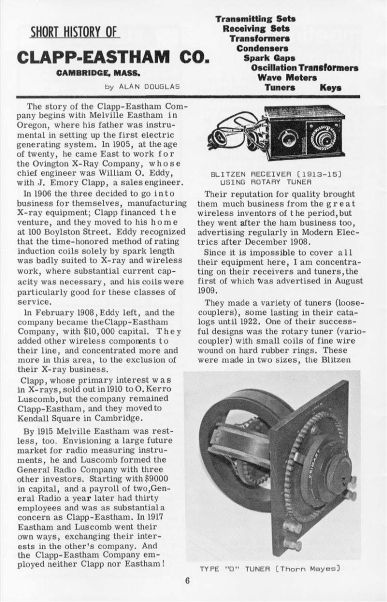
Early Innovations: Clapp-Eastham built a strong reputation for quality wireless technology among early amateur operators ("hams") and inventors. Notable early successes included loose-couplers, complete receiving sets (like the $550 Type AF in 1914), and rotary tuners (vario-couplers) built with hard rubber rings.
The Broadcast Boom: In April 1920, Clapp-Eastham secured the first post-WW1 Armstrong regenerative license. This allowed them to cash in on the early 1920s broadcasting boom with their highly popular, reasonably priced Model HR receiver ($35–$40) and matching HZ two-stage amplifier.
The "Radak" Era: In late 1922, the company introduced the trademark RADAK for its simplified radio models. Their last massive seller was the single-tube R4 receiver in late 1923, which was also distributed through the United Cigar Store chain under the name "Unico Special".
Decline and Move to New York
Quality and Tech Issues: Despite functional designs, the construction quality of later broadcast models declined. The company hurt its standing by clinging to outdated regenerative circuits and cutting corners, such as literally cutting leftover Model HR nameplates in half to reuse on newer sets.
Downsizing: Competitors like Crosley capitalized on heavier advertising with similar technology, causing Clapp-Eastham to shrink dramatically after mid-1924.
The Final Chapter: In May 1926, President Verner A. Hendrickson announced that the company was moving its plant from Cambridge, Massachusetts, to the Chicle Building in Long Island City, New York. Though a large-scale reorganization promised volume production of a new, single-dial radio frequency receiver line, the historic manufacturer ultimately faded out of operation.