Note
This article outlines the history of Cutting & Washington (C&W), an early pioneer radio manufacturing firm founded by Dr. Fulton Cutting and Bowden Washington.
Founders and Formation
Fulton Cutting: Born into a wealthy New York family in 1886, Cutting earned multiple degrees from Harvard and served as president of the Institute of Radio Engineers (IRE) in 1922.
Bowden Washington: Born in Maine in 1892, Washington was an experienced radio engineer who met Cutting while assisting at Harvard’s Cruft Laboratory in 1915.
The duo began developing wireless telegraph equipment at Cruft Labs, securing a patent for a quenched spark gap from E. Leon Chaffee, and formed their partnership around 1916.
Business Evolution and Product Line
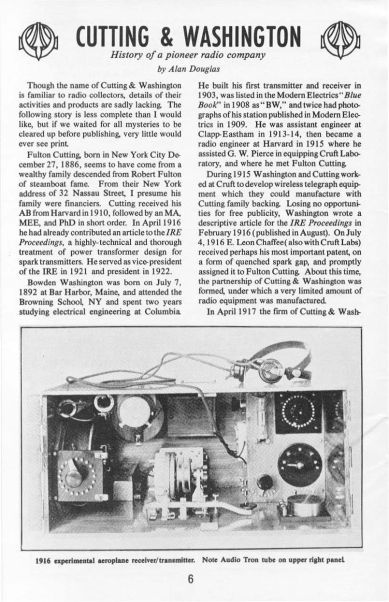
Early Successes: Incorporated in New York in 1917, the company sold 1,000 impact excitation transmitters to the U.S. government for $750 each and produced lightweight airplane transmitters.
Expansion: Re-incorporated in 1919 in New York City, they maintained a commercial coastal radio station (WSA) and obtained an Armstrong license in 1920 to produce consumer broadcast receivers. Their first notable public receiver, the Model 11 , was introduced in 1922.
Relocation to Minneapolis: Lacking their own manufacturing plant, C&W relied on subcontractors. Production difficulties and high demand prompted a move to Minneapolis in September 1922 to partner with the Minneapolis Heat Regulator Company. Upon arrival, they also took over the radio station WLAG .
Manufacturing Adjustments: Following issues with their first Minneapolis partner, they turned to the Automatic Electric Company, releasing models like the 11A, 11B, 12A, and 15 in late 1923.
Legal Troubles and Decline
Westinghouse Lawsuit: In December 1923, Westinghouse (the Armstrong patent owner) won a pivotal court decision that prohibited C&W from selling their products through jobbers, distributors, or dealers, severely crippling their sales model.
Receivership: Despite introducing a new "Teledyne" radio in early 1924, Cutting & Washington went into receivership by August 16, 1924. Their radio station WLAG closed but was ultimately revived by the Washburn-Crosby Company under the call letters WCCO .
Post-C&W Legacy
Following the company's collapse, Cutting and Washington moved to Long Island to form Colonial Radio later in 1924. Free from the necessity of the Armstrong license due to technological shifts, Colonial grew by absorbing other companies before eventually being acquired by Sylvania in 1944.