Note
Here is a summary of The EIMAC Story:
Company Origins
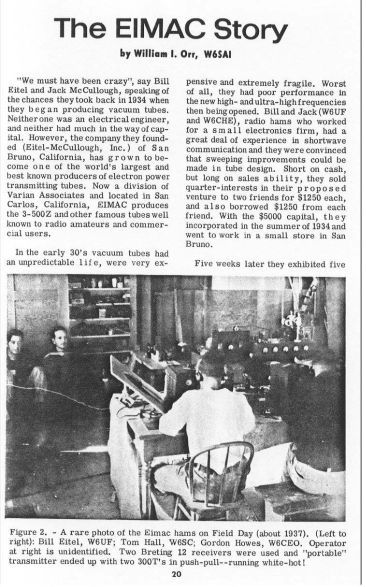
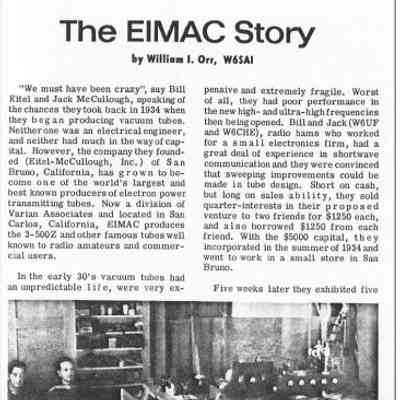
Founding: In the summer of 1934, radio amateurs Bill Eitel ($W6UF$) and Jack McCullough (W6CHE) incorporated Eitel-McCullough, Inc. in San Bruno, California.
Motivation: They aimed to improve upon the unpredictable life, fragility, high cost, and poor high-frequency performance of early 1930s vacuum tubes.
Starting Capital: Lacking significant capital, they raised $5,000 by selling quarter-interests and securing loans from two friends.
Early Gamble: Their first five exhibition tubes at the ARRL Convention were actually "duds" with cracked filament stems, but the defects went unnoticed. They launched a successful ad in QST magazine in November 1934 selling the EIMAC 150T triode for $24.50, establishing a steady stream of orders.
Growth and World War II Expansion
Product Line Expansion: By 1936, the company repaid its loans, built a new plant, and expanded its tube lineup to include models like the 35T, 50T, 300T, and larger variations.
Mass Production Shift: In July 1940, a massive order of 10,000 tubes from Western Electric forced the company to rapidly transition from manual hand-crafting to mass production. By 1941, they began hiring women for production work.
The War Effort: During WWII, Eimac expanded further, opening a plant in Salt Lake City. Tube production peaked at over 100,000 per month by the end of the war, with their designs proving highly valuable for military radar equipment.
Investor Returns: The original investors saw massive returns; one sold their quarter-share back in 1941 for $57,000, and the other sold theirs in 1945 for about $223,000.
Post-War Era to Acquisition
Post-War Adaptation: Eimac survived the post-war glut of cheap government surplus tubes by introducing advanced new tetrodes (4-125A, 4-250A, and 4-400A).
Diversification: In the 1949 and 1950s, the company manufactured black-and-white TV picture tubes, converted to power tubes during the Korean War, and expanded into microwave technology (producing high-power klystrons and traveling wave tubes).
Acquisition: In 1965, Varian Associates bought a controlling interest in the company, transforming it into the EIMAC division of Varian based in San Carlos, California.