AWA Old Timer's Bulletin Vol 26 No 4 1986. Courtesy Antique Wireless Association
Name/Title
History of Gilfillan Brother Radio Manufacturers
Scope and Content
History of Gilfillan Brother Radio Manufacturers
Category
Company Histories
General Notes
Note
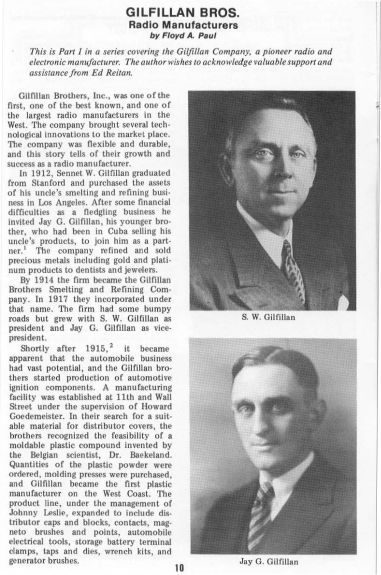
This article presents a comprehensive historical overview of Gilfillan Brothers, Inc. (later Gilfillan Corp. and ITT Gilfillan), tracing its evolution from a fledgling Los Angeles precious metals refinery established in 1912 into one of the largest and most technologically innovative radio and electronics manufacturers on the West Coast.
Founded by brothers Sennet W. and Jay G. Gilfillan, the company demonstrated exceptional adaptability by continually shifting its product lines in response to economic conditions. Key operational pivots included:
Entering the automotive ignition market after 1915 and becoming the first plastic manufacturer on the West Coast using Bakelite molding.
Transitioning into radio component manufacturing in 1922 and co-founding the Independent Radio Manufacturers, Inc. (IRM) to counter RCA's early circuit patent monopolies.
Introducing pioneering technologies, such as the West Coast's first Neutrodyne receivers (1924), shielded constant gain Neutrodynes (1926), and early commercial television receivers (1939).
Following a landmark legal confrontation with RCA in 1927, Gilfillan secured exclusive territorial rights to RCA patents across eleven western states. This prompted a highly successful marketing strategy focused on the American West and catalyzed the 1930s "midget" or mantel radio boom. Furthermore, the article details Gilfillan’s extensive contract manufacturing operations.
Operating from factories in Los Angeles and San Francisco, the company served as a massive manufacturing hub that produced chassis and fully integrated licensed sets for dozens of regional brands—such as Packard Bell, Jackson Bell, and Echophone—while navigating the strict royalty regulations and legal crackdowns of the era.