Note
By G. J. Gray
Summary of the Grebe Radio Story:
The Foundations of Grebe Radio
Alfred H. Grebe's Early Start: Born in Richmond Hill, Long Island in 1895, Grebe began tinkering with radio at a young age. At 14, he built a workshop in his mother's backyard to construct high-quality loose couplers, launching his business in 1909.
Maritime Experience: Instead of attending college, Grebe spent three years as a sea-going wireless operator. His experiences with crude commercial spark equipment gave him a practical, firsthand understanding of transmission conditions. His time spent traveling the Orient later inspired his company's iconic "Dr. Mu" advertisements.
Company Growth: Returning home to a rapidly growing interest in radio, Grebe began building custom equipment and issuing small catalogs. Though a self-trained engineer without a college degree, his talent for high-quality craftsmanship drove company expansion until the Grebe plant was capable of producing 10,000 receivers in 1926.
Engineering Excellence and Innovation
High Quality and Innovation: Every part of a Grebe receiver was built to demanding standards inside the Grebe plant. The company developed and patented several technologies, including automatic filament control, molded bakelite variometers, calibrated rheostats, and tangent wheel verniers.
The Famous CR Series: Grebe introduced an illustrious line of receivers starting with the CR-1 in 1919 (a 1-tube shortwave regenerative receiver). The line evolved through various models to accommodate different wavelengths, relay operators, and the amateur radio market, culminating in models like the CR-13 and the low-loss plug-in coil CR-18.
Collaborative Design: Grebe was a tireless experimenter who would keep his engineering staff up all night to build "breadboard" models of new ideas. Prominent inventors and engineers of the time—such as Major Edwin Armstrong, Stewart Ballantine, John Hogan, and Chief Engineer Bill Diehl—contributed to testing and refining Grebe products.
Broadcasting and Notable Milestones
Broadcasting and Mobile Stations: Grebe built and operated early broadcast stations WBOQ and WAHG (which later became WABC). The company also established the first marine broadcast station (WRMU) on the company treasurer's yacht, and developed the first mobile transmitter (WGMU) inside a car to broadcast remote events like horse races.
Milestones: Grebe equipment accompanied Admiral Byrd's first expedition to the South Pole. Additionally, Grebe's Service Director, Ted Ostman (2OM), won the 1922 Hoover Cup for excellence in amateur design and operation.
The Synchrophase Era: In 1926, Grebe moved into popular broadcast receivers featuring the "Synchrophase" circuit and "binocular" coils designed to prevent stage interaction.
The End of an Era
Liquidation: Alfred Grebe was a modest perfectionist dedicated to top-tier quality. However, the economic collapse of the 1929 Great Depression severely reduced the market for luxury, high-quality receivers, forcing the company to liquidate in 1932.
Grebe's Passing: In 1935, just as Grebe completed plans to launch a new company with a 1936 line of receivers, he underwent a serious operation. Following complications, Alfred H. Grebe passed away on October 24, 1935.
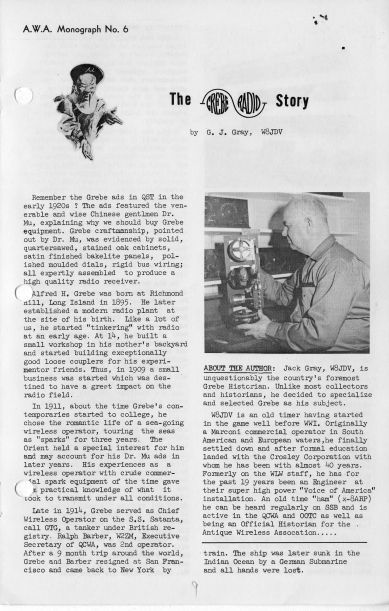
ABOUT THE AUTHOR: Jack Gray, W8JDV, is unquestionably the country's foremost Grebe Historian. Unlike most collectors and historians, he decided to specialize and selected Grebe as his subject. W8JDV is an old timer having started in the game well before WWI. Originally a Marconi commercial operator in South American and European waters, he finally settled down and after formal education landed with the Crosley Corporation with whom he has been with almost 40 years.
Formerly on the WLW staff, he has for the past 19 years been an Engineer at their super high power "Voice of America" installation. An old time "ham" (x-8ARP) he can be heard regularly on SSB and is active in the QCWA and OOTC as well as being an Official Historian for the Antique Wireless Association.