Abstract
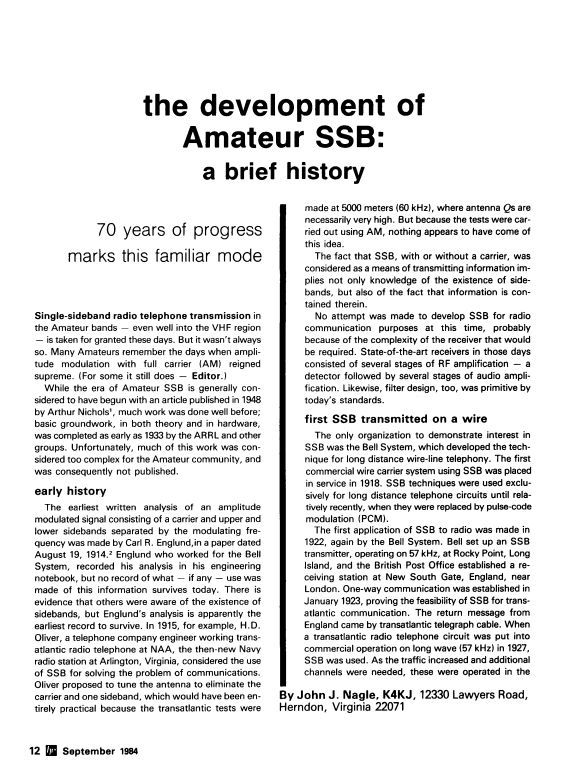
This article outlines the historical trajectory of Single-Sideband (SSB) radio telephone transmission within the amateur radio community, spanning roughly 70 years of development. While the public era of amateur SSB is widely recognized as beginning with an article by Arthur Nichols in 1948, foundational theoretical and hardware breakthroughs occurred much earlier.
The text highlights early milestones, including Carl R. Englund's 1914 mathematical analysis of amplitude modulated signals and subsequent long-wave radio telephone adaptations by the Bell System in the 1920s. In the early 1930s, pioneering amateur efforts emerged in parallel:
Robert M. Moore (W6DEI) published detailed technical schematics for a 75-meter SSB transmitter.
An American Radio Relay League (ARRL) team, led by QST Technical Editor James J. Lamb, conceptualized revolutionary designs, including a crystal filter SSB generator and an integrated transceiver configuration.
Despite these early breakthroughs, ARRL management intentionally shelved the deployment of SSB in the 1930s. They believed the required equipment was too complex for the average amateur operator and instead prioritized a "keep it simple" editorial philosophy to maximize the licensing of new operators and protect frequency allocations.
The second phase of amateur SSB acceleration occurred during and after World War II. Driven by wartime electronic advancements and an elevated technical proficiency within the ham community, innovators like O. G. Villard (W6QYT) successfully implemented a filter-free "phasing method" for SSB generation. This achievement prompted Arthur Nichols (W0TQK) to build a robust, filter-based 20-meter SSB rig, effectively bringing single-sideband technology into the amateur mainstream.