Note
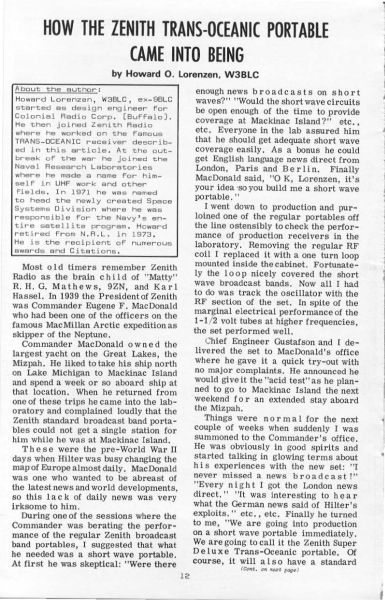
Here is a summary of the the AWA article outlining how the Zenith Trans-Oceanic portable radio was created:
The Origin of the Idea
The Problem: In 1939, Zenith Radio President Commander Eugene F. MacDonald complained that the company's standard broadcast portables could not pick up any stations while he was vacationing on his yacht, the Mizpah, near Mackinac Island.
The Solution: Amidst the rapidly changing political landscape of pre-World War II Europe, MacDonald wanted reliable world news. Design engineer Howard O. Lorenzen suggested building a shortwave portable, which would allow MacDonald to receive direct English-language news broadcasts from cities like London, Paris, and Berlin.
The Prototype: Although initially skeptical, MacDonald tasked Lorenzen with building a prototype. Lorenzen modified a standard production-line portable by adding a one-turn internal loop to cover the shortwave bands. Despite the marginal performance of the radio's $1\frac{1}{2}$-volt tubes at higher frequencies, the prototype performed well.
Testing and Production
The Acid Test: MacDonald took the prototype to Mackinac Island for an extended weekend test. He returned highly impressed, having successfully listened to daily direct news broadcasts from London and Germany.
To prove its ruggedness, Zenith sent two units to famed Arctic explorer Commander Donald B. MacMillan. MacMillan praised the radios, noting they surpassed anything he had used in 20 years of Arctic exploration and kept his team fully informed of global news day and night.
Going to Market: Based on this success, MacDonald immediately ordered the radio into production under the name Zenith Super Deluxe Trans-Oceanic portable, featuring both standard broadcast and shortwave bands.
Features and Performance
The Zenith Trans-Oceanic introduced several key features to the public:
– Guaranteed Reception: It was marketed as the first portable radio guaranteed to receive Europe, South America, or the Orient daily, or your money back.
– Innovative Engineering: The radio utilized patented "Wavemagnet" and "Shortwave Magnet" antennas, a telescopic whip aerial for extra distance, and a "Band Spread" tuning system to make finding foreign stations simple. It also included a factory pre-logged station chart on the inside lid and the Radiorgan Tone Device.
– Dual Power & Versatility: It could run on its own self-contained battery power (crucial for local blackouts or emergencies) or standard lighting current. It was also designed to operate inside moving planes, trains, and ships.