Note
QST, Jan 1939, p. 107.
Radio Craft, Feb 1939, p. 501.
Introduced in 1938 and manufactured during what many would argue was the "Golden Age" of radio (1930s–1940s). The 438 sold retail for $59.95 (with an optional plug-in crystal filter available for an additional $10).
The receiver was positioned as a low-end, budget-friendly set. It generally lacked the feature set, build quality, and competitive edge of contemporary rivals like the Hallicrafters S-20R or SX-24.
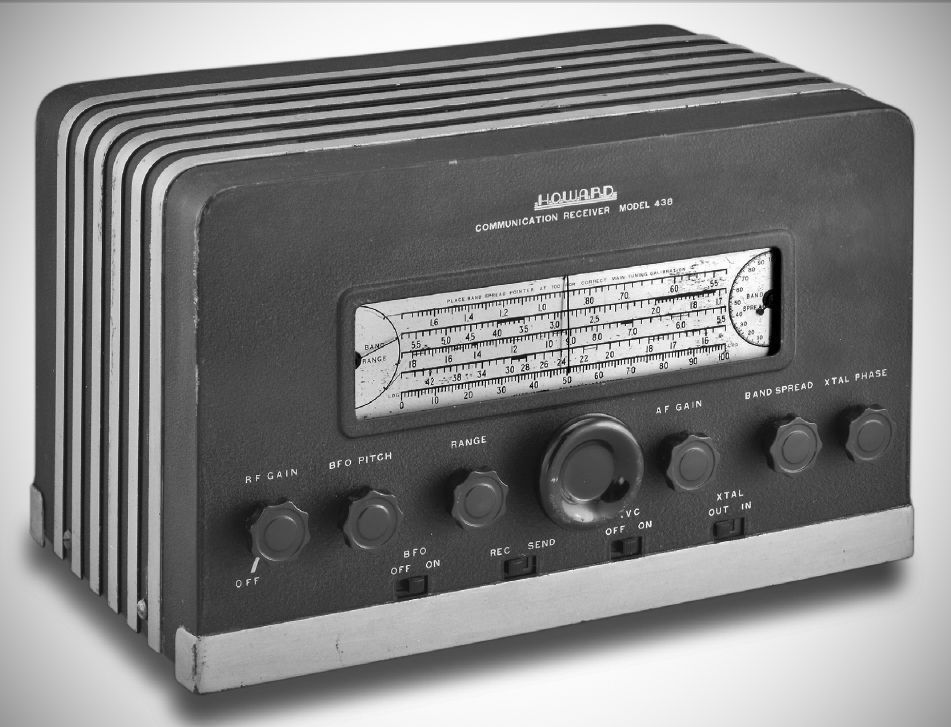
It is a typical eight-tube superheterodyne receiver and tunes from the bottom of the AM broadcast band up to 43 MHz across four selectable bands, with a 0–100 calibrated bandspread that is functional across all frequency ranges. The half circle dial on the left is the band indicator. The half circle on the right is the band spread.
A somewhat cumbersome, single-piece metal housing covers the top and all four sides. While it features a bottom plate for chassis access, servicing the top-chassis components or changing tubes requires removing all front knobs and sliding the control shafts out of the tight-fitting shell.
Includes an internal, built-in speaker. The circuit utilizes the speaker's field coil as the power supply filter choke.
To keep production costs low, Howard utilized inexpensive broadcast-receiver wafer tube sockets (rather than molded plastic sockets) and slide-type front-panel switches instead of robust toggles.
Tube Lineup:
– 6K7 RF amplifier
– 6K8G converter
– (2) 6K7 455 kHz (or 465 kHz per the schematic) IF amplifiers
– 6Q7G detector and first audio
– 41 audio output
– 6C5 BFO
– 80 rectifier
The BFO pitch control is mechanically driven by a knob directly attached to the shaft of a tuning slug inside the BFO coil, rather than using a variable capacitor.
The receiver originally shipped without an RF gain control. The RF and IF stages constantly ran at full gain unless pulled back automatically by the AVC. This posed a problem for CW operation, where turning the AVC off is preferred to prevent the BFO signal from blocking the receiver. (Note: Operators often modified these sets by adding a 20K potentiometer to manually control RF/IF gain).
In its original stock form, the receiver was known to be somewhat drifty with bouncing gain, heavily affected by aging paper bypass capacitors and composition resistors feeding B+ to the local oscillator, requiring a warm-up period of half an hour or more.