Note
Here is a summary of the life, achievements, and legacy of Hugo Gernsback:
Personal and Professional Background
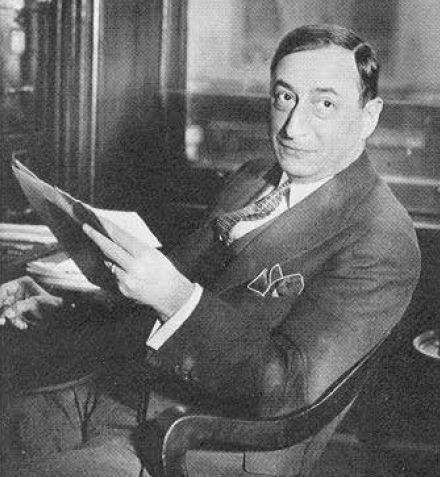
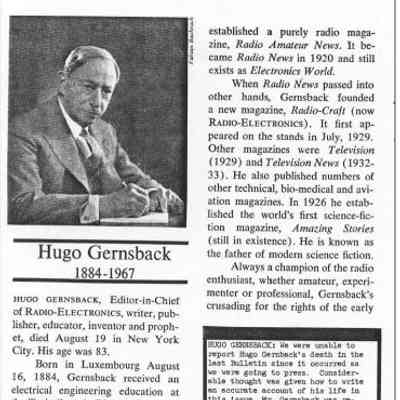
Life: Hugo Gernsback was born in Luxembourg on August 16, 1884, and received an electrical engineering education in Germany. He moved to the United States in 1904 to market an improved dry battery invention and passed away on August 19, 1967, in New York City at the age of 83.
Family: He was survived by four children (including M. Harvey Gernsback, who became the publisher of Radio-Electronics), seven grandchildren, and one great-grandchild.
Media and Publishing Contributions
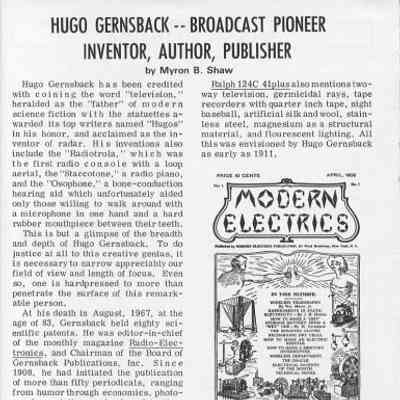
Technical Magazines: Recognized by radio historians as the world's foremost pioneer radio publisher, Gernsback served as the Editor-in-Chief of Radio-Electronics. In 1905, he started the world's first radio supply house, and in 1906, he founded Modern Electrics, the first in a long line of technical and radio magazines he would establish over his career (such as Radio News and Television).
Science Fiction: In 1926, he created Amazing Stories, the world's first science-fiction magazine, earning him the title of the "father of modern science fiction".
Broadcasting: In 1928, his New York radio station, WRNY, became the first to broadcast television on a regular schedule to thousands of amateur viewers.
Organizations and Innovations
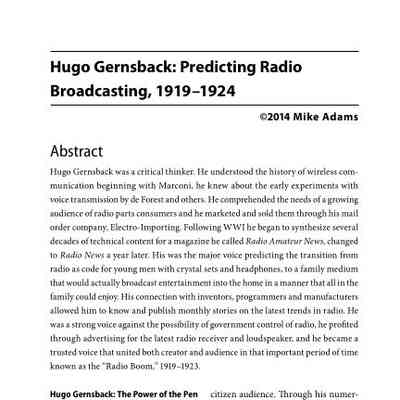
Radio Advocacy: Gernsback was a major champion for early radio enthusiasts, helping sponsor the association that became the IEEE and prompting the American Radio Relay League to call him the "Father of Amateur Radio".
Inventions: He held roughly 80 patents, which included the compression-type capacitor and hearing aids utilizing bone conduction.
Predictions and Writing
Prophetic Vision: Gernsback was widely celebrated as a prophet for accurately predicting future technologies in his fictional writing. In his serial story "Ralph 124C 41+" (first published in 1911–1912), he accurately anticipated radar, space travel, microfilm, tape recording, fluorescent lights, and two-way television.
(Note: The article also includes an historical note critiquing mainstream trade journals for giving his passing minimal notice, alongside an original 1911 synopsis of his famous futuristic story.)