Note
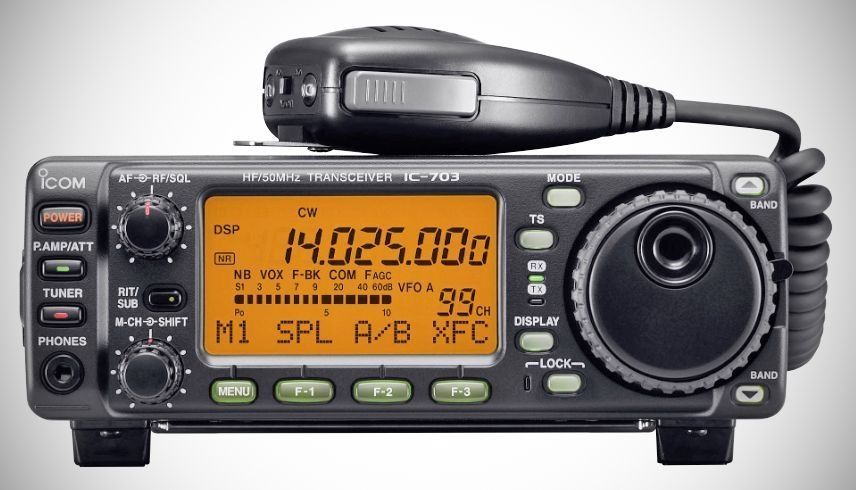
The IC-703 is a very impressive design for its size. Weighing in at only 4.5 lbs and being roughly the size of a paperback book, it packs a lot of utility for portable operation.
The IC-703 is a versatile, lightweight transceiver covering the HF bands from 160 meters through 10 meters, plus the 6-meter band. It features a detachable front panel for flexible mounting and a built-in antenna tuner. Engineered for the QRP operator, it provides a stable 100mW–10W adjustable output and includes advanced features typically found in larger base stations, such as a high-stability TCXO and DSP capabilities.
It shares a similar form factor to the IC-706 series but is specifically optimized for low-power (QRP) operation. The inclusion of a built-in automatic antenna tuner in a chassis that small is a particularly nice touch for field work where antenna conditions might not be ideal.
Note: The original IC-703 was launched in 2003. Due to a printing error at Icom, the very first production runs had "HF/50MHz" printed on the front panel, even though those specific units did not actually include the 50MHz band.
To resolve this and clear up the confusion, Icom released the IC-703 Plus shortly after. This version:
– Actually included the 6-meter (50MHz) band.
– Included the UT-106 DSP board as a standard factory-installed feature (it was an optional add-on for the original model).
– Had updated firmware for better power management.
Note: The front panel nomenclature did not change. It still reads only "IC-703."
How to tell if yours is a Plus
There is really no way to tell just by looking:
– Turn on the radio.
– Use the band buttons to cycle through the bands.
– If the radio allows you to tune to the 50MHz (6m) band and transmit, it is a Plus version. If it skips from 28MHz back to 1.8MHz, it is the original HF-only version
Key Features
– QRP Optimized Power: Delivers a maximum of 10W of output power (at 13.8V DC), which can be dialed down for low-power operation to conserve battery life.
– Built-in Automatic Antenna Tuner: Covers 1.8 MHz to 54 MHz, ensuring a good match for various portable antennas.
– Detachable Front Panel: Allows the main body of the radio to be stored in a backpack or under a seat while the controller is mounted for easy access.
– High Stability: Equipped with a ±0.5 ppm High Stability Crystal Unit (TCXO) as standard.
– Digital Signal Processing (DSP): Supports AF DSP (with the UT-106 unit) for noise reduction and automatic notch filtering to improve weak signal reception.
– Low Current Consumption: Designed for maximum efficiency during battery operation, with a dedicated "Battery Power Requirement" mode.
– Band Scope: Provides a visual representation of activity around the current operating frequency., although crude by modern standards.
Specifications
– Frequency Coverage:
Receive: 0.030–60.000 MHz (continuous).
Transmit: 1.8, 3.5, 7, 10, 14, 18, 21, 24, 28, and 50 MHz amateur bands.
– Operating Modes: USB, LSB, CW, RTTY, AM, and FM.
– RF Output Power: SSB/CW/RTTY/FM: 0.1W to 10W (at 13.8V DC); AM: 0.1W to 4W.
– Number of Memory Channels: 105 (99 regular, 6 scan edges).
– Antenna Connector: SO-239 (50Ω).
Power Supply Requirement: 9.0V to 15.87V DC (negative ground).
Current Drain:
Transmit (10W): Approx. 3.0 A.
Receive (Max Audio): Approx. 450 mA.
Receive (Standby): Approx. 300 mA.